Home Blog Page 7

Kisah 32 Murid Utama Buddha Gotama: 1. YA Sāriputta Thera

0
  1. YA Sāriputta Thera

Terlahir di desa Nālaka dekat Rājagaha. Karena beliau anak tertua dari keluarga utama di desa itu, nama beliau adalah Upatissa. Ayah beliau seorang brahmana yang bernama Vaṅganta dan ibu beliau  Rūpasārī. Karena itu, beliau dikenal pula sebagai Sāriputta, putra Sāri.

Beliau memiliki tiga orang adik laki-laki, Mahācunda, Upasena dan Revata Khadiravaniya, yang semuanya menjadi bhikkhu dan Arahat. YA Revata, yang termuda di antara mereka, diumumkan oleh Sang Buddha sebagai siswa yang terkemuka di antara siswa yang menghuni hutan. YA Upasena, yang juga dikenal sebagai Vagantaputta, diumumkan oleh Sang Buddha sebagai bhikkhu yang paling menyenangkan orang lain.

Juga, YA Sāriputta memiliki tiga orang adik perempuan, Cālā, Upacālā and Sisūpacālā, yang semuanya menjadi bhikkhuni setelah masing-masing menikah dan memiliki seorang putra. Semua putra mereka masuk Saṅgha juga. Semua saudari YA Sāriputta tersebut juga menjadi Arahat.

Halaman 75-76 Vinaya Piṭaka mencatat bahwa pertama kali mendengar Dhamma melalui sebuah bait yang diucapkan oleh YA Assaji, salah seorang dari Lima Petapa di Rājagaha, YA Sāriputta langsung memperoleh Mata Dhamma dan menjadi seorang Sotāpanna (orang suci tingkat pertama).

Bait termasyur tersebut berbunyi sebagai berikut:

“Tentang hal-hal yang muncul karena sebab,
Sang Tathāgata (Sang Buddha) telah membabarkan sebab tersebut,
Dan juga bagaimana berhentinya sebab tersebut.
Inilah ajaran Sang Petapa Agung (Sang Buddha).”

Lalu beliau dan sahabatnya, yang kemudian menjadi YA Mahā Moggallāna, serta dua ratus lima puluh orang petapa pengembara pengikut mereka pergi ke Vihāra Veluvana untuk menemui Sang Buddha. Mereka semua memohon penahbisan dan Sang Buddha menerima mereka menjadi anggota Saṅgha dengan perkataan “Mari, wahai para bhikkhu.”

Setengah bulan kemudian YA Sāriputta menjadi seorang Arahat (Yang Tersuci) ketika sedang mengipasi Sang Buddha yang sedang berceramah kepada pengembara Dīghanakha tentang perenungan mengenai perasaan (MN 74.14)… Dighanakha mendapatkan Mata Dhamma yang merupakan sotāpattimagga (jalan menuju Sotāpanna) langsung setelah ceramah tersebut. Kalimat ”Semua yang dapat timbul akan musnah” menunjukkan cara timbulnya jalan tersebut.

Menghormat Guru Pertamanya dalam Dhamma

Selama hidupnya YA Sāriputta menunjukkan hormat kepada YA Assaji. Penjelasan tentang Syair 392 Dhammapada bercerita bahwa kapan pun YA  Sāriputta berdiam di vihara yang sama dengan YA Assaji, langsung setelah menghormat Sang Buddha, beliau selalu pergi untuk menghormat sesepuh yang agung itu, sambil berpikir, “Bhante ini adalah guru pertama saya. Karena beliaulah saya mengetahui Ajaran Sang Buddha.” Ketika YA Assaji berdiam di vihara lain, YA Sāriputta biasanya menghadap arah di mana sang sesepuh sedang berdiam dan  bernamaskara  (menghormat dengan kepala, dua tangan dan lutut menyentuh bumi).

Penolong Sesama Bhikkhu

Beliau mengunjungi bhikkhu-bhikkhu    lain yang jatuh sakit. Pada Devadaha Sutta (SN 22:2), Sang Buddha sendiri bersabda tentang siswa hebat-Nya itu,” Para bhikkhu, Sāriputta bijaksana dan penolong sesama bhikkhu.”

Parinibbāna

Mahāsudassana Jātaka (Jātaka 95), Cunda Sutta (SN 47.13)  dan Great Disciples of the Buddha (Bodhi, ed., 2003:48-54) mencatat bahwa pada bulan Kattika, enam bulan sebelum Sang Buddha mencapai Mahāparinibbāna, YA Sāriputta mohon ijin kepada Sang Buddha untuk Parinibbāna di dalam kamar kelahiran beliau di kampung halamannya, desa Nālaka. Sebelum Parinibbāna YA Sāriputta mengajarkan Dhamma kepada ibunya, Rūpasārī, yang langsung menjadi Sotāpanna. Beliau mencapai Parinibbāna pada bulan purnama Kattika. (YA Mahāmoggallāna menyusul dua minggu kemudian)

Setelah upacara kremasi selama tujuh hari, YA Anuruddha memadamkan api dengan air harum. Cunda Sutta mencatat bahwa YA Cunda, adik dan juga pembantu pribadinya, mengumpulkan relik-relik YA Sāriputta ke dalam sebuah saringan air dan membawanya ke Sāvatthi.

Di Sāvatthi, YA Cunda menemui YA Ānanda dahulu untuk menyerahkan relik-relik itu di dalam saringan air dan, kemudian, YA Ānanda menyerahkannya kepada Sang Buddha. Sang Buddha memperlihatkan relik-relik itu kepada para bhikkhu dan memuji cara hidup YA Sāriputta. Lalu, relik-relik itu disimpan di dalam sebuah cetiya di Sāvatthi.

YA Sāriputta dan YA Moggallāna merupakan Aggasāvaka (Siswa Utama). YA Sāriputta juga  dikenal sebagai Dhammasenāpati (panglima Dhamma). Dalam suatu ceramah kepada para bhikkhu, Sang Buddha menyatakan bahwa YA Sāriputta adalah siswa yang terkemuka dalam Kebijaksanaan sedangkan YA Moggallāna dalam kekuatan batin (AN 1:14).

Pada Saccavibhaṅga Sutta (MN 141) Sang Buddha bersabda: ”Pereratlah persahabatan dengan Sāriputta dan Moggallāna. Mereka bijaksana dan suka menolong teman-teman mereka yang ada di dalam Ariya Saṅgha. Sāriputta seperti seorang ibu; Moggallāna seperti juru rawat. Sariputta melatih bhikkhu-bhikkhu yang lain untuk mencapai sotāpattiphala (menjadi Sotāpanna), Moggallāna untuk mencapai tujuan tertinggi (Arahat). Para bhikkhu, Sāriputta dapat mengumumkan, mengajarkan, menggambarkan, menetapkan, mengungkapkan, membabarkan dan menunjukkan Empat Kebenaran Mulia.”

  1. The Venerable Sāriputta Thera

Born in the village of Nālaka near Rājagaha, he was called Upatissa as he was the eldest child of a leading family there. His father was a Brahmin named Vaṅganta and his mother Rūpasārī. For this reason, the elder was also known as Sāriputta, son of Sāri.

He had three brothers, Mahācunda, Upasena and Revata Khadiravaniya, all of whom became monks. The Venerable Revata, who was the youngest of the brothers, was declared by the Buddha as the disciple foremost among forest-dwellers. The Venerable Upasena, also known as Vagantaputta, was declared by the Buddha as the monk who was most pleasing to others.

In addition, he had three sisters, Cālā, Upacālā and Sisūpacālā, all of whom became nuns after their respective marriages, each of which produced a son. All their sons joined the Order of Monks, too. All the three sisters attained arahantship.

Pages 75-76 of Vinaya Texts records that he first learned the Dhamma through a stanza recited by the Venerable Assaji, one of the Five Ascetics in Rājagaha, and gained the Dhamma Eye on the spot and became a Sotāpanna (first degree saint).

The famous stanza reads as follows:

“Of those things that arise from cause,
The Tathāgata has told the cause,
And also what their cessation is:
This is the doctrine of the Great Recluse.”

Then, he and his friend Moggallāna, the future Mahā Moggallāna and their followers totalling another two hundred and fifty wandering ascetics, went to the Veluvanna Monastery to see the Buddha. They requested ordination and the Buddha admitted them into Saṅgha by saying, “Come, monks.”

The Venerable Sāriputta became an Arahant (or the highest degree saint) half a month later when he was fanning the Buddha who was preaching to the wanderer Dīghanakha on the contemplation of feelings (MN 74.14)… Dīghanakha gained the Dhamma Eye (dhammacakkhu) which is the path of stream-entry (sotāpattimagga) right after the preaching. The phrase ”All that is subject to arising is subject to cessation” shows the mode in which the path arises.

Respect for His First Teacher in Dhamma

Throughout his life the Venerable Sāriputta showed respect for the Venerable Assaji. The commentary to verse 392 of the Dhammapada tells us that whenever the Venerable Sāriputta lived in the same monastery with the Elder Assaji, immediately after having paid homage to the Blessed One, he always went to venerate the great elder, thinking: “This venerable one was my first teacher. It was through him that I came to know the Buddha’s Dispensation.” And when the Elder Assaji lived in another monastery, the Venerable Sāriputta used to face the direction in which he was living and pay homage to him by touching the ground at five places (with the head, hands, and feet), and saluting him with joined palms.

Helper of fellow Monks

He spent time visiting other monks who fell ill. In the Devadaha Sutta (SN 22:2) the Buddha Himself said of His great disciple,” Sāriputta, bhikkhus, is wise and a helper of his fellow monks.”

Final Nibbāna

The Mahāsudassana Jātaka (Jātaka 95), Cunda Sutta (SN 47.13) and Great Disciples of the Buddha (Bodhi, ed., 2003:48-54)  record that six months before the Buddha’s Final Parinibbāna, the Venerable Sāriputta sought the Buddha’s permission to attain his Parinibbᾱna in his birth chamber in his home town, the village of Nālaka. Before his Parinibbᾱna, he taught the Dhamma to his mother who immediately became a Sotāpanna. He attained the Final Nibbāna on the full moon day of Kattika. (The Venerable Mahāmoggallāna followed suit two weeks therafter)

After a cremation ceremony which lasted for seven days, the Venerable  put out the fire with scented water. The Cunda Sutta records that the Venerable Cunda, his brother and personal attendant,  gathered all his relics in a water strainer and took them to Sāvatthi.

In Sāvatthi the Venerable Cunda first met the Venerable Ᾱnanda who then handed the relics to the latter for further delivery to the Buddha. The Buddha showed all the monks the relics and praised the Venerable Sāriputta’s way of life. The relics were then kept in a cetiya in Sāvatthi.

The Venerable Sāriputta and the Venerable Moggāllana were known as the Chief Disciples, or Aggasāvaka. The former was also known as Dhammasenāpati, or Marshal of the Dhamma. In a discourse to monks the Buddha said that the Venerable Sāriputta was foremost in wisdom and the Venerable Moggallāna in psychic powers (AN 1:14).

In the Saccavibhaṅga Sutta (MN 141) the Buddha says: “Cultivate the friendship of Sāriputta and Moggallāna, bhikkhus; associate with Sāriputta and Moggallāna. They are wise and helpful to their companions in the holy life. Sāriputta is like a mother; Moggāllana is like a nurse. Sāriputta trains others for the fruit of stream-entry, Moggallāna for the supreme goal. Sāriputta, bhikkhus, is able to announce, teach, describe, establish, reveal, expound, and exhibit the Four Noble Truths.”

Ditulis oleh Rama Tjan Sie Tek, M.Sc., Penerjemah Tersumpah, Sāsanadhaja Dharma Adhyapaka Dasa Marsa, Rohaniwan Buddha

Kisah YM Sīvali: Penderitaan menyamar sebagai kesenangan dan berkah, kesulitan mematahkan semangat para pemalas: Asātarūpa-Jātaka (Jātaka 100)

(the English version follows)
Ringkasan jātaka ini: 
Kisah ini diceritakan oleh Sang Guru ketika berada di Kundadhānavana dekat kota Kundiya mengenai Suppavāsā, seorang upāsika, yang merupakan putri Raja Koliya. Pada saat itu, ia telah mengandung seorang anak selama tujuh tahun dan sudah memasuki hari ketujuh penderitaan persalinannya dan rasa nyerinya berat sekali. Walaupun semua penderitaan berat itu, ia berpikir sebagai berikut, “Sang Bhagavā (Sang Buddha), Yang Tercerahkan Sempurna, membabarkan Dhamma dengan tujuan agar penderitaan ini dapat berakhir; Orang-orang pilihan Sang Bhagavā hidup demikian bajik sehingga penderitaan ini dapat berakhir; Nibbāna adalah tempat membahagiakan dan penderitaan ini benar-benar berakhir.” Ketiga pikiran itu merupakan penghiburan baginya selama dalam penderitaan hebatnya itu. Kemudian, ia menyuruh suaminya menemui Sang Bhagavā untuk memberitahukan keadaannya dan menyampaikan salam atas namanya.

Pesannya disampaikan kepada Sang Bhagavā, yang bersabda, “Semoga Suppavāsā, putri Raja Koliya, tumbuh kuat dan sehat lagi serta melahirkan seorang bayi yang sehat.” Langsung setelah kata-kata Sang Bhagavā, Suppavāsā menjadi sehat dan kuat dan melahirkan seorang bayi yang sehat. 

Saat kembali dan mendapati istrinya telah melahirkan dengan selamat, sang suami amat takjub pada kekuatan luhur Sang Buddha. Karena anaknya telah lahir, Suppavāsā sangat ingin mempersembahkan hadiah selama tujuh hari kepada Sańgha dengan Sang Buddha sebagai pemimpin mereka dan menyuruh suaminya lagi untuk mengundang mereka. 
Kebetulan pada saat itu Sańgha yang dipimpin oleh Sang Buddha telah menerima undangan upāsaka (umat pria) yang menyokong YA Mahā Moggallāna; tetapi, Sang Guru, yang ingin memenuhi niat berdana Suppavāsā, mengirimkan utusan kepada sang thera untuk menjelaskan hal tersebut dan bersama Sangha menerima perjamuan Suppavāsā selama tujuh hari. 

Pada hari ketujuh ia mendandani bayi kecilnya, yang bernama Sīvali dan memyuruhnya membungkuk di depan Sang Buddha dan Sańgha. Saat bayi itu dibawa menghadap YA Sāriputta pada waktu yang semestinya, YA Sāriputta dengan penuh keramahan menyapa bayi itu, “Nah, Sīvali, apakah kamu baik-baik?” “Bagaimana bisa begitu, Bhante?” kata sang bayi, “Selama tujuh tahun yang panjang saya harus berkubang dalam darah.”
Lalu, dengan gembira Suppavāsā berseru, “Anakku, yang baru berusia tujuh hari, benar-benar sedang berbincang-bincang mengenai agama dengan YA Sāriputta, Panglima Dhamma?”

“Maukah engkau memiliki anak lagi yang seperti ini?” tanya Sang Guru. “Mau, Bhante,” jawab Suppavāsā, “tujuh lagi jika saya bisa mendapatkan anak yang seperti dia.” Dengan perkataan yang khidmat Sang Guru berterima kasih atas jamuan oleh Suppavāsā dan pergi.

Pada usia tujuh tahun Sīvali kecil menerima Dhamma dengan sepenuh hati dan meninggalkan keduniawian untuk masuk Sańgha (sebagai sāmanera); pada usia dua puluh tahun beliau diterima menjadi bhikkhu. Beliau bersifat bajik dan mendapatkan mahkota kebajikan berupa pencapaian sebagai Arahat dan bumi pun bersorak keras karena gembira. 

(Ańgutarra Nikāya I.24 mencatat bahwa Sang Buddha menganugerahi YA Sīvali gelar sebagai yang terbaik di antara para penerima persembahan.)

Setelah mengakhiri jātaka ini, Sang Guru, sebagai Buddha, mengulangi atararupa Jatakastanza ini:

”Dengan menyamar sebagai kesenangan dan berkah, datanglah dukkha, lalu, kesulitan juga datang untuk mematahkan semangat para pemalas.”

(Diterjemahkan oleh Tjan Sie Tek, M.Sc., Penerjemah Tersumpah, dari The Jātaka, translated by Robert Chalmers from Pāli into English)

English version of Asātarūpa-Jātaka (Jātaka 100):
(Sorrow comes in the disguise of joy and blessings, and trouble, to overwhelm sluggards’ hearts) 

This story was told by the Master while at Kuṇḍadhānavana near the city of Kuṇḍiya about Suppavāsā, a lay-sister, who was daughter to King Koliya. For at that time, she, who had carried a child seven years in her womb, was in the seventh day of her throes, and her pains were grievous. In spite of all her agony, she thought as follows: “All-Enlightened is the Blessed One who preaches the Truth to the end that such suffering may cease; righteous are the Elect of the Blessed One who so walk that such suffering may cease; blessed is Nibbāna wherein such suffering doth cease.” These three thoughts were her consolation in her pangs. And she sent her husband to the Buddha to tell her state and bear a greeting for her.

Her message was given to the Blessed One, who said, “May Suppavāsā, daughter of the king of the Koliyas, grow strong and well again, and bear a healthy child.” And at the word of the Blessed One, Suppavāsā, daughter of the king of the Koliyas, became well and strong, and bore a healthy child. 

Finding on his return that his wife had been safely delivered, the husband marvelled greatly at the exalted powers of the Buddha. Now that her child was born, Suppavāsā was eager to show bounty for seven days to the Brotherhood with the Buddha at its head, and sent her husband back to invite them. 

Now it chanced that at the time the Brotherhood with the Buddha at its head had received an invitation from the layman who supported the Elder Moggallāna the Great; but the Master, wishing to gratify Suppavāsā’s charitable desires, sent to the Elder to explain the matter, and with the Brotherhood accepted for seven days the hospitality of Suppavāsā. 

On the seventh day she dressed up her little boy, whose name was Sīvali, and made him bow before the Buddha and the Brotherhood. And when he was brought in due course to the Venerable Sāriputta, the Elder in all kindness greeted the infant, saying, “Well, Sīvali, is all well with you?” “How could it be, sir?” said the infant. “Seven long years have I had to wallow in blood.”

Then in joy Suppavāsā exclaimed, “My child, only seven days old, is actually discoursing on religion with the apostle Sāriputta, the Captain of the Faith?”

“Would you like another such a child?” asked the Master. “Yes, sir,” said Suppavāsā, “seven more, if I could have them like him.” In solemn phrase the Master gave thanks for Suppavāsā’s hospitality and departed. 

At seven years of age the child Sīvali gave his heart to the faith and forsook the world to join the Brotherhood; at twenty he was admitted a full Brother. Righteous was he and won the crown of righteousness which is Arahatship, and the earth shouted aloud for joy.

(Ańgutarra Nikāya 1.24 records that the Buddha granted him the title the best among the recipients of gifts.)

His story ended, the Master, as Buddha, repeated these verses:
“In disguise of joy and blessings, sorrow comes
And trouble, the sluggards’ hearts to overwhelm.”

Silakan share cerita ini dengan semua teman.

Please share this story with all friends.


Lima Orang Bhikkhu Pertama (Pañcavaggiya) dan Pembentukan Sang Tiratana (Tiga Permata)

Lima Orang Bhikkhu Pertama (Pañcavaggiya) dan Pembentukan Sang Tiratana (Tiga Permata)

Dua bulan setelah Pencerahan Agung beliau pada bulan purnama Ᾱsāḷhā (Juli; Sansekerta:

Āşādha), Sang Buddha mendatangi kelima orang petapa (yang sering disebut sebagai Pañcavaggiya), yaitu Kondañña, Bhaddiya, Vappa, Mahānāma, and Assaji dari kelompok brahmana, yang sebelumnya telah melayani beliau selama melakukan tindakan tapa yang teramat keras, yang akhirnya beliau tinggalkan, di Taman Rusa di Isipatana, Benares.

Ceramah Pertama

Kemudian, Sang Buddha membabarkan ceramah atau doktrin pertama-Nya kepada mereka. Doktrin yang termasyur itu diberi nama “Dhammacakkappavattana Sutta,” Ceramah tentang Pemutaran Roda Dhamma.” (VT: 52-54; SN V.56.12; MN 141). Hari penting tersebut tetap dirayakan oleh Buddhis di seluruh dunia sekarang sebagai Hari Ᾱsāḷhā.

Bhikkhu Pertama di Dunia

Halaman 54 Vinaya Piṭaka  mencatat bahwa setelah ceramah pertama itu, YA Kondañña mendapatkan Mata Dhamma (Dhammacakkhu), mohon dan menerima status pabbajjā (meninggalkan keluarga dan menjadi orang yang tanpa rumah atau hidup sebagai petapa) sebagai sāmanera atau calon bhikkhu dan bhikkhu upasampadā (penahbisan sebagai bhikkhu) dari Sang Buddha sehingga menjadi bhikkhu yang pertama di dunia.

Lima Orang Bhikkhu Pertama di Dunia yang membentuk Saṅgha

Beberapa saat kemudian keempat orang petapa lainnya juga mendapatkan Mata Dhamma dan mengikuti jejak YA Kondañña. Dengan demikian, para petapa itu menjadi lima orang bhikkhu Buddhis  pertama di dunia dan dengan demikian, membentuk Bhikkhu Saṅgha. Karena itu, Sang Tiratana (atau Triratna dalam bahasa Sansekerta, atau Tiga Permata, yaitu Sang Buddha, Dhamma dan Saṅgha) terbentuk.


Five First Monks (Pañcavaggiya)  and the Establishment of the Tiratana (the Three Jewels, or the Triple Gem))

Two months after His Great Enlightenment on the full moon day of Ᾱsāḷhā (July; Sanskrit:

Āşādha), the Buddha approached the five ascetics (often called as Pañcavaggiya), Kondañña, Bhaddiya, Vappa, Mahānāma, and Assaji of the brahmin clan, that used to attend on Him while He was undertaking extreme ascetic austerities, which He subsequently abandoned, at the Deer Park in Isipatana, Benares.

First Sermon 

Then, the Buddha delivered His first discourse or doctrine to them. This famous doctrine is called “Dhammacakkappavattana Sutta, Discourse on the Turning of  the Wheel of Truth.” (VT: 52-54; SN V.56.12; M 141). The momentous day continues to be commemorated by Buddhists around the world today as the Ᾱsāḷhā Day.

First Buddhist Monk in the World

Page 54 of the Vinaya Pīṭaka (or the Monastic Discipline Basket of Books) records that after the first sermon, Kondañña requested and received the lower and higher ordinations from the Buddha and, thus, becoming the first Buddhist monk in the world.

First Five Monks in the World to form the Sangha

Some time later the other four ascetics obtained the Dhamma Eye and followed suit. Hence, the ascetics became the first five Buddhist monks in the world and, thereby, forming the Order of Monks, Saṅgha. As such, the Tiratana (or Triratna in Sanskrit; the Three Jewels, or the Triple Gem), that is, the Buddha, the Dhamma and the Saṅgha, was constituted.

References:

Bechert, Heinz & Gombrich, Richard (eds.) (1995). The World of Buddhism. London: Thames & Hudson

Buddha, Gotama. Oldenberg (1981, 2007) (transl.). Vinaya Texts, Volumes I, II & III (The Vinaya Pitaka). Lexington: Forgotten Books

Buddha, Gotama. Walshe (1995) (transl.). The Long Discourses of the Buddha (The Digha Nikaya). Boston: Wisdom Publications

Buddha, Gotama. Nanamoli & Bodhi (1995) (transls.). The Middle-length Discourses of the Buddha (The Majjhima Nikaya). Kandy: Buddhist Publication Society

Buddha, Gotama. Bodhi (2003), (transl.). The Connected Discourses of the Buddha (The Samyutta Nikaya), 2nd edition. Boston: Wisdom Publications

Buddha, Gotama. Nyanaponika & Bodhi (2000), (transls.). The Numerical Discourses of the Buddha (Anguttara Nikāya).  Lanham: Altamira Press

Buddha, Gotama. Rājawithayalay (BE 2536), (transl.). Angguttaranikāya Ekanipata, 10th Vagga, Suttantapiṭaka dan Atthakathā, Vo. 32 of the Thai version.  Bangkok: Mahāmakut

Buddha, Gotama. Chalmers (1895), (transl.). Volumes 1 & 2 of the Jataka, or Stories of the Buddha’s Previous Births. Lexington: Forgotten Books

Buddhaghosa. Nanamoli (2010) (transl.). The Path of Purification (Visuddhimagga). Onalaska: Pariyati Publishing

Davids, T.W. Rhys & Stede, William, 1986, The Pali Text Society’s Pali-English Dictionary, London: Pali Text Society

Dhammananda, K. Sri. Are Buddhist Idol-worshippers? www.what-Buddha-taught

Dhammika. The Buddha and His Disciples. www.buddhanet.net

Gombrich, Richard (1960s). The Kosala-Bimba-Vannana. London: Oxford Centre for Buddhist Studies

Hecker, Helmuth & Nyanaponika (2003). Great Disciples of the Buddha. Boston: Wisdom Publications

Kariyasawan, A.G.S., (1995). Buddhist Ceremonies and Rituals of Sri Lanka. www.accesstoinsight.org

Lee, Ajaan. Thanissaro (transl.) (1993). Autobiography of Ajaan Lee. www.what-Buddha-taught-net.org

Malalasekara, G.P, (1937). Dictionary of Pali Proper Names. www.palikanon.org

Merriam-Webster’s Collegiate Dictionary (2000). Massachusetts: Merriam-Webster, Inc.

Muller, F. Max (ed.) (1969). The Questions of King Milinda. Delhi: Motila Bonarsidass

Nānasampano, Mahā Boowa (2005). A Spiritual Biography of the Venerable Ācariya Mun Bhūridatta Thera. Udorn Thani: Forest Dhamma Books

Narada (1968). A Manual of Abhidhamma (Abhidhammattha Sańgaha). Kandy: Buddhist Publication Society

Nyanatiloka (1991). Buddhist Dictionary. Singapore: Singapore Buddhist Meditation Centre

Nyanaponika & Hecker, Helmuth. Bodhi (ed.) (2003). Great Disciples of the Buddha. Boston: Wisdom Publications

Sarada, Weragoda (1998). The Greatest Man Who Ever Lived: The Supreme Buddha. Singapore: Singapore Buddhist Meditation Centre

Sarada, Weragoda (1993). The Treasury of Truth: Illustrated Dhammapada. Singapore: Singapore Buddhist Meditation Centre

Silaratano (1994). Mae Chee Kaew: A Spiritual Awakening. www.what-Buddha-taught-net.org


Ditulis oleh Rama Tjan Sie Tek, M.Sc., Penerjemah Tersumpah (www.tjansietek.com),

Sāsanadhaja Dharma Adhgapaka, Rohaniwan Buddha Kementerian Agama

Dua Upāsaka yang Pertama yang berlindung pada Buddha dan Dhamma (sebelum terbentuknya Tiga Permata)

Dua Upāsaka yang Pertama

Khandhaka Pertama Vinaya Piṭaka mencatat fakta bahwa Tapussa dan Bhallika, dua orang pedagang dari Ukkala (atau Orissa, Myanmar), adalah dua orang manusia pertama yang memberikan makanan berupa kue dari beras dan bungkahan-bungkahan madu kepada Sang Buddha ketika beliau sedang duduk bersila di bawah (pohon) Rājāyatana sekitar enam minggu setelah Pencerahan Agung-Nya dan menjadi upāsaka-upāsaka (siswa awam) yang pertama dengan mengucapkan paritta (ucapan perlindungan)  yang terdiri atas Dua Permata, Buddha dan Dhamma, karena Tiga Permata belum dibentuk.

First Two Male Lay Disciples

The First Khandhaka of Vinaya Texts records the fact that Tapussa and Bhallika, two merchants from Ukkala (Orissa), were the first human beings to give a meal of rice cakes and lumps of honey to the Buddha when He was sitting cross-legged at the foot of the Rajayatana (tree) about six weeks after His Great Enlightenment and to become the first lay disciples by the formula which contained (only) the Two Jewels, or the Double gem, that is, the Buddha and the Dhamma, as the Three Jewels, or the Triple Gem,  had not been formed yet.

Ditulis oleh Rama Tjan Sie Tek, M.Sc., Penerjemah Tersumpah (www.tjansietek.com),

Sāsanadhaja Dharma Adhgapaka, Rohaniwan Buddha Kementerian Agama
spot_img

Dhammapada 15

Yamaka Vagga


Vocabulary
idha: (adv.) = here (in this world)
socati: (a) grieves, laments; (b) 3rd pers. sg. pres. act. indic. of √suc ‘to grieve’
pecca: (a) after having gone past, after going past,’ i.e., after death; (b) absol. derived from pa-  ‘away, out; greatly,  exceedingly’ + √i ‘to go’
socati (3rd pers. sg. pres. act. indic. of √suc ‘grieve’) = grieves
ubhayattha: (adv. derived from the adj. ubhaya meaning ‘both, twofold’) = in both cases
so (sg.masc. nom. of personal pron. so ‘he, this, that’) = he
vihaññati (3rd pers. sg. pres. act. indic. derived from vi- (pf. used here to intensify) +√han ‘to strike, to vex’ = is greatly vexed, is greatly distressed
disvā (absol. of √dis ‘see’) = having seen, after seeing

Grammar

1pāpakārī: pāpa (nt.) = evil; kāra (masc. derived from √kar ‘do, to make’) = action; kāra+ī* (poss. sf.) = kārī (adj.) = doer; pāpa + kārī= pāpakārī (adj.) = evildoer; pāpakārī (sg. masc. nom.) = evildoer;

*the new poss. sf. -ī  or  the old -in (Geiger & Norman, 2005: § 95, p.88; Duroiselle, 1915/1997:143:) kāra+in= karin (with the elision of the final a in kāra); hence,  pāpakārin ‘evildoer’

2kammakiliṭṭhamattano: (a) one’s, his or her own evil kamma; (b) kamma (nt. derived from √kar ‘ do, to make’ = deed, kamma; kiliṭṭha (adj. past part. of √kilis ‘to go bad’) = evil, bad; kamma+kiliṭṭha= kammakiliṭṭha (nt.) = evil kamma; kammakiliṭtha (acc. sg.) evil kamma; attā (masc.) = self, oneself, himself, herself; attano (gen. sg.) = one’s own, his or her own; (c) kammakiliṭtha+attano= kammakiliṭṭhamattano (with the ṁ becoming m before a vowel) = one’s, his or her own evil kamma

1.2socati, vihaññati: (a) she or he grieves, she or he is vexed; (b) the two verbs are the present active indicative forms of the stems soca ‘to grieve’ and vihana ‘to be vexed,’ respectively; (b) Duroiselle [1915/1997:161, No. 605(iii)] writes that with verbs, the personal pronouns are frequently understood, as the endings of the tenses clearly indicate also the person, as: gacchati ‘(he) goes’ = so gacchati; gaccheyyāmi ‘(I) should go’ = ahaṁ gaccheyyāmi, etc.

English 1:
Sarada

English 2:
Carter & Paliwahadana

Here one grieves, one grieves hereafter, in both ways does the evil-doer grieve; one grieves and is afflicted, one’s own base kammas seing.

Here he grieves; having passed away he grieves;
In both places the wrongdoer grieves.
He grieves; he is afflicted,
Having seen the stain of his own action.

Indonesia 1:
CDD

Indonesia 2:
YDD

Di sini dia bersedih, di alam berikutnya dia juga bersedih, pelaku kejahatan bersedih di kedua alam tersebut. Dia bersedih dan merasa jengkel setelah melihat (hasil) perbuatan buruknya sendiri.

Dalam kehidupan ini ia menderita, dalam kehidupan yang akan datang ia juga akan menderita, dalam kedua alam kehidupan si pembuat kejahatan menderita. Ia menderita dan bersedih menyaksikan buah dari perbuatannya yang buruk.

Dhammapada 14

Yamaka Vagga


Vocabulary
yathā (adv.) = as, how, like;
agāra: agāra (nt.) = house; agāra (sg. acc.) = house
vuṭṭhi: vuṭṭhi (fem.) = rain; vuṭṭhi (sg. nom.) = rain
evaṁ: (adv. thus, so, in this way, likewise, either referring to what follows or what precedes
citta: citta (nt.) = mind; citta (sg. acc.) = mind
rāgo: rāga (masc. derived from √raj ‘ colour’) = passion; rāgo (sg. nom.) = passion

Grammar

1succhanna: (a) (sg. nt. acc.) well-covered, well-thatched; (b) formed from succhanna ‘well-covered, well-thatched’ + –, a suffix indicating the acc. case of a neuter adj. which modifies a neuter noun in its accusative function; (c) suchanna: derived from su- (pf.) ‘good, perfect’ + channa ‘covered, thatched,’ the past.part. of √chad ‘to cover,’ = well-covered, well-thatched

3subhāvita: su- (pf.) + bhāvita (adj. past.part. of bhāveti) ‘developed,’ derived from bhāveti (3rd pers. sg. pres. indic. caus. of √bhū ‘to be, to produce, to cultivate, to develop’ = subhāvita ‘well-developed;’ subhāvita (sg. nt. acc.) = well-developed

2samativijjhati: (3rd pers. sg. pres. act. indic.) derived from sa* (adj. pf. implying conjunction and completeness) + ati- (pf.) ‘extremely’ + √vidh ‘to pierce’ = penetrates

*saṁ- or saṃ-, an indeclinable prefix to verbal roots:* (1) implying a conjunction, e.g., with, together;’ (2) denoting (i) ’completeness,’  (opposite vi-):
(a)Duroiselle (1915/1997:14, No. 38) writes that the niggahīta when followed by a consonant may remain unchanged.
Examples:
       (xi)  ta dhamma kata; (ii) ta khaṇa; (iii) ta patto
(b) Nasal-nasal: a nasal consonant (ń, ñ, ṇ, n, or m) followed by another nasal consonant, is assimilated to the latter: saṁ-nisīdati > sannisīdati ‘he sinks down’ (Perniola, 2001:23, No.15(a);
a.1sam-: (a) before a labial (b, bh, m, p, or ph) [(i) thus forming nasal-nasal (Perniola, idem.) (ii) niggahīta, followed by a consonant, may be transformed into the nasal of the class to which that consonant belongs (Duroiselle, idem., p. 14, No.39)]: Sambuddha (saṁ- + buddha,*), sampajāna ‘attentive, thoughtful, mindful, deliberate’ (sa + pajāna ‘understanding, distinguishing’)
(b) before a vowel: samativijjhati, derived from saṁ– +ativijjhati ‘(it) penetrates,’ samacchati ‘(she, she, or it, or one) sits together,’ derived from saṁ- + acchati ‘(she, he, it or one) sits
*Sambuddha: (a) saṁ- + buddha, which is derived from budh ‘to enlighten’ + -ta (a past participle suffix; if formed from a transitive verb, it makes a passive meaning ; otherwise, it forms an active meaning) = budhta > buddha ‘enlightened.’ This is as written by Perniola [idem., p. 17, No.13(a)] that when  two mute consonants come together, the first is assimilated to the second since both are of the same strength:
yuj-ta > yutta ‘joined’
 mad-ta > matta ‘intoxicated’
tadkāro > takkāro ‘he who does that’
sat-puriso > sappuriso ‘good man.’
The consonant t, however, preceded by one of the soft aspirate consonants gh, dh, or bh, is first shortened to d and then assimilation takes place:
labh-tum > labh-dum > laddhum ‘to bobtain’
lubh-ta > lubhda > luddha ‘greedy’
budh-ta > budh-da > buddha ‘enlightened ;’

(b) Duroiselle (ibid.,p 18, No.63) writes that   when initial t follows a sonant aspirate (gh, jh, ḍh, dh, or bh),  the assimilation is progressive: the final sonant aspirate loses its aspiration, the following t (surd) becomes sonant, viz. d, and, taking the aspiration which the final sonant has lost, becomes dh:
EXAMPLE:
√rudh+ta=rudh+da=rud+dha=ruddha
a.2saṁ– before (i) a surd (or sibilant)  (s), labial (b, bh, m, p, or ph), or glide (or semi-vowel) (y,* or v):, e.g., saṁsara, Saṁbuddha,* saṁyojana,b saṁyutta;b

Remark: In the case of final bh, initial t having become dh, regressive assimilation takes place: √labh + ta = labh + da = lab + dha = laddha ‘(having) taken, obtained, received;’ (labhati ‘obtains, takes, receives’)
a.2.1 by assimilation, also san– before a dental (d, dh, t, th, or n), e.g., santapeti, sandahati;
a.3saṅ– or saṇ: (a) before a guttural (or velar) (k, kh, g, gh, and ṅ) or aspirate (h), e.g.,  (i)saṅgha ‘assembly, community, brotherhood, sisterhood, order, or a chapter of a certain Buddhist order, or a certain number of monks;’  (ii) saṅkhāra, saṅkhata, asaṅkheyya; (iii) saha ‘smooth, gentle, mild,’ (Andersen, 1907/2020:253); saheti ‘to brush down’ (Davids & Stede 1921-1925/2005, Part VII, p.131);’ (b) before retroflex, or cerebral:,h, ṭ, ṭh, or : saṁ+hiṭṭhati > saṇṭhiṭṭhati ‘stands;’ saṁ+hānaṁ > saṇṭhānaṁ ‘position’ (called as assimilation or adaptation by Perniola, 1997:14, No. 11(b)]
a.4sañ- (i) before a palatal (c, ch, j, jh, or ñ), e.g., sañcarati [also found in Perniola, 1997:14, No.11(b)], sañchidati ‘to cut, ‘to destroy,’ sañjāti ‘birth, origin, outcome;’ sañjagghati ‘to joke,’ sañña ‘perception,’ viññū ‘intelligent, wise, learned, knowledgable;’ (ii) before a word beginning with e and the  ñ, the initial e changes into ññ: ta+eva= taññeva, paccantaraṁ+eva= paccantaraññeva; (iii) before a word beginning with h: eva hi kho= evañhi kho, ta+hitassa= tañhitassa (Duroiselle,1915/1997:14, No.40) [see also a.3(iii)];
a.5(i)sal- before the liquids l, ļ or ļh, e.g., sallakhetti ‘to observe,’ sallapati ‘to talk with;’ sa-before the liquid r, sometimes sā-, e.g., sāratta, sārambha (Davids & Stede 1921-1925/2005, Part IV:114,  Geiger & Norman, 2005, § 74.3, & the present author’s  own research);
(ii) Before initial l, the niggahīta of sa and pu is changed to l:
(i) saṁ+lakkhaṇā=sallakkhaṇā; (ii) paṭi saṁ līno=paṭisallīno; (iii) saṁ+lekko=sallekho (Duroiselle, 1915/1997:14, No.39); (iv)
puṁ+ligaṁ=pulligaṁ (idem., No.39);
a.6 Duroiselle( idem., No.39) writes that the niggahīta, when followed by a consonant, may be transformed into the nasal of the class to which that consonant belongs.
EXAMPLES with (the explanatory notes in the parentheses being added by the present author):
(xlix) raṇaṁ+jaho=ranañjaho (ñ belongs to the guttural (or velar) consonant class or group, consisting of g, gh, k, kh, and ń);
(l) taṇhaṁ+karo=taṇhańkaro;
(li) saṁ+ṭhito=saṇṭhito (ṇ belongs to the cerebral or retroflex) consonant class or group, consisting of ṭ, th, ḍ, ḍh, and ṇ);
(lii) jutiṁ+dharo=jutindharo (n belongs to the dental consonant class or group, consisting of d, dh, t, th, and n);
(liii) saṁ+mato=sammato (m belongs to the (bi-)labial consonant class or group, consisting of b, bh, p, ph, and m);
(liv) evaṁ+kho=evań kho [see (i)];
(lv) dhammaṁ+ca=dhammañca (ñ belongs to the palatal consonant class or group, consisting of c, ch, j, jh, and ñ);
(lvi) taṁ+niccutaṁ=taññiccutaṁ;

bsaṁ- + yogo: the niggahīta following y is assimilated into the y, and both together may become ññ: saññogo
saṁ- + yutta: saññutta
Often, no coalescence takes place, and both letters remain unchanged:
saṁyuttaṁ, saṁyojanaṁ (Duroiselle, 1915/1997:14, No.41).

Examples taken by the present author from the other stanzas of the Dhammapada:
31: saṁyojanaṁ >saññojanaṁ
37: saṁyamessanti > saññamessanti

*(Davids & Stede 1921-1925/2005, Part IV:114,  Geiger & Norman, 2005, § 74.3, & Tjan’s own research)

Davids & Stede (ibid.) writes that saṁ- (or sa) is the second most frequently (16%) used prefix in Pali after vi- (19%).

English 1:
Ānandajoti

English 2:
Burlingame

Just as rain does not penetrate
a house with thatching that is good,
so passion can*not penetrate
a mind that is well-developed.

*In English and Indonesian, this auxiliary verb should not be used, as this stanza refers to what is an eternal, or general, or universal truth [Hands, 2011:208, No. 410; Thomson & Martinet, 1986:159, No. 173(A); https://byjus.com/question-answer/give-some-examples-of-universal-truth/]

Hence, the correct clause: … so passion does not penetrate ….

Even as rain breaks not through a well-thatched house. So lust breaks not through a well-trained mind.

Indonesia 1:
BDG

Indonesia 2:
CDD

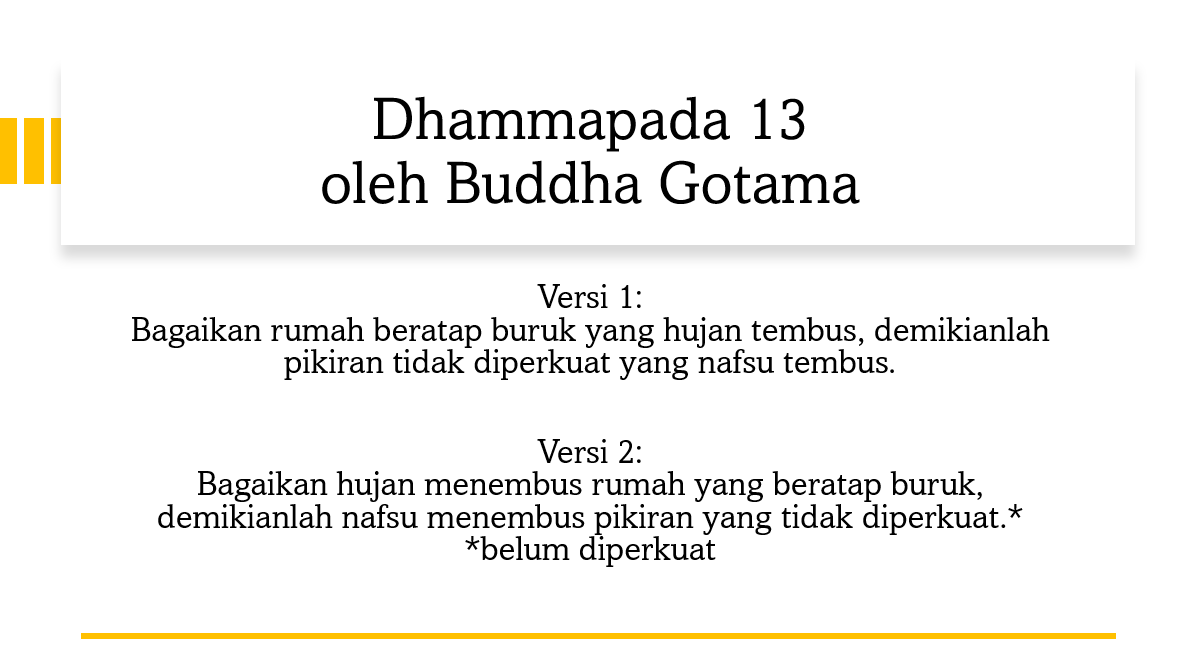
Bagaikan hujan yang takdapat menembus rumah beratap baik, demikian pula nafsu tidak dapat merasuki pikiran yang telah sangat diperkuat.

Bagaikan (air) hujan yang tidak dapat merembes sebuah rumah yang beratap baik, demikianlah nafsu indera tidak dapat merasuk pikiran yang telah dikembangkan dengan baik.

Dhammapada 13

Yamaka Vagga


Vocabulary
tathā: (adv.) as, how, like;
agāra: (a) house; (b) derived from agāra (nt.) + -ṁ, an acc. nt. suffix
ducchanna: (a) (sg. nt.acc) poorly thatched; (b) derived from ducchanna (adj.), derived from du (antithetic pf.) ‘bad, insufficient’ + past.part. of √chad ‘to cover’ + – ṁ, an acc. nt. suffix
vuṭṭhi: (sg. fem.nom.) rain
evaṁ: (adv. thus, so, in this way, likewise, either referring to what follows or what precedes
abhāvita: bhāveti (3rd pers. sg. pres. indic. caus. of √bhū ‘to be’ = produces, cultivates, develops; bhāvita (adj. past.part. of bhāveti) developed; a- (neg. pf.) + bhāvita = abhāvita (adj.) = undeveloped. abhāvita (sg. nt. acc.) = un-developed
citta: citta (nt.) = mind; citta (sg. acc.) = mind
rāgo: rāga (masc. derived from √raj ‘ colour) = passion; rāgo (sg. nom.) = passion

Grammar

1samativijjhati (3rd pers. sg. pres. act. indic.), derived from sa* (adj. pf. implying conjunction and completeness) + ati-
(pf.) ‘extremely’ + √vidh ‘to pierce’ = penetrates

* saṁ- or saṃ-, an indeclinable prefix to verbal roots:* (1) implying a conjunction, e.g., with, together;’ (2) denoting (i) ’completeness,’  (opposite vi-):
(a)Duroiselle (1915/1997:14, No. 38) writes that the niggahīta when followed by a consonant may remain unchanged.
Examples:
     (x) ta dhamma kata; (ii) ta khaa; (iii) ta patto
(b) Nasal-nasal: a nasal consonant (ń, ñ, ṇ, n, or m) followed by another nasal consonant, is assimilated to the latter: saṁ-nisīdati > sannisīdati ‘he sinks down’ (Perniola, 2001:23, No.15(a);
a.1sam-: (a) before a labial (b, bh, m, p, or ph) [(i) thus forming nasal-nasal (Perniola, idem.) (ii) niggahīta, followed by a consonant, may be transformed into the nasal of the class to which that consonant belongs (Duroiselle, idem., p. 14, No.39)]: Sambuddha (saṁ- + buddha,*), sampajāna ‘attentive, thoughtful, mindful, deliberate’ (sa + pajāna ‘understanding, distinguishing’)
(b) before a vowel: samativijjhati, derived from saṁ– +ativijjhati ‘(it) penetrates,’ samacchati ‘(she, she, or it, or one) sits together,’ derived from saṁ- + acchati ‘(she, he, it or one) sits
*Sambuddha: (a) saṁ- + buddha, which is derived from budh ‘to enlighten’ + -ta (a past participle suffix; if formed from a transitive verb, it makes a passive meaning ; otherwise, it forms an active meaning) = budhta > buddha ‘enlightened.’ This is as written by Perniola [idem., p. 17, No.13(a)] that when  two mute consonants come together, the first is assimilated to the second since both are of the same strength:
yuj-ta > yutta ‘joined’
 mad-ta > matta ‘intoxicated’
tadkāro > takkāro ‘he who does that’
sat-puriso > sappuriso ‘good man.’
The consonant t, however, preceded by one of the soft aspirate consonants gh, dh, or bh, is first shortened to d and then assimilation takes place:
labh-tum > labh-dum > laddhum ‘to bobtain’
lubh-ta > lubhda > luddha ‘greedy’
budh-ta > budh-da > buddha ‘enlightened ;’
(b) Duroiselle (ibid.,p 18, No.63) writes that   when initial t follows a sonant aspirate (gh, jh, ḍh, dh, or bh),  the assimilation is progressive: the final sonant aspirate loses its aspiration, the following t (surd) becomes sonant, viz. d, and, taking the aspiration which the final sonant has lost, becomes dh:
EXAMPLE:
√rudh+ta=rudh+da=rud+dha=ruddha
a.2saṁ– before (i) a surd (or sibilant)  (s), labial (b, bh, m, p, or ph), or glide (or semi-vowel) (y,* or v):, e.g., saṁsara, Saṁbuddha,* saṁyojana,b saṁyutta;b

Remark: In the case of final bh, initial t having become dh, regressive assimilation takes place: √labh + ta = labh + da = lab + dha = laddha ‘(having) taken, obtained, received;’ (labhati ‘obtains, takes, receives’)
a.2.1 by assimilation, also san– before a dental (d, dh, t, th, or n), e.g., santapeti, sandahati;
a.3saṅ– or saṇ: (a) before a guttural (or velar) (k, kh, g, gh, and ṅ) or aspirate (h), e.g.,  (i)saṅgha ‘assembly, community, brotherhood, sisterhood, order, or a chapter of a certain Buddhist order, or a certain number of monks;’  (ii) saṅkhāra, saṅkhata, asaṅkheyya; (iii) saha ‘smooth, gentle, mild,’ (Andersen, 1907/2020:253); saheti ‘to brush down’ (Davids & Stede 1921-1925/2005, Part VII, p.131);’ (b) before retroflex, or cerebral:,h, ṭ, ṭh, or : saṁ+hiṭṭhati > saṇṭhiṭṭhati ‘stands;’ saṁ+hānaṁ > saṇṭhānaṁ ‘position’ (called as assimilation or adaptation by Perniola, 1997:14, No. 11(b)]
a.4sañ- (i) before a palatal (c, ch, j, jh, or ñ), e.g., sañcarati [also found in Perniola, 1997:14, No.11(b)], sañchidati ‘to cut, ‘to destroy,’ sañjāti ‘birth, origin, outcome;’ sañjagghati ‘to joke,’ sañña ‘perception,’ viññū ‘intelligent, wise, learned, knowledgable;’ (ii) before a word beginning with e and the  ñ, the initial e changes into ññ: ta+eva= taññeva, paccantaraṁ+eva= paccantaraññeva; (iii) before a word beginning with h: eva hi kho= evañhi kho, ta+hitassa= tañhitassa (Duroiselle,1915/1997:14, No.40) [see also a.3(iii)];
a.5(i)sal- before the liquids l, ļ or ļh, e.g., sallakhetti ‘to observe,’ sallapati ‘to talk with;’ sa-before the liquid r, sometimes sā-, e.g., sāratta, sārambha (Davids & Stede 1921-1925/2005, Part IV:114,  Geiger & Norman, 2005, § 74.3, & the present author’s  own research);
(ii) Before initial l, the niggahīta of sa and pu is changed to l:
(i) saṁ+lakkhaṇā=sallakkhaṇā; (ii) paṭi saṁ līno=paṭisallīno; (iii) saṁ+lekko=sallekho (Duroiselle, 1915/1997:14, No.39); (iv) puṁ+ligaṁ=pulligaṁ (idem., No.39);
a.6 Duroiselle( idem., No.39) writes that the niggahīta, when followed by a consonant, may be transformed into the nasal of the class to which that consonant belongs.
EXAMPLES with (the explanatory notes in the parentheses being added by the present author):
(xli) raṇaṁ+jaho=ranañjaho (ñ belongs to the guttural (or velar) consonant class or group, consisting of g, gh, k, kh, and ń);
(xlii) taṇhaṁ+karo=taṇhańkaro;
(xliii) saṁ+ṭhito=saṇṭhito (ṇ belongs to the cerebral or retroflex) consonant class or group, consisting of ṭ, th, ḍ, ḍh, and ṇ);
(xliv) jutiṁ+dharo=jutindharo (n belongs to the dental consonant class or group, consisting of d, dh, t, th, and n);
(xlv) saṁ+mato=sammato (m belongs to the (bi-)labial consonant class or group, consisting of b, bh, p, ph, and m);
(xlvi) evaṁ+kho=evań kho [see (i)];
(xlvii) dhammaṁ+ca=dhammañca (ñ belongs to the palatal consonant class or group, consisting of c, ch, j, jh, and ñ);
(xlviii) taṁ+niccutaṁ=taññiccutaṁ;

–Iklan–


Untuk informasi lebih lanjut tentang manfaat dan pentingnya fang sheng, silakan klik: https://www.buddha-gotama.com/2023/06/28/buah-lebat-fang-sheng-pengikisan-kilesa/

bsaṁ- + yogo: the niggahīta following y is assimilated into the y, and both together may become ññ: saññogo
saṁ- + yutta: saññutta
Often, no coalescence takes place, and both letters remain unchanged:
saṁyuttaṁ, saṁyojanaṁ (Duroiselle, 1915/1997:14, No.41).

Examples taken by the present author from the other stanzas of the Dhammapada:
31: saṁyojanaṁ >saññojanaṁ
37: saṁyamessanti > saññamessanti

*(Davids & Stede 1921-1925/2005, Part IV:114,  Geiger & Norman, 2005, § 74.3, & Tjan’s own research)

Davids & Stede (ibid.) writes that saṁ- (or sa) is the second most frequently (16%) used prefix in Pali after vi- (19%).

Davids & Stede (ibid.) writes that saṁ- (or saṁ-) is the second most frequently (16%) used prefix in Pali after vi- (19%).

English 1:
Ānandajoti

English 2:
Burlingame

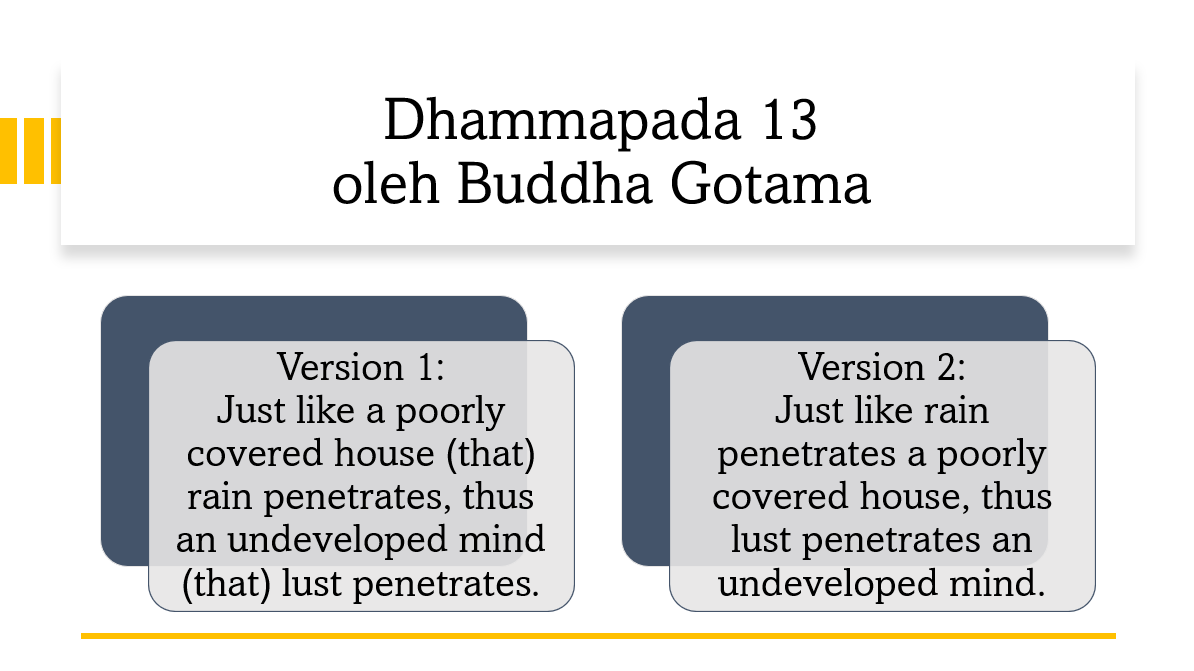
Just as the rain can penetrate
a house with thatching that is poor,
so also passion penetrates
a mind that is undeveloped.

Even as rain breaks through an ill-thatched house. So lust breaks through an ill-trained mind.

Indonesia:
CDD

Indonesia:
YDD

Bagaikan (air) hujan yang merembes sebuah rumah yang beratap buruk, demikianlah nafsu indera merasuk pikiran yang tidak dikembangkan.

Seperti air hujan yang menetes menembus atap jerami yang jarang, demikianlah nafsu keinginan menembus batin yang rapuh (tidak terlatih)

Dhammapada 12

Yamaka Vagga


Vocabulary 1
Vocabulary 2
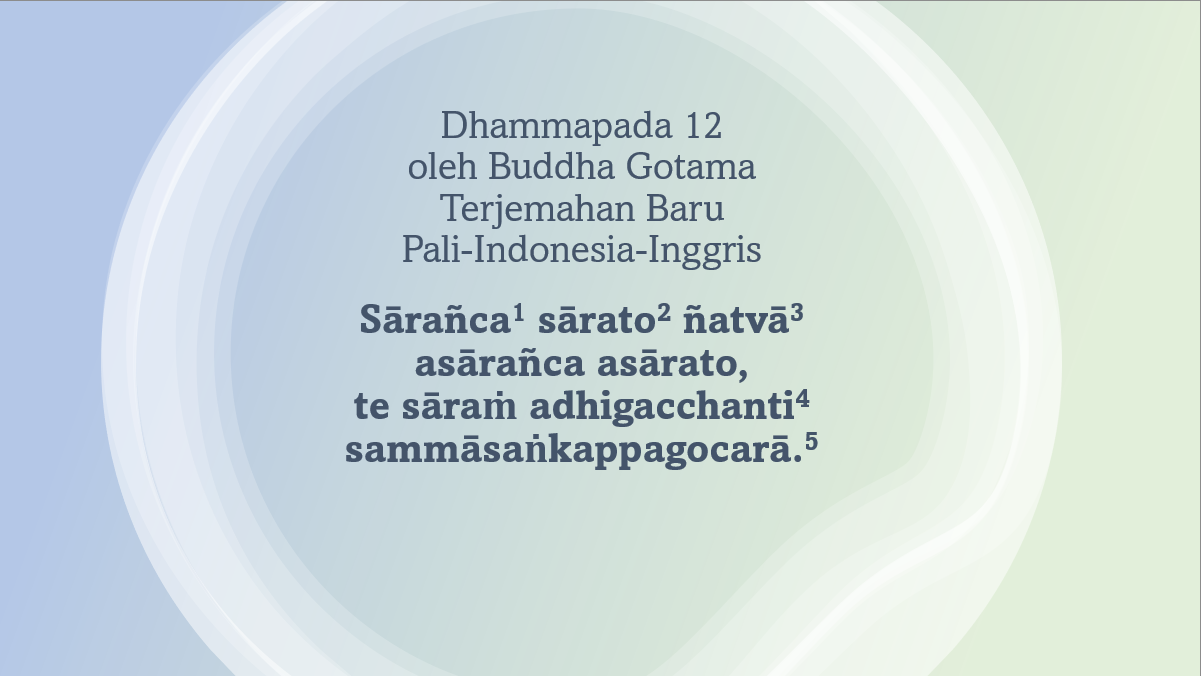
sārañca: (a) euphonic combination of (sg acc. nt.) sāraṁ ‘truth, right view, substance’ + ca ‘and;’ (b) sāraṁ is the sg. nom. and acc. of sāra (nt.) ‘substance, truth’
sārato: (a) (adv., dat.) from right view, from truth, from essence; (b) derived from sāra (nt.) ‘right view, truth, essence;’ (c) as the substance (Sarao, 2009:15)
ñatvā (absol. of √ña ‘to know’ = having known, after knowing
asārañca: (i) sāra (nt.) = substance, a- (neg. pf.) + sāra= asāra; (ii) wrong view (nt.) substanceless; ca (indef. encl. part.) = and; asārañ + ca = asārañca
asārato: (i) sāra (nt.) = substance. a (neg. pf.) + sāra = asārato (adv.) = as the substanceless; (ii) from wrong view;
te: (masc. nom. pl. of  demonstr. pron. ta ‘it, that’ = they.
sāraṁ: (a) (nt. acc.) truth, lit. substance, essence; (b) formed from sāra ‘truth, lit. substance, essence’ + (an acc. suffix of sg. nt.)
adhigacchanti: 3rd. pl. pres. act. indic. derived from adhi (pf.) ‘towards’ + √gam ‘ go’ = get, discover
sammāsakappagocarā: (a) holding right thoughts

Grammar:

1sārañca: (a) euphonic combination of (sg acc. nt.) sāraṁ ‘essence, substance, truth’ + (indef. encl. part.) ca ‘and;’ b) sāraṁ is the sg. nom. and acc. of sāra (nt.) ‘essence, substance, truth;’ (c) the niggahīta in sāraṁ is changed into which ñ, which is the nasal which belongs to the class of the initial palatal consonant c in ca, as written by:
Tilbe (1899:10-11) that when niggahīta () meets either a vowel or consonant, the group may remain intact;a.2 niggahīta may be elided; a vowel following niggahīta may be elided; or one of the following changes may occur (with the examples in the parentheses given by the present author):
(1) niggahīta preceding a vowel generally changes to m;.a.1 or if the vowel is e, the group changes to ññ;a4(ii)
(2) niggahīta followed by a mute [mute sonants: (i) gutturals: g, gh; (ii) palatals: j, jh; (iii) linguals (or retroflex): ḍ,h; (iv) dentals: d, dh, (v) labials: b, bh; (vi) liquids:a.5 y, r, ļ, v; (vii) aspirant: h)] is generally changed to the nasal (ń, ñ, ṇ, n, or m) of the class (guttural: ń,a.3 palatal: ñ,1.4 lingual (or retroflex):, dental: n; or labial: m) to which the mute belongs;a
(3) when niggahīta is followed by y, the group may become ññ;b or
(4) when niggahīta precedes h, it may change to ñ.a.3(iii)

asaṁ- or saṃ-, an indeclinable prefix to verbal roots:* (1) implying a conjunction, e.g., with, together;’ (2) denoting (i) ’completeness,’  (opposite vi-):
(a)Duroiselle (1915/1997:14, No. 38) writes that the niggahīta when followed by a consonant may remain unchanged.
Examples:
     (ix) ta dhamma kata; (ii) ta khaa; (iii) ta patto
     (m) Nasal-nasal: a nasal consonant (ń, ñ, ṇ, n, or m) followed by another nasal consonant, is assimilated to the latter: saṁ-nisīdati > sannisīdati ‘he sinks down’ (Perniola, 2001:23, No.15(a);

a.1sam-: (a) before a labial (b, bh, m, p, or ph) [(i) thus forming nasal-nasal (Perniola, idem.) (ii) niggahīta, followed by a consonant, may be transformed into the nasal of the class to which that consonant belongs (Duroiselle, idem., p. 14, No.39)]: Sambuddha (saṁ- + buddha,*), sampajāna ‘attentive, thoughtful, mindful, deliberate’ (sa + pajāna ‘understanding, distinguishing’)

–Iklan–


(b) before a vowel: samativijjhati, derived from saṁ– +ativijjhati ‘(it) penetrates,’ samacchati ‘(she, she, or it, or one) sits together,’ derived from saṁ- + acchati ‘(she, he, it or one) sits

*Sambuddha: (a) saṁ- + buddha, which is derived from budh ‘to enlighten’ + -ta (a past participle suffix; if formed from a transitive verb, it makes a passive meaning ; otherwise, it forms an active meaning) = budhta > buddha ‘enlightened.’ This is as written by Perniola [idem., p. 17, No.13(a)] that when  two mute consonants come together, the first is assimilated to the second since both are of the same strength:
yuj-ta > yutta ‘joined’
 mad-ta > matta ‘intoxicated’
tadkāro > takkāro ‘he who does that’
sat-puriso > sappuriso ‘good man.’

The consonant t, however, preceded by one of the soft aspirate consonants gh, dh, or bh, is first shortened to d and then assimilation takes place:
labh-tum > labh-dum > laddhum ‘to bobtain’
lubh-ta > lubhda > luddha ‘greedy’
budh-ta > budh-da > buddha ‘enlightened ;’

(b) Duroiselle (ibid.,p 18, No.63) writes that   when initial t follows a sonant aspirate (gh, jh, ḍh, dh, or bh),  the assimilation is progressive: the final sonant aspirate loses its aspiration, the following t (surd) becomes sonant, viz. d, and, taking the aspiration which the final sonant has lost, becomes dh:

EXAMPLE:

√rudh+ta=rudh+da=rud+dha=ruddha

a.2saṁ– before (i) a surd (or sibilant)  (s), labial (b, bh, m, p, or ph), or glide (or semi-vowel) (y,* or v):, e.g., saṁsara, Saṁbuddha,* saṁyojana,b saṁyutta;b

Remark: In the case of final bh, initial t having become dh, regressive assimilation takes place: √labh + ta = labh + da = lab + dha = laddha ‘(having) taken, obtained, received;’ (labhati ‘obtains, takes, receives’)
a.2.1 by assimilation, also san– before a dental (d, dh, t, th, or n), e.g., santapeti, sandahati;
a.3saṅ– or saṇ: (a) before a guttural (or velar) (k, kh, g, gh, and ṅ) or aspirate (h), e.g.,  (i)saṅgha ‘assembly, community, brotherhood, sisterhood, order, or a chapter of a certain Buddhist order, or a certain number of monks;’  (ii) saṅkhāra, saṅkhata, asaṅkheyya; (iii) saha ‘smooth, gentle, mild,’ (Andersen, 1907/2020:253); saheti ‘to brush down’ (Davids & Stede 1921-1925/2005, Part VII, p.131);’ (b) before retroflex, or cerebral:,h, ṭ, ṭh, or : saṁ+hiṭṭhati > saṇṭhiṭṭhati ‘stands;’ saṁ+hānaṁ > saṇṭhānaṁ ‘position’ (called as assimilation or adaptation by Perniola, 1997:14, No. 11(b)]
a.4sañ-: (i) before a palatal (c, ch, j, jh, or ñ), e.g., sañcarati [also found in Perniola, 1997:14, No.11(b)], sañchidati ‘to cut, ‘to destroy,’ sañjāti ‘birth, origin, outcome;’ sañjagghati ‘to joke,’ sañña ‘perception,’ viññū ‘intelligent, wise, learned, knowledgable;’ (ii) before a word beginning with e and the  ñ, the initial e changes into ññ: ta+eva= taññeva, paccantaraṁ+eva= paccantaraññeva; (iii) before a word beginning with h: eva hi kho= evañhi kho, ta+hitassa= tañhitassa (Duroiselle,1915/1997:14, No.40) [see also a.3(iii)];
a.5(i)sal– before the liquids l, ļ or ļh, e.g., sallakhetti ‘to observe,’ sallapati ‘to talk with;’ sa-before the liquid r, sometimes sā-, e.g., sāratta, sārambha (Davids & Stede 1921-1925/2005, Part IV:114,  Geiger & Norman, 2005, § 74.3, & the present author’s  own research);
(ii) Before initial l, the niggahīta of sa and pu is changed to l:
(i) saṁ+lakkhaṇā=sallakkhaṇā; (ii) paṭi saṁ līno=paṭisallīno; (iii) saṁ+lekko=sallekho (Duroiselle, 1915/1997:14, No.39); (iv)
puṁ+ligaṁ=pulligaṁ (idem., No.39);
a.6 Duroiselle( idem., No.39) writes that the niggahīta, when followed by a consonant, may be transformed into the nasal of the class to which that consonant belongs.
EXAMPLES with (the explanatory notes in the parentheses being added by the present author):
(xxxiii) raṇaṁ+jaho=ranañjaho (ñ belongs to the guttural (or velar) consonant class or group, consisting of g, gh, k, kh, and ń);
(xxxiv) taṇhaṁ+karo=taṇhańkaro;
(xxxv) saṁ+ṭhito=saṇṭhito (ṇ belongs to the cerebral or retroflex) consonant class or group, consisting of ṭ, th, ḍ, ḍh, and ṇ);
(xxxvi) jutiṁ+dharo=jutindharo (n belongs to the dental consonant class or group, consisting of d, dh, t, th, and n);
(xxxvii) saṁ+mato=sammato (m belongs to the (bi-)labial consonant class or group, consisting of b, bh, p, ph, and m);
(xxxviii) evaṁ+kho=evań kho [see (i)];
(xxxix)dhammaṁ+ca=dhammañca (ñ belongs to the palatal consonant class or group, consisting of c, ch, j, jh, and ñ);
(xl) taṁ+niccutaṁ=taññiccutaṁ;

bsaṁ- + yogo: the niggahīta following y is assimilated into the y, and both together may become ññ: saññogo
saṁ- + yutta: saññutta
Often, no coalescence takes place, and both letters remain unchanged:
saṁyuttaṁ, saṁyojanaṁ (Duroiselle, 1915/1997:14, No.41).

Examples taken by the present author from the other stanzas of the Dhammapada:
31: saṁyojanaṁ >saññojanaṁ
37: saṁyamessanti > saññamessanti

*(Davids & Stede, 1921-1925/2005, Part IV:114,  Geiger & Norman, 2005, § 74.3, & Tjan’s own research)

Davids & Stede (ibid.) writes that saṁ- (or sa) is the second most frequently (16%) used prefix in Pali after vi- (19%).

2sarato: (a) (adv., dat.) from right view, from truth, from essence; (b) derived from sāra (nt.) ‘right view, truth, essence;’ (c) as the substance (Sarao, 2009:15); (d)
an optional form of sārantassa ‘from, for, or of, one who has right view,’ which is an ablative case and also a genitive case of a noun or adjective ending in -a; the entire suffix -ntu and the inflection endings -sa, -smi, and nā, are changed to -to, -ti, and tā, respectively. Examples: gunavantassa > gunavato ‘of or for one who has virtue; gunavantu+-smiṁ > gunavati ‘in one who has virtue;’ gunavantu+ -nā > gunavatā (Kaccayana, § 127.102)

4te sāraṁ adhigacchanti: (a) they discover (or encounter) truth (or essence); (b) a general word order of a Pali full sentence: te ‘they,’ the subject, nominative of so ‘he’ + sāraṁ ‘truth, essence,’ the object, or accusative of sāra ‘truth, essence,’ + adhigacchanti, pl. 3rd. pers. act. pres. active indic. voice of adhigaccha ‘to come into possession of, to acquire, discover, to attain, (fig.) to understand’ + -nti, 3rd. pers. pl. personal ending (Duroiselle, 1915/1997:86, 1st conjugation, No. 381); (c) adhigaccha is derived from adhi ‘towards, above, over’ + gaccha ‘goes;’ (d) gaccha belongs to irregular bases of the seventh conjugation, as written by Duroiselle (idem, p. 93, No. 404):
404. The roots of the seventh conjugation, as has been remarked above (379), have two bases: one in e and one in aya, which are conjugated exactly like the roots of the third class of the first conjugation (see 393).

Irregular Bases
Some roots form their special bases according to none of the above given rules, and they are in consequence called Irregular.
The principal forms are here given:
Roots                                            Special bases
√gam, to go                                      gaccha
√yam, to restrain                               yaccha
√guh, to hide                                     gūhe
√dhā, to hold                                daha, dhe (391)
√dā, to give                                       dajja
√jā, jan, to be born                            jāya
√pā, to drink                                     piva
√ḍaṁs, to bite                                   ḍasa
√dhmā, to blow                                 dhama
√vyadh (=vadh)                                vadha
√sad, to sit                                       sīda
√ṭhā, to stand                                   tiṭṭhā
√is, to wish                                       iccha
√vad, to speak, say               vajja, vajje, vada, vāde
√mar, to die                             miya, miyya, mara
√gah to take, seize                           gheppa*
√gam, to go                             ghamma, gaggha*
√jir, to gow old, decay                     jiya, jiyya
√dis, das to see                          dakkha, daccha*

*These forms are given by the Saddanīti and the Akhyatapadamālā. They are regularly conjugated like gaccha: ghammāmi, ghammasi ghammati, etc.; ghagghami, ghagghasi ghagghati, etc.; ghammeyya, gagghe, gaggheyya, etc. The bases dakkha and daccha from √da, dis are formed on the false analogy of the future base, which we shall see when treating of the future. Most of the changes noticed above correspond to similar changes which occur in the 1st, 4th and 6th Conjugations of Sanskrit verbs.

5sammāsaṅkappaā: (a)(1) (pl. 3rd. pers. nom.) fig. holding right thoughts; (2) the fig. meaning is derived from the analogy of the construction (i) X-pakata ‘done or made out of X, (ii) X-ja ‘be born of X, (iii) X-nidāna ‘having X as the source of origin,’ (iv) X-vipāka ‘having X as result or fruit,’ (v) X-samudaya ‘having X as the origin, or arising from X, or the origin of X’ (Gair & Karunatillake, 2014:28), but (vi) X-gamin (fem. gaminī) ‘leading to X, going to X,’ (vii) x-jāta ‘having become X’ (idem, p.160), (viii) X-deva ‘having X as god, highly respecting X’ (idem., p.161); (ix) (Davids & Stede (1924:32, Part III) kamāvacara ‘having its province in kāma’

(b) euphonic union, or sandhi, of sammā (3rd. pers. pl. adjective) ‘right, correct’ + sakappa (sg. masc.) ‘thought’ + gocarā ‘(those who are) wandering, roaming, (those cows which are) grazing;’ © gocarā is derived from go (masc.) ‘cow” + carā (pl. adj. and agent noun or doer*) ‘(those who are) walking, wandering, roaming, (lit. those cows which are) grazing’ (action noun) ‘destination, or place, of wandering or roaming or walking, pasture, grazing field, a cow’s grazing,;’ (d) gocarā is 3rd. pl. nom. and adj. of gocara (3rd person. sg. nom. and adj.) ‘(one who is) walking, roaming, wandering, (lit. that cow which is) grazing, roaming.
*Duroiselle (1915/1997:141-142, Nos. 576-578) writes:
(i)         Primary Derivatives (kita)
575. As has been said already Primary Derivatives are formed directly from the roots by means of certain suffixes; these suffixes are called kita suffixes.
576. The kita suffixes are given below in alphabetical order to faciliate reference.
a – (a) (ṇ) (a). By means of this suffix are formed an extremely large number of derivatives, some of which take guṇa and some of which do not. It forms nouns, (substantive and adjective) showing:
1st-action: √pac, to cook+a=pāka, the act of cooking; √caj, to forsake+a=cāga, forsaking, abandonment; √bhaj, to divide+a=bhāga, dividing; √kam, to love+a=kāma, love.
2nd- the doer or agent: √car, to roam+a=cāra and cara, a spy; √har, to take, captivate,+a=hara, the Captivator, a name of Shiva; √kar, to do, make+a=kara, that which does, the hand; also kāra, a doer, maker.
3rd- abstract nouns of action: √kar+a=kara, action, making; √kam to step, proceed+a=kama, step, succession, order; √kamp, to shake+a=kampa, shaking, trembling; √yuj, to join+a=yoga, joining.
4th- It forms adjectives: √kar+a=kāra, doing, making, also kara, causing, making; √car, to walk, roam, cāra, walking, roaming, and also cara, do; √plu, to swim, float+a=plava, swimming, floating.
The student will readily understand that the root may be preceded by any prefix: saṁ+√gam+a=saṅgāma, assembly; pa+√vis, to enter+a=pavesa, entrance; anu+√sar to go, move, walk+a=anusara, following. The same remark applies to all the other suffixes.
577. From the adjectives formed by this suffix (4th), are formed the upapada compounds (552): kammakāro=kammaṁ kāro (kammaṁ karotī’ ti), the doer of the act; kumbhakāro=khumbhaṁ kāro (kumbhaṁ karotī’ti), the maker of the pot, potter.
588. Very similar in nature with the upapada compounds are those compounds which are the names of persons. In our opinion they are purely and simply upapadas, but Kacchāyana has the following rule: “saññāyaṁ a nu” that is, to form a proper name, suffix nu (=ṁ=Accus. case) is added to the 1st member of the compound, which is the direct object of the root which forms the 2nd member and after which the suffix a is added to denote the agent: arindama, the subduer of his enemies=ari, enemy+ṁ (nu)+√dam, to subdue+a. So vessantara, who has crossed over to the merchants, (vessa+ṁ (nu)+√tar, to cross+a); taṇhaṅkara, creating desire=tanhā, desire+ṁ (nu)+kar+a. The name of a Buddha.
It will be seen from the above examples that the 1st member is in the Acc. case and is governed by the 2nd member which is an agent-noun formed by the suffix a.
Remarks: The nouns formed by a are masculine: they form the feminine according to rules (183), and the same applies to the adjectives (197).

English 1:
Burlingame

English 2:
Buddharakhita

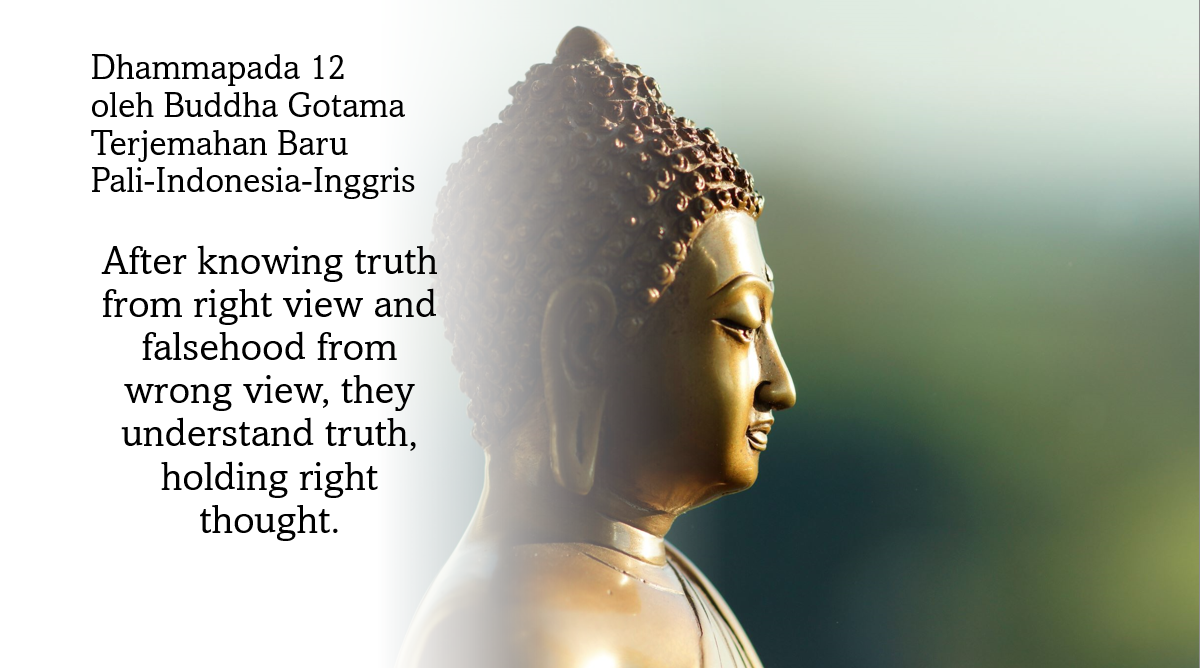
They who have rightly discerned the true in its truth and the false in its falsity. They attain the goal of truth and abide in the pasture-ground of right thinking.

Those who know the essential to be essential and the unessential to be unessential, dwelling in right thoughts, do arrive at the essential.

Indonesia 1:
BDG

Indonesia 2:
CDD

Barang siapa menganggap sesuatu yang hakiki sebagai hakiki, sesuatu yang tak hakiki sebagai tak hakiki; mereka yang mempunyai pikiran benar semacam itu niscaya akan memperoleh apa yang hakiki.

Setelah mengetahui dari yang hakiki sebagai hakiki, dan dari yang bukan hakiki sebagai bukan hakiki. Mereka yang bersekutu dengan pikiran benar (seperti itu) akan memahami yang hakiki.

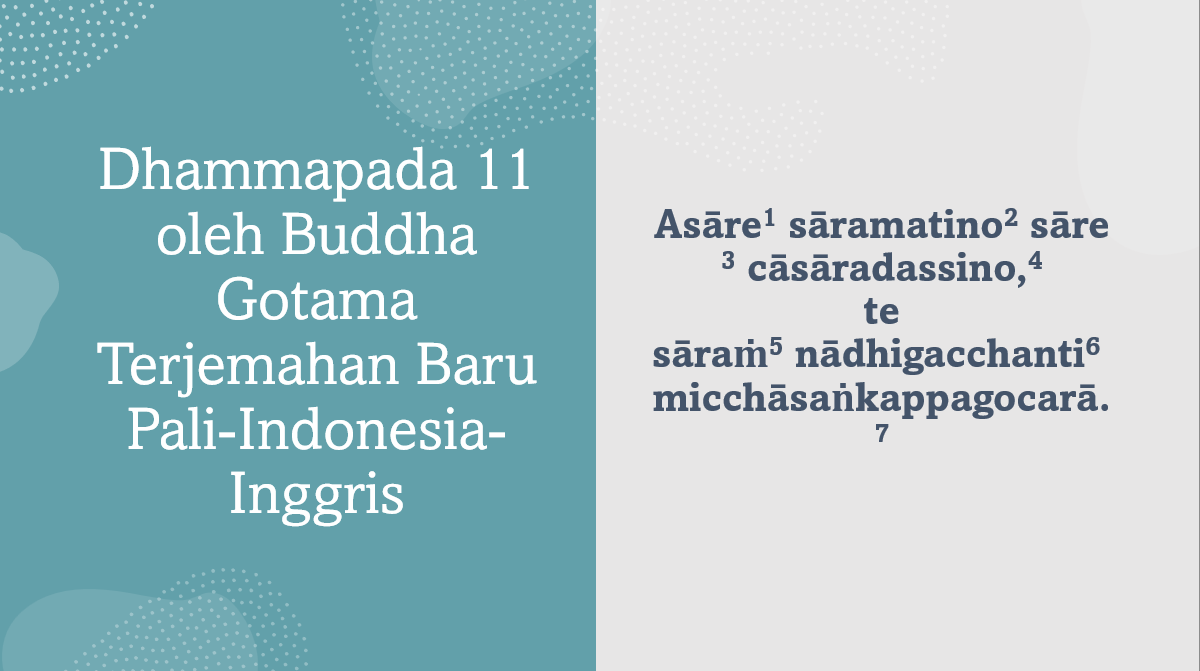
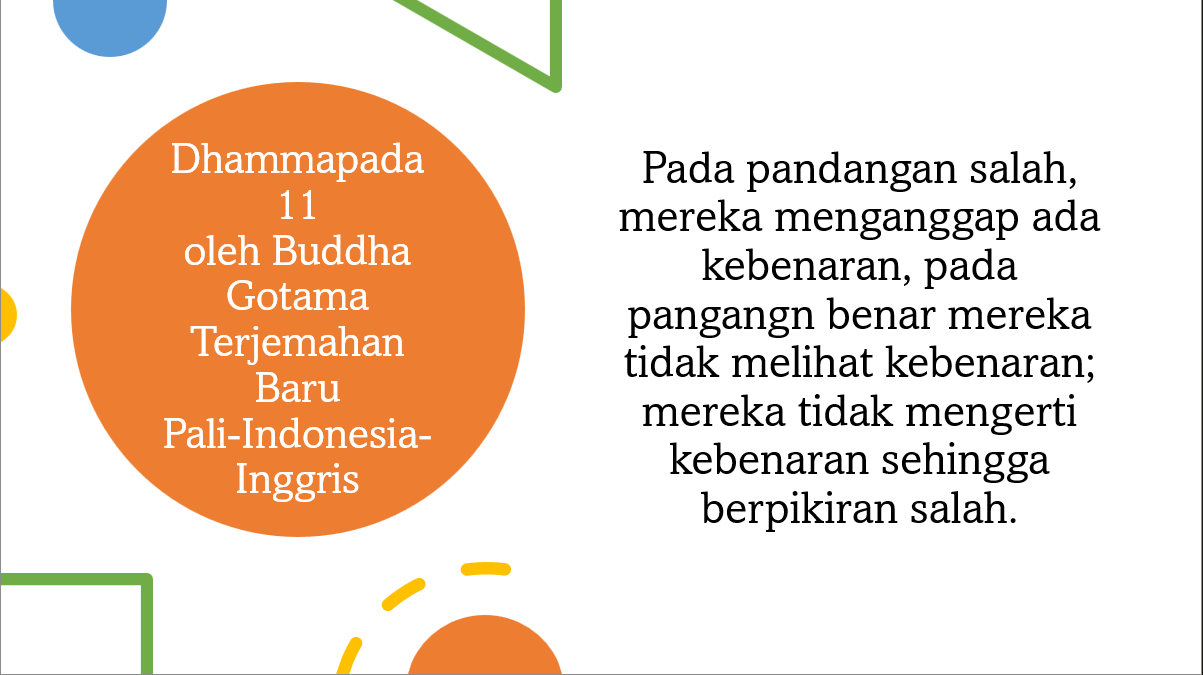
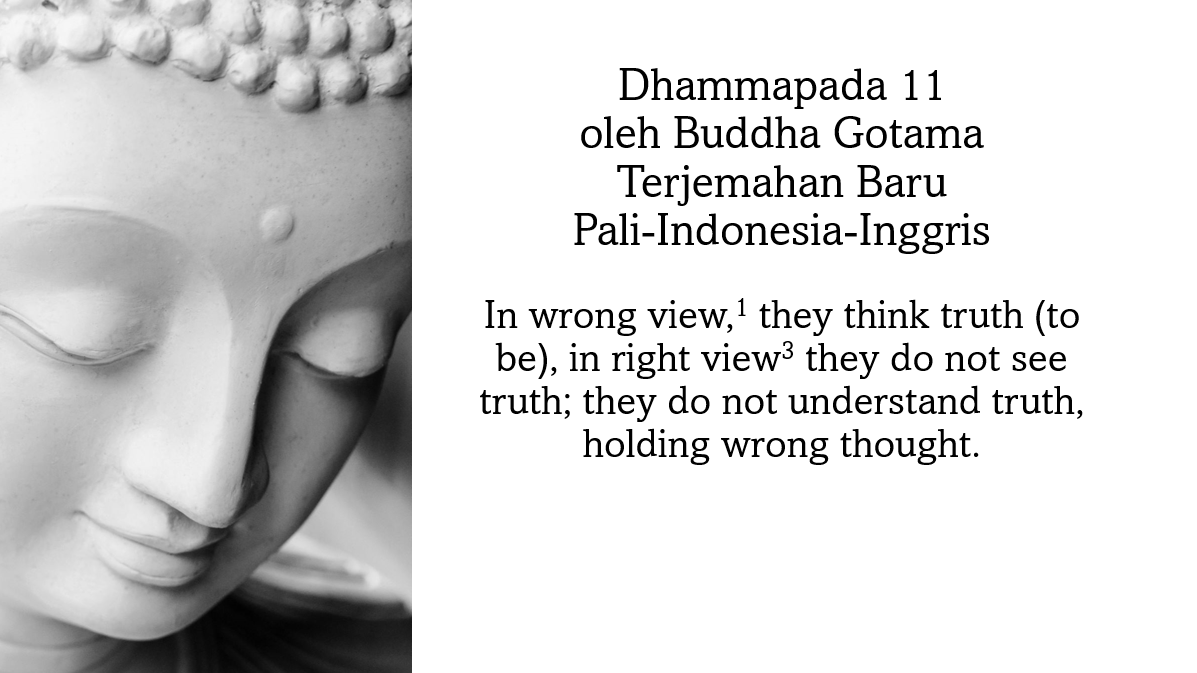
Dhammapada 11

Yamaka Vagga


Vocabulary 1
Vocabulary 2
asāre: in falsehood
sāramatino: (those who are) seeing truth or essence
sāre: in truth, in essence
cāsāradassino:  (a) and (those who are) not seeing truth or essence; (b) euphonic union, or sandhi of, ca ‘and’ + āsāradassino ‘(those who are) not seeing truth or essence’
te sāraṁ nādhigacchanti: they do not acquire, do not come into possession of, do not attain, (fig.) do not understand;
nādhigacchanti: (a) (3rd. pers. pl. act. pres. indic.) do not acquire, do not attain, do not come into possession of , do not acquire, (fig.) do not understand; (b)  euphonic union, or sandhi, of na ‘no, not;’ + adhigacchanti ‘to get to, to come into possession of, to acquire, (fig.) to understand;
micchāsakappagocarā: (pl. nom.) holding  wrong thought; fig. having wrong thought as a pasture

Grammar

1asāre: (a) lit., in  what is not an essence (asāra); (b) according to the Commentary, (in) wrong view (asāra), i.e., untruth (Tin, 1993:5).
2sāramatino: (a) the plural form of the masculine noun saramatī ‘one who imagines finding the essence, which is also an adjective which means  imagining finding the essence;’ (b) Geiger & Norman, 2005, § 83, p.76.5) write that sāramatino is  a result of the mixing-up of –in and –ī inflections  which has also led in the case of the –ī stems to the construction of forms according to the in declension.
Thus, aggino Saddh 585; dummatino Mhv 4.3 (with the analogous form mittadduno); sāramatino Dh.11; vajjamatino Dhp318 ….;
(c) Geiger & Norman (idem, § 95, pp. 87-88) further write:
The declension of substantives and adjectives ending in -in: Stem: hatthin ‘elephant’
(the sequence of cases has been reversed by the present author)

                                      Singular plural       

Singular                                                    Plural

Nom.   hatthī, hatthi                                  hatthī, hatthino

Gen.    hatthissa, hatthino                         hatthinaṁ

Dat.     hatthissa, hatthino                          hatthīnaṁ

Acc.     hatthiṁ, hatthinaṁ                         hatthī, hatthino

Ins.      hatthinā                                          hatthīhi

Abl.      hatthinā, hatthismā, hattimhā        hatthīhi

Loc.     hatthinī, hatthismiṁ, hatthimhi      hatthīsu

Voc.     hatthī                                            hatthī, hatthino 

(d)Duroiselle (1997:45, No.173) writes that there are some masculine nouns whose nominative singular ends in -ī. As a general rule, the masculine nouns of this class are adjectives used substantively; they properly belong to the consonantal declension, and their stems end in -in.

The plural nominative forms of these nouns take the suffix -no, as the those of dandī ‘merchant.’

singular                                                                       plural

sāramatī (stem in) ‘(one) imagining truth’             sāramatino ‘(those) imagining truth’ (11)

asāradassī or āsāradassin ‘(one) not seeing truth’  asāradassino ‘(those) not seeing truth’ (11; cāsāradassino = ca + asāradassino ‘and/but those not seeing truth)

Declension of sāramatī following Duroiselle (idem., p.33, No.136):

Singular                                                    Plural
Nom.   sāramatī                                        sāramatī, sāramatino
Gen.    sāramatissa, sāramatino               sāramatinaṁ
Dat.     sāramatissa, sāramatino               sāramatinaṁ
Acc.     sāramatiṁ, sāramatinaṁ               sāramatī, sāramatino
Ins.      sāramatinā                                     sāramatīhi, sāramatībhi
Abl.      sāramatinā, sāramatismā              sāramatīhi, sāramatībhi
Loc.     sāramatismiṁ, sāramatimhi           sāramatīsu
Voc.     sāramatī                                         sāramatī, sāramatino

3sāre: (a) lit., in the essence; according to the Commentary, (in the) right view, i.e.,(in) truth (Tin, idem.); (b) the locative case of sāra ‘essence, right view, truth.’ See the declension table below.
The declension of sāra, a neuter noun, following Duroiselle (1915/1997:28, No.124)

singular                                                    plural
Nom.  sāraṁ                                 sārāni,(a) & (b) sārā
Gen.   sārassa                              sārānaṁ
Dat.    sārassa, sārāya*                sārānaṁ
Acc.    sāraṁ                                 sārāni, sāre
Ins.     sārena**                             sārehi, sārebhi
Abl.    sārā                                    sārehi,  sārebhi
          sārasmā***
          sāramhā,*** sārato
Loc.     sāre, sārasmiṁ***            sāresu
           sāramhi***
Voc.     sāra(-aṁ***)                     sārāni, sārā

Remarks:
(a) ni is essentially the distinctive sign of neuter nouns in the nom. acc., and voc. plur. in all declensions.
(b) The final vowel of the stem is lengthened before ni.

*sārāya: (1) Perniola (1997:325, No. 259) writes that in Pali only the thematic stems have a true dative case in -āya…. For the rest, Pali uses the genitive and it is under the genitive that are classified the examples which in other languages are considered as datives; (2) Muller, Edward (1884:67) writes that the old dative in -āya is only used to denote the intention, and is almost synonimous with an infinitive; only few instances occur where the dative has a terminating meaning as Dhp. v. 174, saggāya gacchati ‘goes to heaven,” and Dhp. v.311, nirayāya upkaddhati ‘brings to hell’….
(3) Duroiselle (ibid, p.26, No.122) writes that:
(a) The true Dat. sing. in āya has now generally been displaced by the suffix of the gen. ssa; the Dat. āya is almost equal to an lnfinitive and mostly denotes intention.
(c) so is sometimes used also as an Abl. sing. suffix: vaggaso, by groups, bhāgaso, by share.
(d) sā is also found as an Ins. sing. suffix, as: balasā, by force, forcibly, talasā, with the sole of the foot.
(e)Before ehi, ebhi, Ins. and Abl. plur. and e, Acc. plur. , the final a of the stem is dropped: dukkha + ehi = dukkh + ehi = dukkehi
(f)Before su, the Loc. plur., the final a of the stem is changed to e: dukkhesu.

**sārena: (a) by, with, because of truth, essence;’ (b) formed from sāra + -nā, with the elision of the final in sāra and the change of -nā to e  (Kaccayana, idem, p. .., Thitzana trsl) ???

© Following Duroiselle (ibid, p. 8, No.21, & pp. 26-27, Nos. 120123), however, sārena would be derived from sāra + -ina in which the final a in sāra and the initial i in -ina combine to produce e.

Other examples of neuter nouns (Duroiselle, 1915/1997:28, No. 124):
citta, mind                                  sota, ear
mūla, root, price                  veḷuriya, coral
upaṭṭhāna, service                  ahata, cloth (new)
jala, water                              osāna, end
loṇa, salt                                  savana, hearing
vajira, diamond                     sāṭaka, garment
vāta, wind                                  pesana, despatch, sending
yotta, rope                               paṭṭana, a seaport
yuddha, fight                           paṇṇa, leaf

Remarks:
(vii) It will be noticed that neuter nouns in a differ from the masculine in a, in the nom. and in the nom., acc. and voc. plur.; all the other cases are identical.

(b) In the plur. the nom. acc. and voc. have the same form.

(viii) The form in āni, of the , acc. and voc. plur. is the most common.

***-smā and -mhā, and -smiṁ and -mhi:  (a) Mūller, Edward (1884:67-68) writes that in the ablative, the terminations -smā and -mhā, and in the locative, -smim and -mhi, are taken from the pronominal inflection. Besides, we have two other terminations for the ablative, to = skt. tas, and so = ças, which occur mostly in later texts, but also in a few instances in the Jataka and Dhp.v.320: cāpāto ‘from the bow’ ….; (b) Duroiselle (idem., pp. 26-27, No.122) writes that smā and mhā of the Abl. and smiṁ and mhi of the Loc. have been borrowed from the pronominal declension (see Declension of Pronouns); (c) The suffixes -asmā, -amhā, -ebhi, asmiṁ, and -amhi, and the singular vocative sāraṁ are alternate forms which are less common, or generally found in later or commentarial texts rather than in canonical texts (Gair & Karunatillake, 1998/2014:5).

4(i) This parses as ca + asāra + dassino; it is not clear to me why ca is found here, as it is not needed by the grammar, the meaning or the metre (Ānandajoti, www.ancient-buddhist-texts.net); (ii) cāsāradassino is ambiguous as it can be comprised of ca + either ᾱsara+dassino ‘seeing superficiality’ or a- + sradassino ‘not seeing substance’ (Tjan)

5sāram: (i) essence, as in Dhammasāra ‘essence of the Dhamma (Davids & Stede 1923:175); (ii)Truth- According to the Commentary, essence of the Dhamma. The essence of the Dhamma comprises sīla (moral precepts or morality), samādhi (concentation), pañña (knowledge), vimutti (liberation), vimutti-ñaṇadassana (Knowledge of Insight into liberation), paramattha (ultimate truth), and Nibbāna (Tin, 2003:5).

6nādhigacchanti: (a) (3rd. pers. pl. act. pres. indic.) do not acquire, do not attain, do not get to, do not come into possession of, (fig.) do not understand; (b) derived from na ‘no, not’ + adhigacchanti (3rd pl. act. pres. indic.) acquire, attain, get to, come into possession of, (fig.) understand; (c) adhigacchanti: derived from adhi-* (verbal pf.) ‘over, above, on, upon, at, to, in, superior to, great, towards’ + √gachha** ‘to go’ + -nti (a verbal suffix to indicate 3rd. pl. act. pres.indic.)

*(a) Other examples of the usage of the prefix adhi-: adhi- + √vas ‘to live = adhivas ‘to live in, to inhabit;’  adhi- + √bhās ‘to speak = ‘adhibhās’ to speak to, to address; (b) the prefix adhi becomes ajjh before a vowel (Duroiselle, 1915/1997:119, No. 516): adhi-+ agaṁ ‘to go’ = ajjhagaṁ ‘ (I) approach;’ © agaṁ is an example of the radical aorist.

Duroiselle (idem., p.94, Nos. 409-410) writes that this aorist is not very common. We will give a few examples. Let it be first remarked that the aorist may also take the augment a before it, as the does the imperfect.

4.10 from √gam, and √ga and √gu (subsidiary forms of √gam) ‘to go,’ we have:

(a)        Sing.                                      Plur.

  1. agaṁ, agamā, agamiṁ                  agumha
  2. agā, agamā                                 aguttha
  3. agā, agami                              aguṁ, agamixsu

(b) √as, to be (with augment a):

            Sing.       Plur.

  1.      āsiṁ          āsimha
  2.      āsi            āsittha
  3.      āsi           āsuṁ, āsiṁsu

4.11 √ṭhā

            Sing.       Plur.

  1.       aṭṭhaṁ   aṭṭhamha
  2.       aṭṭho    aṭṭhattha

3.       aṭṭha     aṭṭhaṁsu, aṭṭhuṁ

Remarks: For the doubling of initial ṭh, see 33.

4.12 From √kar we find: akaṁ (1st singular), no doubt formed on the analogy of: akā (1st, 2nd and 3rd singular); akā being itself from the Vedic form: akar, the loss of the r is compensated by the lengthening of the final a.

In the 1st singular, we also have: akaraṁ, akariṁ.
In the plural:    2. akattha;       3. akaruṁ, akarū, akariṁsu

4.13 √hū (a form of √bhū) to be.
3rd singular: ahū, ahu, and before a vowel, ahud. 1st plural: ahumhā; 3rd plural: ahuṁ.

4.14 √da

1st singular: adā, which is also 2nd and 3rd singular. In the plural we find: 3rd aduṁ, adaṁsu, adāsuṁ.

4.15 The augment a is not inseparable from the Aorist, so that we meet with such forms as: gā=agā, etc.

**gachha belongs to the irregular bases of the seventh conjugation, as written by Duroiselle (idem, p.93, No. 404):
404. The roots of the seventh conjugation, as has been remarked above (379), have two bases: one in e and one in aya, which are conjugated exactly like the roots of the third class of the first conjugation (see 393).

Irregular Bases

Some roots form their special bases according to none of the above given rules, and they are in consequence called Irregular.
The principal forms are here given:

Roots                                            Special bases

√gam, to go                           gaccha

√yam, to restrain                   yaccha

√guh, to hide                         gūhe

√dhā, to hold                         daha, dhe (391)

√dā, to give                           dajja

√jā, jan, to be born                 jāya

√pā, to drink                           piva

√ḍaṁs, to bite                        ḍasa

√dhmā, to blow                      dhama

√vyadh (=vadh)                      vadha

√sad, to sit                             sīda

√ṭhā, to stand                         tiṭṭhā

√is, to wish                             iccha

√vad, to speak, say                vajja, vajje, vada, vāde

√mar, to die                             miya, miyya, mara

√gah to take, seize                 gheppa*

√gam, to go                             ghamma, gaggha*

√jir, to grow old, decay            jiya, jiyya

√dis, das to see                       dakkha, daccha*

*These forms are given by the Saddanīti and the Akhyatapadamālā. They are regularly conjugated like gaccha: ghammāmi, ghammasi ghammati, etc.; ghagghami, ghagghasi ghagghati, etc.; ghammeyya, gagghe, gaggheyya, etc. The bases dakkha and daccha from √da, dis are formed on the false analogy of the future base, which we shall see when treating of the future. Most of the changes noticed above correspond to similar changes which occur in the 1st, 4th and 6th Conjugations of Sanskrit verbs.

7micchāsakappagocarā: (a)(1) (pl. 3rd. pers. nom.) holding wrong thoughts, fig. having wrong thought as a sphere or pasture; (2) the fig. meaning is derived from the analogy of the construction (i) X-pakata ‘done or made out of X, (ii) X-ja ‘be born of X, (iii) X-nidāna ‘having X as the source of origin,’ (iv) X-vipāka ‘having X as result or fruit,’ (v) X-samudaya ‘having X as the origin, or arising from X, or the origin of X’ (Gair & Karunatillake, 2014:28), but (vi) X-gamin (fem. gaminī) ‘leading to X, going to X,’ (vii) x-jāta ‘having become X’ (idem, p.160), (viii) X-deva ‘having X as god, highly respecting X’ (idem., p.161); (ix) (Davids & Stede (1924:32, Part III) kamāvacara ‘having its province in kāma’

(b) euphonic union, or sandhi, of micchā (3rd. pers. pl. adjective) ‘wrong, erroneous’ + sakappa (masc.) ‘thought’ + gocarā ‘(those who are) wandering, roaming, (those cows which are) grazing;’ © gocarā is derived from go (masc.) ‘cow” + carā (pl. adj. and agent noun or doer*) ‘(those who are) walking, wandering, roaming, (lit. those cows which are) grazing’ (action noun) ‘destination, or place, of wandering or roaming or walking, pasture, grazing field, a cow’s grazing,;’ (d) gocarā is 3rd. pl. nom. and adj. of gocara (3rd person. sg. nom. and adj.) ‘(one who is) walking, roaming, wandering, (lit. that cow which is) grazing, roaming.

*Duroiselle (1915/1997:141-142, Nos.576-578) writes:
(i)         Primary Derivatives (kita)

575. As has been said already Primary Derivatives are formed directly from the roots by means of certain suffixes; these suffixes are called kita suffixes.
576. The kita suffixes are given below in alphabetical order to facilitate reference.
a- (a) (ṇ) (a). By means of this suffix are formed an extremely large number of derivatives, some of which take guṇa and some of which do not. It forms nouns, (substantive and adjective) showing:
1st-action: √pac, to cook+a=pāka, the act of cooking; √caj, to forsake+a=cāga, forsaking, abandonment; √bhaj, to divide+a=bhāga, dividing; √kam, to love+a=kāma, love.
2nd- the doer or agent: √car, to roam+a=cāra and cara, a spy; √har, to take, captivate,+a=hara, the Captivator, a name of Shiva; √kar, to do, make+a=kara, that which does, the hand; also kāra, a doer, maker.
3rd- abstract nouns of action: √kar+a=kara, action, making; √kam to step, proceed+a=kama, step, succession, order; √kamp, to shake+a=kampa, shaking, trembling; √yuj, to join+a=yoga, joining.
4th- It forms adjectives: √kar+a=kāra, doing, making, also kara, causing, making; √car, to walk, roam, cāra, walking, roaming, and also cara, do; √plu, to swim, float+a=plava, swimming, floating.
The student will readily understand that the root may be preceded by any prefix: saṁ+√gam+a=saṅgāma, assembly; pa+√vis, to enter+a=pavesa, entrance; anu+√sar to go, move, walk+a=anusara, following. The same remark applies to all the other suffixes.
577. From the adjectives formed by this suffix (4th), are formed the upapada compounds (552): kammakāro=kammaṁ kāro (kammaṁ karotī’ ti), the doer of the act; kumbhakāro=khumbhaṁ kāro (kumbhaṁ karotī’ti), the maker of the pot, potter.
578. Very similar in nature with the upapada compounds are those compounds which are the names of persons. In our opinion they are purely and simply upapadas, but Kacchāyana has the following rule: “saññāyaṁ a nu” that is, to form a proper name, suffix nu (=ṁ=Accus. case) is added to the 1st member of the compound, which is the direct object of the root which forms the 2nd member and after which the suffix a is added to denote the agent: arindama, the subduer of his enemies=ari, enemy+ṁ (nu)+√dam, to subdue+a. So vessantara, who has crossed over to the merchants, (vessa+ṁ (nu)+√tar, to cross+a); taṇhaṅkara, creating desire=tanhā, desire+ṁ (nu)+kar+a. The name of a Buddha.
It will be seen from the above examples that the 1st member is in the Acc. case and is governed by the 2nd member which is an agent-noun formed by the suffix a.
Remarks: The nouns formed by a are masculine: they form the feminine according to rules (183), and the same applies to the adjectives (197).

English 1:
Carter & Paliwahandana

English 2:
Müller

Those who consider the non-essential as the essential,
And see the essential as the non-essential,
They do not attain the essential,
Being in the pastures of improper intentions.

They who imagine truth in untuth, and see untuth in truth, never arrive at truth, but follow vain desires.

Indonesia 1:
BDG

Indonesia 2:
CDD

Barangsiapa menganggap sesuatu yang tak hakiki sebagai hakiki, dan sebaliknya menganggap tak hakiki sesuatu yang hakiki, mereka yang terpacak pada pikiran keliru semacam ini tidak akan memperoleh apa yang hakiki.

Mereka yang menganggap (sebagai) hakiki pada sesuatu yang bukan hakiki, dan mereka yang melihat (sebagai) bukan hakiki pada sesuatu yang hakiki. Mereka yang bersekutu dengan pikiran keliru (seperti itu) tidak akan memahami sesuatu yang hakiki.

Dhammapada 10

Yamaka Vagga


Vocabulary 1
Vocabulary 2
Yo: sg.masc.nom. of the rel. pron. ya ‘he who’ = he who
vantakasāv’assa: vantakasāvo+assa= vantakasāv’assa (euphonic sandhi) = (one who) would/could get rid of defilement;
sīlesu: sīla (nt.) = virtue, sīlesu (loc. pl.) = in virtues
upeto: upata (adj. made of upa (pf. meaning ‘close by, near’ + past part. of √i ‘ go’ = endowed. upeto (masc. nom. sg.) = endowed
damasaccena: dama (nt. derived from √dam ‘to domesticate, to tame’ = restraint; sacca (nt.) = truth; dama+sacca= damasacca (nt.) = restraint and truth; damasaccena (ins. sg.) by restraint and truth
na ( part.) = no, not
so (sg. masc. nom. of the personal pron so ‘he, this, that’ = he
kāsāvamarahati: kāsāva (adj.) = yellow; kāsāva (sg. acc. nt.) = yellow; arahati (3rd pers. sg. pres. act. indic.), derived from √arah ‘to deserve’ = deserves; kāsāva+ arahati = kāsāvamarahati = deserves the yellow (robe)

Grammar:

1(a)(i) the construction with a double pronoun, that is, a relative pronoun (e.g., yo) …, a demonstrative pronoun (e.g., so) …. is typical of a Pali sentence with a relative pronoun phrase acting as the subordinate clause and the main clause following it after a comma (also known as the ya + ta construction); in this construction, the demonstrative pronouns so, sā, and taare used as co-relative pronouns [Duroiselle, 1915/1997:153, No.592(1)]; (ii) The relative clause regularly precedes the main clause. The relative word introduces the clause, but may be preceded by indeclinables connecting the whole sentence to the narrative of which it forms a part (Warder, 1963/2001:71)

2vantakasāv’assa: (a) lit. has vomited all moral defilements; it means has discarded all moral defilements through the four-Path Knowledge (Magga ñāṇa) (Tin, 2003:5); (b) vantakasāv’assa: vantakasāvo+assa= vantakasāv’assa (euphonic sandhi)* = (one who) would get rid of defilement; vanta (adj. past part. of √vam ‘discard’) = vomitted, (fig.) discarded, got rid of, left behind; kasāva (masc.) defilement; vanta + kasāva = vantakasāva (adj.) = (one who has got oneself) rid of defilement; vantakasāvo (sg. masc. gen.) = of (one who has got oneself) rid of defilement; assa (3rd pers. sg. pot. act. of √as ‘ be’ = would be; (c)* vantakasāvo+assa= vantakasāv’assa (a euphonic sandhi):

3susamāhito: (a) susamāhita (adj. derived from su (pf. ‘well, thorough’ + sa* (pf. implying conjunction and completeness) +  ā (pf. denoting a close relationship to the object or the aim of action expressed in the verb) + past part. of √dha ‘ put’ = well-settled; susamāhito (sg. masc. nom.) = well-settled; (b) It is unexpected that the opposite form, sīlesu asamāhito, unsteady in virtue, is not found in the corresponding line in the previous verse (Ānandajoti, www.ancient-buddhist-texts.net).

*saṁ- or saṁ:
saṁ- or saṃ-, an indeclinable prefix to verbal roots:* (1) implying a conjunction, e.g., with, together;’ (2) denoting (i) ’completeness,’  (opposite vi-):
(a)Duroiselle (1915/1997:14, No. 38) writes that the niggahīta when followed by a consonant may remain unchanged.

Examples:

  • ta dhamma kata; (ii) ta khaa; (iii) ta patto

(b) Nasal-nasal: a nasal consonant (ń, ñ, ṇ, n, or m) followed by another nasal consonant, is assimilated to the latter: saṁ-nisīdati > sannisīdati ‘he sinks down’ (Perniola, 2001:23, No.15(a);

a.1sam-: (a) before a labial (b, bh, m, p, or ph) [(i) thus forming nasal-nasal (Perniola, idem.) (ii) niggahīta, followed by a consonant, may be transformed into the nasal of the class to which that consonant belongs (Duroiselle, idem., p. 14, No.39)]: Sambuddha* (saṁ- + buddha), sampajāna ‘attentive, thoughtful, mindful, deliberate’ (sa + pajāna ‘understanding, distinguishing’)

(b) before a vowel: samativijjhati, derived from saṁ– +ativijjhati ‘(it) penetrates,’ samacchati ‘(she, she, or it, or one) sits together,’ derived from saṁ- + acchati ‘(she, he, it or one) sits

*Sambuddha: (a) saṁ- + buddha, which is derived from budh ‘to enlighten’ + -ta (a past participle suffix; if formed from a transitive verb, it makes a passive meaning ; otherwise, it forms an active meaning) = budhta > buddha ‘enlightened.’ This is as written by Perniola [idem., p. 17, No.13(a)] that when  two mute consonants come together, the first is assimilated to the second since both are of the same strength:
yuj-ta > yutta ‘joined’
mad-ta > matta ‘intoxicated’
tadkāro > takkāro ‘he who does that’
sat-puriso > sappuriso ‘good man.’

The consonant t, however, preceded by one of the soft aspirate consonants gh, dh, or bh, is first shortened to d and then assimilation takes place:
labh-tum > labh-dum > laddhum ‘to bobtain’
lubh-ta > lubhda > luddha ‘greedy’
budh-ta > budh-da > buddha ‘enlightened ;’

(b) Duroiselle (ibid.,p 18, No.63) writes that   when initial t follows a sonant aspirate (gh, jh, ḍh, dh, or bh),  the assimilation is progressive: the final sonant aspirate loses its aspiration, the following t (surd) becomes sonant, viz. d, and, taking the aspiration which the final sonant has lost, becomes dh:

EXAMPLE:
√rudh+ta=rudh+da=rud+dha=ruddha

a.2saṁ– before (i) a surd (or sibilant)  (s), labial (b, bh, m, p, or ph), or glide (or semi-vowel) (y,* or v):, e.g., saṁsara, Saṁbuddha,* saṁyojana,b saṁyutta;b

Remark: In the case of final bh, initial t having become dh, regressive assimilation takes place: √labh + ta = labh + da = lab + dha = laddha ‘(having) taken, obtained, received;’ (labhati ‘obtains, takes, receives’)

a.2.1 by assimilation, also san– before a dental (d, dh, t, th, or n), e.g., santapeti, sandahati;

a.3saṅ– or saṇ: (a) before a guttural (or velar) (k, kh, g, gh, and ṅ) or aspirate (h), e.g.,  (i)saṅgha ‘assembly, community, brotherhood, sisterhood, order, or a chapter of a certain Buddhist order, or a certain number of monks;’  (ii) saṅkhāra, saṅkhata, asaṅkheyya; (iii) saha ‘smooth, gentle, mild,’ (Andersen, 1907/2020:253); saheti ‘to brush down’ (Davids & Stede 1921-1925/2005, Part VII, p.131);’ (b) before retroflex, or cerebral:,h, ṭ, ṭh, or : saṁ+hiṭṭhati > saṇṭhiṭṭhati ‘stands;’ saṁ+hānaṁ > saṇṭhānaṁ ‘position’ (called as assimilation or adaptation by Perniola, 1997:14, No. 11(b)]

a.4sañ- (i) before a palatal (c, ch, j, jh, or ñ), e.g., sañcarati [also found in Perniola, 1997:14, No.11(b)], sañchidati ‘to cut, ‘to destroy,’ sañjāti ‘birth, origin, outcome;’ sañjagghati ‘to joke,’ sañña ‘perception,’ viññū ‘intelligent, wise, learned, knowledgable;’ (ii) before a word beginning with e and the  ñ, the initial e changes into ññ: ta+eva= taññeva, paccantaraṁ+eva= paccantaraññeva; (iii) before a word beginning with h: eva hi kho= evañhi kho, ta+hitassa= tañhitassa (Duroiselle,1915/1997:14, No.40) [see also a.3(iii)];

a.5(i)sal- before the liquids l, ļ or ļh, e.g., sallakhetti ‘to observe,’ sallapati ‘to talk with;’ sa-before the liquid r, sometimes sā-, e.g., sāratta, sārambha (Davids & Stede 1921-1925/2005, Part IV:114,  Geiger & Norman, 2005, § 74.3, & the present author’s  own research);

(ii) Before initial l, the niggahīta of sa and pu is changed to l:

(i) saṁ+lakkhaṇā=sallakkhaṇā; (ii) paṭi saṁ līno=paṭisallīno; (iii) saṁ+lekko=sallekho (Duroiselle, 1915/1997:14, No.39); (iv)

puṁ+ligaṁ=pulligaṁ (idem., No.39);

a.6 Duroiselle( idem., No.39) writes that the niggahīta, when followed by a consonant, may be transformed into the nasal of the class to which that consonant belongs.

EXAMPLES with (the explanatory notes in the parentheses being added by the present author):
(xxv) raṇaṁ+jaho=ranañjaho (ñ belongs to the guttural (or velar) consonant class or group, consisting of g, gh, k, kh, and ń);
(xxvi) taṇhaṁ+karo=taṇhańkaro;
(xxvii) saṁ+ṭhito=saṇṭhito (ṇ belongs to the cerebral or retroflex) consonant class or group, consisting of ṭ, th, ḍ, ḍh, and ṇ);
(xxviii) jutiṁ+dharo=jutindharo (n belongs to the dental consonant class or group, consisting of d, dh, t, th, and n);
(xxix) saṁ+mato=sammato (m belongs to the (bi-)labial consonant class or group, consisting of b, bh, p, ph, and m);
(xxx) evaṁ+kho=evań kho [see (i)];
(xxxi) dhammaṁ+ca=dhammañca (ñ belongs to the palatal consonant class or group, consisting of c, ch, j, jh, and ñ);
(xxxii) taṁ+niccutaṁ=taññiccutaṁ;

bsaṁ- + yogo: the niggahīta following y is assimilated into the y, and both together may become ññ: saññogo
saṁ- + yutta: saññutta
Often, no coalescence takes place, and both letters remain unchanged:
saṁyuttaṁ, saṁyojanaṁ (Duroiselle, 1915/1997:14, No.41).

Examples taken by the present author from the other stanzas of the Dhammapada:
31: saṁyojanaṁ >saññojanaṁ
37: saṁyamessanti > saññamessanti

*(Davids & Stede 1921-1925/2005, Part IV:114,  Geiger & Norman, 2005, § 74.3, & Tjan’s own research)

Davids & Stede (ibid.) writes that saṁ- (or sa) is the second most frequently (16%) used prefix in Pali after vi- (19%).

4kasavamarahati: a euphonic combination of kāsāvaṁ+arahati with the niggahīta  in kāsāvabecoming m because it is followed by a vowel, namely, a in arahati (arahati= arhati (Geiger & Norman, 2005:22) (Duroiselle, 1915/1997:15, No.42): taṁ+ atthaṁ= tamatthaṁ; yaṁ+ahu= yamahu; kiṁ+etaṁ= kimetaṁ. Note: sometimes the niggahīta  transforms into d before a vowel, e.g., eta +attho= etadattho,  eta+eva= etadeva, eta +avoca= etadavoca, ya+idam= yadidam (Duroiselle, idem., No. 43).
Duroiselle (ibid.) remarks:
Rules 39 and 42 are not strictly adhered to in texts edited in Roman characters; in proses above all, niggahīta is allowed to remain unchanged before a vowel or consonant, even in the middle of a vowel sometimes; in poetry, the retention of niggahīta or its change to m before a vowel is regulated by the exigencies of the meteres.
Duroiselle (ibid., No. 43) also writes:” Sometimes niggahīta before a vowel may become d: (i) eta+attho= atadattho; (ii) eta+eva+ etadeva; (iii) eta+avoca= etadavoca; (iv) ya+anantara= yadannantaram; (v) ya+idam= yadidam
Duroiselle (ibid, Nos. 44-46) further writes:” Niggahīta  before a vowel or consonant may be elided; niggahīta  may sometimes be inserted before a vowel or consonant; a vowel may be elided after niggahīta.”
(b) Tilbe (1899:10-11) writes that when niggahīta () meets either a vowel or consonant, the group may remain intact; niggahīta may be elided; a vowel following niggahīta may be elided; or one of the following changes may occur (with the examples in the parentheses given by the present author):
(1) niggahīta preceding a vowel generally changes to m;.a.1 or if the vowel is e, the group changes to ññ;a4(ii)
(2) niggahīta followed by a mute [mute sonants: (i) gutturals: g, gh; (ii) palatals: j, jh; (iii) linguals (or retroflex): ḍ,h; (iv) dentals: d, dh, (v) labials: b, bh; (vi) liquids: y, r, ļ, v; (vii) aspirant: h)] is generally changed to the nasal (ń, ñ, ṇ, n, or m) of the class (guttural: ń, palatal: ñ, lingual (or retroflex):, dental: n; or labial: m) to which the mute belongs;a
(3) when niggahīta is followed by y, the group may become ññ;b or
(4) when niggahīta precedes h, it may change to ñ.a.3(iii)

English 1:
Sarada

English 2:
Carter & Paliwahadana

But one who is self-cleansed of stain, in moral conduct firmly set, having restraint and truthfulness is fit for the stainless robe.

But one who, well placed in virtues,
Would be with defilements ejected,
Endowed with control and truth,
That one is worthy of a yellow robe.

Indonesia 1:
CDD

Indonesia 2:
YDD

Namun seseorang yang mampu menyingkirkan semua noda batin, yang teguh dalam aturan moral, yang memiliki pengendalian diri dan kejujuran. Dia sesungguhnya patut menerima jubah kuning.

Tetapi seseorang yang telah terbebas dari kekotoran batin, selalu berbuat baik, penuh pengendalian diri dan memahami Kebenaran, maka ia layak megenakan jubah bhikkhu.