
Home Blog Page 9

Dhammapada 14

Yamaka Vagga


Vocabulary
yathā (adv.) = as, how, like;
agāra: agāra (nt.) = house; agāra (sg. acc.) = house
vuṭṭhi: vuṭṭhi (fem.) = rain; vuṭṭhi (sg. nom.) = rain
evaṁ: (adv. thus, so, in this way, likewise, either referring to what follows or what precedes
citta: citta (nt.) = mind; citta (sg. acc.) = mind
rāgo: rāga (masc. derived from √raj ‘ colour’) = passion; rāgo (sg. nom.) = passion

Grammar

1succhanna: (a) (sg. nt. acc.) well-covered, well-thatched; (b) formed from succhanna ‘well-covered, well-thatched’ + –, a suffix indicating the acc. case of a neuter adj. which modifies a neuter noun in its accusative function; (c) suchanna: derived from su- (pf.) ‘good, perfect’ + channa ‘covered, thatched,’ the past.part. of √chad ‘to cover,’ = well-covered, well-thatched

3subhāvita: su- (pf.) + bhāvita (adj. past.part. of bhāveti) ‘developed,’ derived from bhāveti (3rd pers. sg. pres. indic. caus. of √bhū ‘to be, to produce, to cultivate, to develop’ = subhāvita ‘well-developed;’ subhāvita (sg. nt. acc.) = well-developed

2samativijjhati: (3rd pers. sg. pres. act. indic.) derived from sa* (adj. pf. implying conjunction and completeness) + ati- (pf.) ‘extremely’ + √vidh ‘to pierce’ = penetrates

*saṁ- or saṃ-, an indeclinable prefix to verbal roots:* (1) implying a conjunction, e.g., with, together;’ (2) denoting (i) ’completeness,’  (opposite vi-):
(a)Duroiselle (1915/1997:14, No. 38) writes that the niggahīta when followed by a consonant may remain unchanged.
Examples:
       (xi)  ta dhamma kata; (ii) ta khaṇa; (iii) ta patto
(b) Nasal-nasal: a nasal consonant (ń, ñ, ṇ, n, or m) followed by another nasal consonant, is assimilated to the latter: saṁ-nisīdati > sannisīdati ‘he sinks down’ (Perniola, 2001:23, No.15(a);
a.1sam-: (a) before a labial (b, bh, m, p, or ph) [(i) thus forming nasal-nasal (Perniola, idem.) (ii) niggahīta, followed by a consonant, may be transformed into the nasal of the class to which that consonant belongs (Duroiselle, idem., p. 14, No.39)]: Sambuddha (saṁ- + buddha,*), sampajāna ‘attentive, thoughtful, mindful, deliberate’ (sa + pajāna ‘understanding, distinguishing’)

(b) before a vowel: samativijjhati, derived from saṁ– +ativijjhati ‘(it) penetrates,’ samacchati ‘(she, she, or it, or one) sits together,’ derived from saṁ- + acchati ‘(she, he, it or one) sits
*Sambuddha: (a) saṁ- + buddha, which is derived from budh ‘to enlighten’ + -ta (a past participle suffix; if formed from a transitive verb, it makes a passive meaning ; otherwise, it forms an active meaning) = budhta > buddha ‘enlightened.’ This is as written by Perniola [idem., p. 17, No.13(a)] that when  two mute consonants come together, the first is assimilated to the second since both are of the same strength:
yuj-ta > yutta ‘joined’
 mad-ta > matta ‘intoxicated’
tadkāro > takkāro ‘he who does that’
sat-puriso > sappuriso ‘good man.’
The consonant t, however, preceded by one of the soft aspirate consonants gh, dh, or bh, is first shortened to d and then assimilation takes place:
labh-tum > labh-dum > laddhum ‘to bobtain’
lubh-ta > lubhda > luddha ‘greedy’
budh-ta > budh-da > buddha ‘enlightened ;’
(b) Duroiselle (ibid.,p 18, No.63) writes that   when initial t follows a sonant aspirate (gh, jh, ḍh, dh, or bh),  the assimilation is progressive: the final sonant aspirate loses its aspiration, the following t (surd) becomes sonant, viz. d, and, taking the aspiration which the final sonant has lost, becomes dh:
EXAMPLE:
√rudh+ta=rudh+da=rud+dha=ruddha
a.2saṁ– before (i) a surd (or sibilant)  (s), labial (b, bh, m, p, or ph), or glide (or semi-vowel) (y,* or v):, e.g., saṁsara, Saṁbuddha,* saṁyojana,b saṁyutta;b

Remark: In the case of final bh, initial t having become dh, regressive assimilation takes place: √labh + ta = labh + da = lab + dha = laddha ‘(having) taken, obtained, received;’ (labhati ‘obtains, takes, receives’)
a.2.1 by assimilation, also san– before a dental (d, dh, t, th, or n), e.g., santapeti, sandahati;
a.3saṅ– or saṇ: (a) before a guttural (or velar) (k, kh, g, gh, and ṅ) or aspirate (h), e.g.,  (i)saṅgha ‘assembly, community, brotherhood, sisterhood, order, or a chapter of a certain Buddhist order, or a certain number of monks;’  (ii) saṅkhāra, saṅkhata, asaṅkheyya; (iii) saha ‘smooth, gentle, mild,’ (Andersen, 1907/2020:253); saheti ‘to brush down’ (Davids & Stede 1921-1925/2005, Part VII, p.131);’ (b) before retroflex, or cerebral:,h, ṭ, ṭh, or : saṁ+hiṭṭhati > saṇṭhiṭṭhati ‘stands;’ saṁ+hānaṁ > saṇṭhānaṁ ‘position’ (called as assimilation or adaptation by Perniola, 1997:14, No. 11(b)]
a.4sañ- (i) before a palatal (c, ch, j, jh, or ñ), e.g., sañcarati [also found in Perniola, 1997:14, No.11(b)], sañchidati ‘to cut, ‘to destroy,’ sañjāti ‘birth, origin, outcome;’ sañjagghati ‘to joke,’ sañña ‘perception,’ viññū ‘intelligent, wise, learned, knowledgable;’ (ii) before a word beginning with e and the  ñ, the initial e changes into ññ: ta+eva= taññeva, paccantaraṁ+eva= paccantaraññeva; (iii) before a word beginning with h: eva hi kho= evañhi kho, ta+hitassa= tañhitassa (Duroiselle,1915/1997:14, No.40) [see also a.3(iii)];
a.5(i)sal- before the liquids l, ļ or ļh, e.g., sallakhetti ‘to observe,’ sallapati ‘to talk with;’ sa-before the liquid r, sometimes sā-, e.g., sāratta, sārambha (Davids & Stede 1921-1925/2005, Part IV:114,  Geiger & Norman, 2005, § 74.3, & the present author’s  own research);
(ii) Before initial l, the niggahīta of sa and pu is changed to l:
(i) saṁ+lakkhaṇā=sallakkhaṇā; (ii) paṭi saṁ līno=paṭisallīno; (iii) saṁ+lekko=sallekho (Duroiselle, 1915/1997:14, No.39); (iv)
puṁ+ligaṁ=pulligaṁ (idem., No.39);
a.6 Duroiselle( idem., No.39) writes that the niggahīta, when followed by a consonant, may be transformed into the nasal of the class to which that consonant belongs.
EXAMPLES with (the explanatory notes in the parentheses being added by the present author):
(xlix) raṇaṁ+jaho=ranañjaho (ñ belongs to the guttural (or velar) consonant class or group, consisting of g, gh, k, kh, and ń);
(l) taṇhaṁ+karo=taṇhańkaro;
(li) saṁ+ṭhito=saṇṭhito (ṇ belongs to the cerebral or retroflex) consonant class or group, consisting of ṭ, th, ḍ, ḍh, and ṇ);
(lii) jutiṁ+dharo=jutindharo (n belongs to the dental consonant class or group, consisting of d, dh, t, th, and n);
(liii) saṁ+mato=sammato (m belongs to the (bi-)labial consonant class or group, consisting of b, bh, p, ph, and m);
(liv) evaṁ+kho=evań kho [see (i)];
(lv) dhammaṁ+ca=dhammañca (ñ belongs to the palatal consonant class or group, consisting of c, ch, j, jh, and ñ);
(lvi) taṁ+niccutaṁ=taññiccutaṁ;

bsaṁ- + yogo: the niggahīta following y is assimilated into the y, and both together may become ññ: saññogo
saṁ- + yutta: saññutta
Often, no coalescence takes place, and both letters remain unchanged:
saṁyuttaṁ, saṁyojanaṁ (Duroiselle, 1915/1997:14, No.41).

Examples taken by the present author from the other stanzas of the Dhammapada:
31: saṁyojanaṁ >saññojanaṁ
37: saṁyamessanti > saññamessanti

*(Davids & Stede 1921-1925/2005, Part IV:114,  Geiger & Norman, 2005, § 74.3, & Tjan’s own research)

Davids & Stede (ibid.) writes that saṁ- (or sa) is the second most frequently (16%) used prefix in Pali after vi- (19%).

English 1:
Ānandajoti

English 2:
Burlingame

Just as rain does not penetrate
a house with thatching that is good,
so passion can*not penetrate
a mind that is well-developed.

*In English and Indonesian, this auxiliary verb should not be used, as this stanza refers to what is an eternal, or general, or universal truth [Hands, 2011:208, No. 410; Thomson & Martinet, 1986:159, No. 173(A); https://byjus.com/question-answer/give-some-examples-of-universal-truth/]

Hence, the correct clause: … so passion does not penetrate ….

Even as rain breaks not through a well-thatched house. So lust breaks not through a well-trained mind.

Indonesia 1:
BDG

Indonesia 2:
CDD

Bagaikan hujan yang takdapat menembus rumah beratap baik, demikian pula nafsu tidak dapat merasuki pikiran yang telah sangat diperkuat.

Bagaikan (air) hujan yang tidak dapat merembes sebuah rumah yang beratap baik, demikianlah nafsu indera tidak dapat merasuk pikiran yang telah dikembangkan dengan baik.

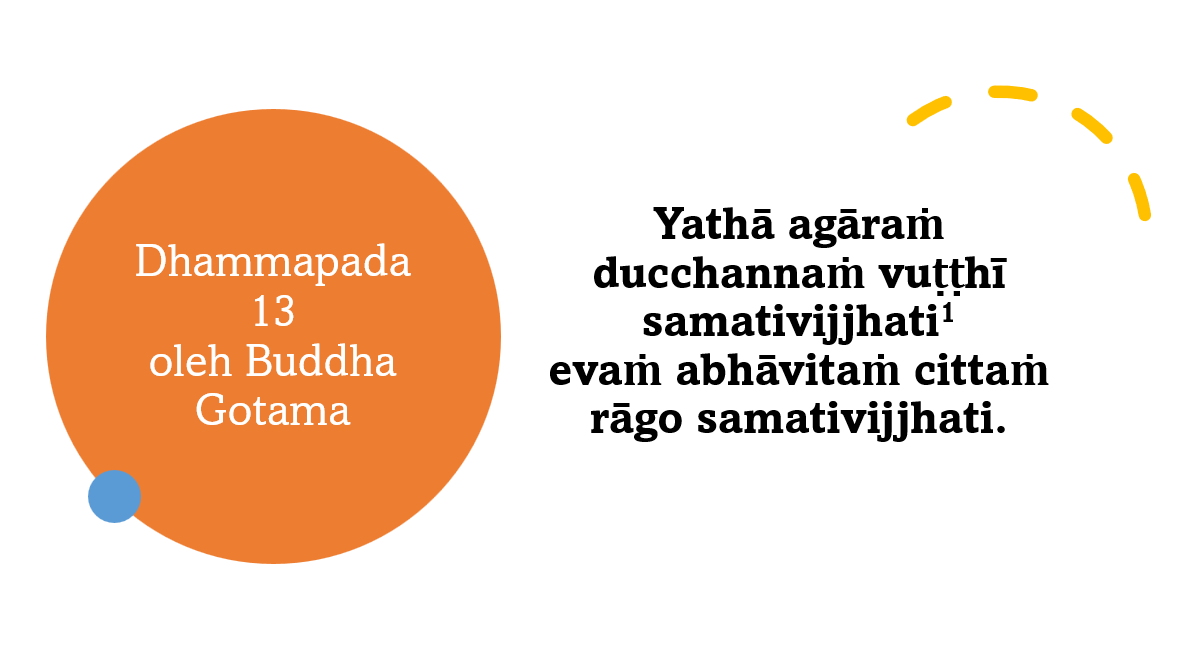
Dhammapada 13

Yamaka Vagga


Vocabulary
tathā: (adv.) as, how, like;
agāra: (a) house; (b) derived from agāra (nt.) + -ṁ, an acc. nt. suffix
ducchanna: (a) (sg. nt.acc) poorly thatched; (b) derived from ducchanna (adj.), derived from du (antithetic pf.) ‘bad, insufficient’ + past.part. of √chad ‘to cover’ + – ṁ, an acc. nt. suffix
vuṭṭhi: (sg. fem.nom.) rain
evaṁ: (adv. thus, so, in this way, likewise, either referring to what follows or what precedes
abhāvita: bhāveti (3rd pers. sg. pres. indic. caus. of √bhū ‘to be’ = produces, cultivates, develops; bhāvita (adj. past.part. of bhāveti) developed; a- (neg. pf.) + bhāvita = abhāvita (adj.) = undeveloped. abhāvita (sg. nt. acc.) = un-developed
citta: citta (nt.) = mind; citta (sg. acc.) = mind
rāgo: rāga (masc. derived from √raj ‘ colour) = passion; rāgo (sg. nom.) = passion

Grammar

1samativijjhati (3rd pers. sg. pres. act. indic.), derived from sa* (adj. pf. implying conjunction and completeness) + ati-
(pf.) ‘extremely’ + √vidh ‘to pierce’ = penetrates

* saṁ- or saṃ-, an indeclinable prefix to verbal roots:* (1) implying a conjunction, e.g., with, together;’ (2) denoting (i) ’completeness,’  (opposite vi-):
(a)Duroiselle (1915/1997:14, No. 38) writes that the niggahīta when followed by a consonant may remain unchanged.
Examples:
     (x) ta dhamma kata; (ii) ta khaa; (iii) ta patto
(b) Nasal-nasal: a nasal consonant (ń, ñ, ṇ, n, or m) followed by another nasal consonant, is assimilated to the latter: saṁ-nisīdati > sannisīdati ‘he sinks down’ (Perniola, 2001:23, No.15(a);
a.1sam-: (a) before a labial (b, bh, m, p, or ph) [(i) thus forming nasal-nasal (Perniola, idem.) (ii) niggahīta, followed by a consonant, may be transformed into the nasal of the class to which that consonant belongs (Duroiselle, idem., p. 14, No.39)]: Sambuddha (saṁ- + buddha,*), sampajāna ‘attentive, thoughtful, mindful, deliberate’ (sa + pajāna ‘understanding, distinguishing’)
(b) before a vowel: samativijjhati, derived from saṁ– +ativijjhati ‘(it) penetrates,’ samacchati ‘(she, she, or it, or one) sits together,’ derived from saṁ- + acchati ‘(she, he, it or one) sits
*Sambuddha: (a) saṁ- + buddha, which is derived from budh ‘to enlighten’ + -ta (a past participle suffix; if formed from a transitive verb, it makes a passive meaning ; otherwise, it forms an active meaning) = budhta > buddha ‘enlightened.’ This is as written by Perniola [idem., p. 17, No.13(a)] that when  two mute consonants come together, the first is assimilated to the second since both are of the same strength:
yuj-ta > yutta ‘joined’
 mad-ta > matta ‘intoxicated’
tadkāro > takkāro ‘he who does that’
sat-puriso > sappuriso ‘good man.’
The consonant t, however, preceded by one of the soft aspirate consonants gh, dh, or bh, is first shortened to d and then assimilation takes place:
labh-tum > labh-dum > laddhum ‘to bobtain’
lubh-ta > lubhda > luddha ‘greedy’
budh-ta > budh-da > buddha ‘enlightened ;’
(b) Duroiselle (ibid.,p 18, No.63) writes that   when initial t follows a sonant aspirate (gh, jh, ḍh, dh, or bh),  the assimilation is progressive: the final sonant aspirate loses its aspiration, the following t (surd) becomes sonant, viz. d, and, taking the aspiration which the final sonant has lost, becomes dh:
EXAMPLE:
√rudh+ta=rudh+da=rud+dha=ruddha
a.2saṁ– before (i) a surd (or sibilant)  (s), labial (b, bh, m, p, or ph), or glide (or semi-vowel) (y,* or v):, e.g., saṁsara, Saṁbuddha,* saṁyojana,b saṁyutta;b

Remark: In the case of final bh, initial t having become dh, regressive assimilation takes place: √labh + ta = labh + da = lab + dha = laddha ‘(having) taken, obtained, received;’ (labhati ‘obtains, takes, receives’)
a.2.1 by assimilation, also san– before a dental (d, dh, t, th, or n), e.g., santapeti, sandahati;
a.3saṅ– or saṇ: (a) before a guttural (or velar) (k, kh, g, gh, and ṅ) or aspirate (h), e.g.,  (i)saṅgha ‘assembly, community, brotherhood, sisterhood, order, or a chapter of a certain Buddhist order, or a certain number of monks;’  (ii) saṅkhāra, saṅkhata, asaṅkheyya; (iii) saha ‘smooth, gentle, mild,’ (Andersen, 1907/2020:253); saheti ‘to brush down’ (Davids & Stede 1921-1925/2005, Part VII, p.131);’ (b) before retroflex, or cerebral:,h, ṭ, ṭh, or : saṁ+hiṭṭhati > saṇṭhiṭṭhati ‘stands;’ saṁ+hānaṁ > saṇṭhānaṁ ‘position’ (called as assimilation or adaptation by Perniola, 1997:14, No. 11(b)]
a.4sañ- (i) before a palatal (c, ch, j, jh, or ñ), e.g., sañcarati [also found in Perniola, 1997:14, No.11(b)], sañchidati ‘to cut, ‘to destroy,’ sañjāti ‘birth, origin, outcome;’ sañjagghati ‘to joke,’ sañña ‘perception,’ viññū ‘intelligent, wise, learned, knowledgable;’ (ii) before a word beginning with e and the  ñ, the initial e changes into ññ: ta+eva= taññeva, paccantaraṁ+eva= paccantaraññeva; (iii) before a word beginning with h: eva hi kho= evañhi kho, ta+hitassa= tañhitassa (Duroiselle,1915/1997:14, No.40) [see also a.3(iii)];
a.5(i)sal- before the liquids l, ļ or ļh, e.g., sallakhetti ‘to observe,’ sallapati ‘to talk with;’ sa-before the liquid r, sometimes sā-, e.g., sāratta, sārambha (Davids & Stede 1921-1925/2005, Part IV:114,  Geiger & Norman, 2005, § 74.3, & the present author’s  own research);
(ii) Before initial l, the niggahīta of sa and pu is changed to l:
(i) saṁ+lakkhaṇā=sallakkhaṇā; (ii) paṭi saṁ līno=paṭisallīno; (iii) saṁ+lekko=sallekho (Duroiselle, 1915/1997:14, No.39); (iv) puṁ+ligaṁ=pulligaṁ (idem., No.39);
a.6 Duroiselle( idem., No.39) writes that the niggahīta, when followed by a consonant, may be transformed into the nasal of the class to which that consonant belongs.
EXAMPLES with (the explanatory notes in the parentheses being added by the present author):
(xli) raṇaṁ+jaho=ranañjaho (ñ belongs to the guttural (or velar) consonant class or group, consisting of g, gh, k, kh, and ń);
(xlii) taṇhaṁ+karo=taṇhańkaro;
(xliii) saṁ+ṭhito=saṇṭhito (ṇ belongs to the cerebral or retroflex) consonant class or group, consisting of ṭ, th, ḍ, ḍh, and ṇ);
(xliv) jutiṁ+dharo=jutindharo (n belongs to the dental consonant class or group, consisting of d, dh, t, th, and n);
(xlv) saṁ+mato=sammato (m belongs to the (bi-)labial consonant class or group, consisting of b, bh, p, ph, and m);
(xlvi) evaṁ+kho=evań kho [see (i)];
(xlvii) dhammaṁ+ca=dhammañca (ñ belongs to the palatal consonant class or group, consisting of c, ch, j, jh, and ñ);
(xlviii) taṁ+niccutaṁ=taññiccutaṁ;

–Iklan–


Untuk informasi lebih lanjut tentang manfaat dan pentingnya fang sheng, silakan klik: https://www.buddha-gotama.com/2023/06/28/buah-lebat-fang-sheng-pengikisan-kilesa/

bsaṁ- + yogo: the niggahīta following y is assimilated into the y, and both together may become ññ: saññogo
saṁ- + yutta: saññutta
Often, no coalescence takes place, and both letters remain unchanged:
saṁyuttaṁ, saṁyojanaṁ (Duroiselle, 1915/1997:14, No.41).

Examples taken by the present author from the other stanzas of the Dhammapada:
31: saṁyojanaṁ >saññojanaṁ
37: saṁyamessanti > saññamessanti

*(Davids & Stede 1921-1925/2005, Part IV:114,  Geiger & Norman, 2005, § 74.3, & Tjan’s own research)

Davids & Stede (ibid.) writes that saṁ- (or sa) is the second most frequently (16%) used prefix in Pali after vi- (19%).

Davids & Stede (ibid.) writes that saṁ- (or saṁ-) is the second most frequently (16%) used prefix in Pali after vi- (19%).

English 1:
Ānandajoti

English 2:
Burlingame

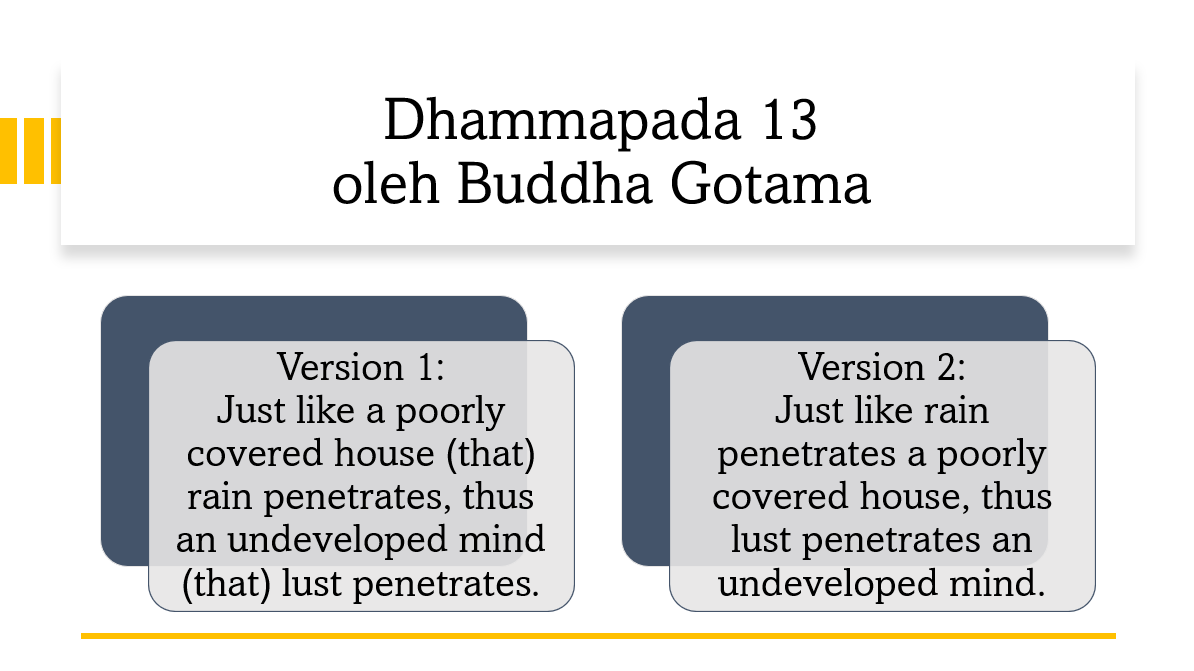
Just as the rain can penetrate
a house with thatching that is poor,
so also passion penetrates
a mind that is undeveloped.

Even as rain breaks through an ill-thatched house. So lust breaks through an ill-trained mind.

Indonesia:
CDD

Indonesia:
YDD

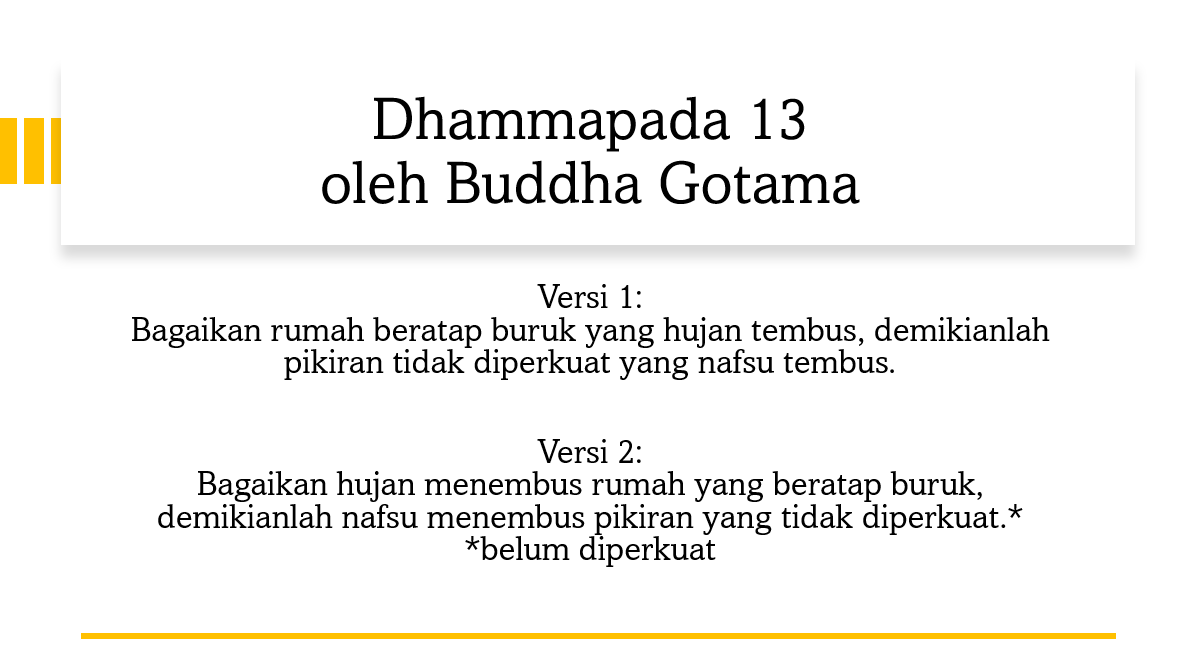
Bagaikan (air) hujan yang merembes sebuah rumah yang beratap buruk, demikianlah nafsu indera merasuk pikiran yang tidak dikembangkan.

Seperti air hujan yang menetes menembus atap jerami yang jarang, demikianlah nafsu keinginan menembus batin yang rapuh (tidak terlatih)

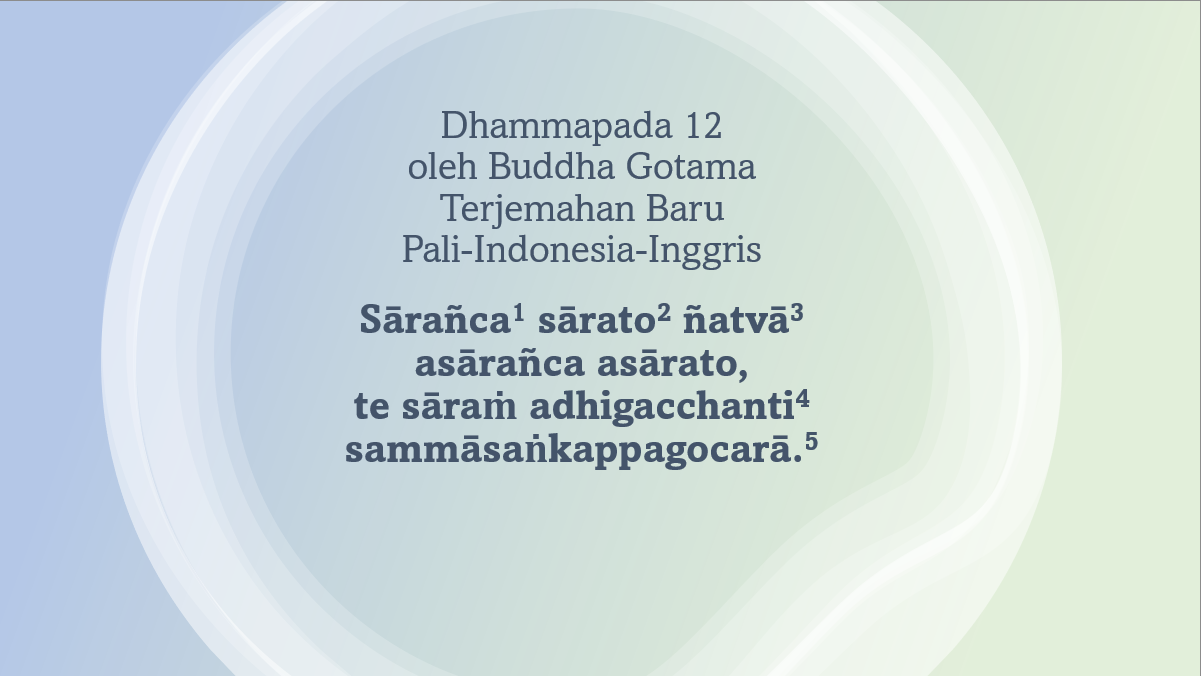
Dhammapada 12

Yamaka Vagga


Vocabulary 1
Vocabulary 2
sārañca: (a) euphonic combination of (sg acc. nt.) sāraṁ ‘truth, right view, substance’ + ca ‘and;’ (b) sāraṁ is the sg. nom. and acc. of sāra (nt.) ‘substance, truth’
sārato: (a) (adv., dat.) from right view, from truth, from essence; (b) derived from sāra (nt.) ‘right view, truth, essence;’ (c) as the substance (Sarao, 2009:15)
ñatvā (absol. of √ña ‘to know’ = having known, after knowing
asārañca: (i) sāra (nt.) = substance, a- (neg. pf.) + sāra= asāra; (ii) wrong view (nt.) substanceless; ca (indef. encl. part.) = and; asārañ + ca = asārañca
asārato: (i) sāra (nt.) = substance. a (neg. pf.) + sāra = asārato (adv.) = as the substanceless; (ii) from wrong view;
te: (masc. nom. pl. of  demonstr. pron. ta ‘it, that’ = they.
sāraṁ: (a) (nt. acc.) truth, lit. substance, essence; (b) formed from sāra ‘truth, lit. substance, essence’ + (an acc. suffix of sg. nt.)
adhigacchanti: 3rd. pl. pres. act. indic. derived from adhi (pf.) ‘towards’ + √gam ‘ go’ = get, discover
sammāsakappagocarā: (a) holding right thoughts

Grammar:

1sārañca: (a) euphonic combination of (sg acc. nt.) sāraṁ ‘essence, substance, truth’ + (indef. encl. part.) ca ‘and;’ b) sāraṁ is the sg. nom. and acc. of sāra (nt.) ‘essence, substance, truth;’ (c) the niggahīta in sāraṁ is changed into which ñ, which is the nasal which belongs to the class of the initial palatal consonant c in ca, as written by:
Tilbe (1899:10-11) that when niggahīta () meets either a vowel or consonant, the group may remain intact;a.2 niggahīta may be elided; a vowel following niggahīta may be elided; or one of the following changes may occur (with the examples in the parentheses given by the present author):
(1) niggahīta preceding a vowel generally changes to m;.a.1 or if the vowel is e, the group changes to ññ;a4(ii)
(2) niggahīta followed by a mute [mute sonants: (i) gutturals: g, gh; (ii) palatals: j, jh; (iii) linguals (or retroflex): ḍ,h; (iv) dentals: d, dh, (v) labials: b, bh; (vi) liquids:a.5 y, r, ļ, v; (vii) aspirant: h)] is generally changed to the nasal (ń, ñ, ṇ, n, or m) of the class (guttural: ń,a.3 palatal: ñ,1.4 lingual (or retroflex):, dental: n; or labial: m) to which the mute belongs;a
(3) when niggahīta is followed by y, the group may become ññ;b or
(4) when niggahīta precedes h, it may change to ñ.a.3(iii)

asaṁ- or saṃ-, an indeclinable prefix to verbal roots:* (1) implying a conjunction, e.g., with, together;’ (2) denoting (i) ’completeness,’  (opposite vi-):
(a)Duroiselle (1915/1997:14, No. 38) writes that the niggahīta when followed by a consonant may remain unchanged.
Examples:
     (ix) ta dhamma kata; (ii) ta khaa; (iii) ta patto
     (m) Nasal-nasal: a nasal consonant (ń, ñ, ṇ, n, or m) followed by another nasal consonant, is assimilated to the latter: saṁ-nisīdati > sannisīdati ‘he sinks down’ (Perniola, 2001:23, No.15(a);

a.1sam-: (a) before a labial (b, bh, m, p, or ph) [(i) thus forming nasal-nasal (Perniola, idem.) (ii) niggahīta, followed by a consonant, may be transformed into the nasal of the class to which that consonant belongs (Duroiselle, idem., p. 14, No.39)]: Sambuddha (saṁ- + buddha,*), sampajāna ‘attentive, thoughtful, mindful, deliberate’ (sa + pajāna ‘understanding, distinguishing’)

–Iklan–


(b) before a vowel: samativijjhati, derived from saṁ– +ativijjhati ‘(it) penetrates,’ samacchati ‘(she, she, or it, or one) sits together,’ derived from saṁ- + acchati ‘(she, he, it or one) sits

*Sambuddha: (a) saṁ- + buddha, which is derived from budh ‘to enlighten’ + -ta (a past participle suffix; if formed from a transitive verb, it makes a passive meaning ; otherwise, it forms an active meaning) = budhta > buddha ‘enlightened.’ This is as written by Perniola [idem., p. 17, No.13(a)] that when  two mute consonants come together, the first is assimilated to the second since both are of the same strength:
yuj-ta > yutta ‘joined’
 mad-ta > matta ‘intoxicated’
tadkāro > takkāro ‘he who does that’
sat-puriso > sappuriso ‘good man.’

The consonant t, however, preceded by one of the soft aspirate consonants gh, dh, or bh, is first shortened to d and then assimilation takes place:
labh-tum > labh-dum > laddhum ‘to bobtain’
lubh-ta > lubhda > luddha ‘greedy’
budh-ta > budh-da > buddha ‘enlightened ;’

(b) Duroiselle (ibid.,p 18, No.63) writes that   when initial t follows a sonant aspirate (gh, jh, ḍh, dh, or bh),  the assimilation is progressive: the final sonant aspirate loses its aspiration, the following t (surd) becomes sonant, viz. d, and, taking the aspiration which the final sonant has lost, becomes dh:

EXAMPLE:

√rudh+ta=rudh+da=rud+dha=ruddha

a.2saṁ– before (i) a surd (or sibilant)  (s), labial (b, bh, m, p, or ph), or glide (or semi-vowel) (y,* or v):, e.g., saṁsara, Saṁbuddha,* saṁyojana,b saṁyutta;b

Remark: In the case of final bh, initial t having become dh, regressive assimilation takes place: √labh + ta = labh + da = lab + dha = laddha ‘(having) taken, obtained, received;’ (labhati ‘obtains, takes, receives’)
a.2.1 by assimilation, also san– before a dental (d, dh, t, th, or n), e.g., santapeti, sandahati;
a.3saṅ– or saṇ: (a) before a guttural (or velar) (k, kh, g, gh, and ṅ) or aspirate (h), e.g.,  (i)saṅgha ‘assembly, community, brotherhood, sisterhood, order, or a chapter of a certain Buddhist order, or a certain number of monks;’  (ii) saṅkhāra, saṅkhata, asaṅkheyya; (iii) saha ‘smooth, gentle, mild,’ (Andersen, 1907/2020:253); saheti ‘to brush down’ (Davids & Stede 1921-1925/2005, Part VII, p.131);’ (b) before retroflex, or cerebral:,h, ṭ, ṭh, or : saṁ+hiṭṭhati > saṇṭhiṭṭhati ‘stands;’ saṁ+hānaṁ > saṇṭhānaṁ ‘position’ (called as assimilation or adaptation by Perniola, 1997:14, No. 11(b)]
a.4sañ-: (i) before a palatal (c, ch, j, jh, or ñ), e.g., sañcarati [also found in Perniola, 1997:14, No.11(b)], sañchidati ‘to cut, ‘to destroy,’ sañjāti ‘birth, origin, outcome;’ sañjagghati ‘to joke,’ sañña ‘perception,’ viññū ‘intelligent, wise, learned, knowledgable;’ (ii) before a word beginning with e and the  ñ, the initial e changes into ññ: ta+eva= taññeva, paccantaraṁ+eva= paccantaraññeva; (iii) before a word beginning with h: eva hi kho= evañhi kho, ta+hitassa= tañhitassa (Duroiselle,1915/1997:14, No.40) [see also a.3(iii)];
a.5(i)sal– before the liquids l, ļ or ļh, e.g., sallakhetti ‘to observe,’ sallapati ‘to talk with;’ sa-before the liquid r, sometimes sā-, e.g., sāratta, sārambha (Davids & Stede 1921-1925/2005, Part IV:114,  Geiger & Norman, 2005, § 74.3, & the present author’s  own research);
(ii) Before initial l, the niggahīta of sa and pu is changed to l:
(i) saṁ+lakkhaṇā=sallakkhaṇā; (ii) paṭi saṁ līno=paṭisallīno; (iii) saṁ+lekko=sallekho (Duroiselle, 1915/1997:14, No.39); (iv)
puṁ+ligaṁ=pulligaṁ (idem., No.39);
a.6 Duroiselle( idem., No.39) writes that the niggahīta, when followed by a consonant, may be transformed into the nasal of the class to which that consonant belongs.
EXAMPLES with (the explanatory notes in the parentheses being added by the present author):
(xxxiii) raṇaṁ+jaho=ranañjaho (ñ belongs to the guttural (or velar) consonant class or group, consisting of g, gh, k, kh, and ń);
(xxxiv) taṇhaṁ+karo=taṇhańkaro;
(xxxv) saṁ+ṭhito=saṇṭhito (ṇ belongs to the cerebral or retroflex) consonant class or group, consisting of ṭ, th, ḍ, ḍh, and ṇ);
(xxxvi) jutiṁ+dharo=jutindharo (n belongs to the dental consonant class or group, consisting of d, dh, t, th, and n);
(xxxvii) saṁ+mato=sammato (m belongs to the (bi-)labial consonant class or group, consisting of b, bh, p, ph, and m);
(xxxviii) evaṁ+kho=evań kho [see (i)];
(xxxix)dhammaṁ+ca=dhammañca (ñ belongs to the palatal consonant class or group, consisting of c, ch, j, jh, and ñ);
(xl) taṁ+niccutaṁ=taññiccutaṁ;

bsaṁ- + yogo: the niggahīta following y is assimilated into the y, and both together may become ññ: saññogo
saṁ- + yutta: saññutta
Often, no coalescence takes place, and both letters remain unchanged:
saṁyuttaṁ, saṁyojanaṁ (Duroiselle, 1915/1997:14, No.41).

Examples taken by the present author from the other stanzas of the Dhammapada:
31: saṁyojanaṁ >saññojanaṁ
37: saṁyamessanti > saññamessanti

*(Davids & Stede, 1921-1925/2005, Part IV:114,  Geiger & Norman, 2005, § 74.3, & Tjan’s own research)

Davids & Stede (ibid.) writes that saṁ- (or sa) is the second most frequently (16%) used prefix in Pali after vi- (19%).

2sarato: (a) (adv., dat.) from right view, from truth, from essence; (b) derived from sāra (nt.) ‘right view, truth, essence;’ (c) as the substance (Sarao, 2009:15); (d)
an optional form of sārantassa ‘from, for, or of, one who has right view,’ which is an ablative case and also a genitive case of a noun or adjective ending in -a; the entire suffix -ntu and the inflection endings -sa, -smi, and nā, are changed to -to, -ti, and tā, respectively. Examples: gunavantassa > gunavato ‘of or for one who has virtue; gunavantu+-smiṁ > gunavati ‘in one who has virtue;’ gunavantu+ -nā > gunavatā (Kaccayana, § 127.102)

4te sāraṁ adhigacchanti: (a) they discover (or encounter) truth (or essence); (b) a general word order of a Pali full sentence: te ‘they,’ the subject, nominative of so ‘he’ + sāraṁ ‘truth, essence,’ the object, or accusative of sāra ‘truth, essence,’ + adhigacchanti, pl. 3rd. pers. act. pres. active indic. voice of adhigaccha ‘to come into possession of, to acquire, discover, to attain, (fig.) to understand’ + -nti, 3rd. pers. pl. personal ending (Duroiselle, 1915/1997:86, 1st conjugation, No. 381); (c) adhigaccha is derived from adhi ‘towards, above, over’ + gaccha ‘goes;’ (d) gaccha belongs to irregular bases of the seventh conjugation, as written by Duroiselle (idem, p. 93, No. 404):
404. The roots of the seventh conjugation, as has been remarked above (379), have two bases: one in e and one in aya, which are conjugated exactly like the roots of the third class of the first conjugation (see 393).

Irregular Bases
Some roots form their special bases according to none of the above given rules, and they are in consequence called Irregular.
The principal forms are here given:
Roots                                            Special bases
√gam, to go                                      gaccha
√yam, to restrain                               yaccha
√guh, to hide                                     gūhe
√dhā, to hold                                daha, dhe (391)
√dā, to give                                       dajja
√jā, jan, to be born                            jāya
√pā, to drink                                     piva
√ḍaṁs, to bite                                   ḍasa
√dhmā, to blow                                 dhama
√vyadh (=vadh)                                vadha
√sad, to sit                                       sīda
√ṭhā, to stand                                   tiṭṭhā
√is, to wish                                       iccha
√vad, to speak, say               vajja, vajje, vada, vāde
√mar, to die                             miya, miyya, mara
√gah to take, seize                           gheppa*
√gam, to go                             ghamma, gaggha*
√jir, to gow old, decay                     jiya, jiyya
√dis, das to see                          dakkha, daccha*

*These forms are given by the Saddanīti and the Akhyatapadamālā. They are regularly conjugated like gaccha: ghammāmi, ghammasi ghammati, etc.; ghagghami, ghagghasi ghagghati, etc.; ghammeyya, gagghe, gaggheyya, etc. The bases dakkha and daccha from √da, dis are formed on the false analogy of the future base, which we shall see when treating of the future. Most of the changes noticed above correspond to similar changes which occur in the 1st, 4th and 6th Conjugations of Sanskrit verbs.

5sammāsaṅkappaā: (a)(1) (pl. 3rd. pers. nom.) fig. holding right thoughts; (2) the fig. meaning is derived from the analogy of the construction (i) X-pakata ‘done or made out of X, (ii) X-ja ‘be born of X, (iii) X-nidāna ‘having X as the source of origin,’ (iv) X-vipāka ‘having X as result or fruit,’ (v) X-samudaya ‘having X as the origin, or arising from X, or the origin of X’ (Gair & Karunatillake, 2014:28), but (vi) X-gamin (fem. gaminī) ‘leading to X, going to X,’ (vii) x-jāta ‘having become X’ (idem, p.160), (viii) X-deva ‘having X as god, highly respecting X’ (idem., p.161); (ix) (Davids & Stede (1924:32, Part III) kamāvacara ‘having its province in kāma’

(b) euphonic union, or sandhi, of sammā (3rd. pers. pl. adjective) ‘right, correct’ + sakappa (sg. masc.) ‘thought’ + gocarā ‘(those who are) wandering, roaming, (those cows which are) grazing;’ © gocarā is derived from go (masc.) ‘cow” + carā (pl. adj. and agent noun or doer*) ‘(those who are) walking, wandering, roaming, (lit. those cows which are) grazing’ (action noun) ‘destination, or place, of wandering or roaming or walking, pasture, grazing field, a cow’s grazing,;’ (d) gocarā is 3rd. pl. nom. and adj. of gocara (3rd person. sg. nom. and adj.) ‘(one who is) walking, roaming, wandering, (lit. that cow which is) grazing, roaming.
*Duroiselle (1915/1997:141-142, Nos. 576-578) writes:
(i)         Primary Derivatives (kita)
575. As has been said already Primary Derivatives are formed directly from the roots by means of certain suffixes; these suffixes are called kita suffixes.
576. The kita suffixes are given below in alphabetical order to faciliate reference.
a – (a) (ṇ) (a). By means of this suffix are formed an extremely large number of derivatives, some of which take guṇa and some of which do not. It forms nouns, (substantive and adjective) showing:
1st-action: √pac, to cook+a=pāka, the act of cooking; √caj, to forsake+a=cāga, forsaking, abandonment; √bhaj, to divide+a=bhāga, dividing; √kam, to love+a=kāma, love.
2nd- the doer or agent: √car, to roam+a=cāra and cara, a spy; √har, to take, captivate,+a=hara, the Captivator, a name of Shiva; √kar, to do, make+a=kara, that which does, the hand; also kāra, a doer, maker.
3rd- abstract nouns of action: √kar+a=kara, action, making; √kam to step, proceed+a=kama, step, succession, order; √kamp, to shake+a=kampa, shaking, trembling; √yuj, to join+a=yoga, joining.
4th- It forms adjectives: √kar+a=kāra, doing, making, also kara, causing, making; √car, to walk, roam, cāra, walking, roaming, and also cara, do; √plu, to swim, float+a=plava, swimming, floating.
The student will readily understand that the root may be preceded by any prefix: saṁ+√gam+a=saṅgāma, assembly; pa+√vis, to enter+a=pavesa, entrance; anu+√sar to go, move, walk+a=anusara, following. The same remark applies to all the other suffixes.
577. From the adjectives formed by this suffix (4th), are formed the upapada compounds (552): kammakāro=kammaṁ kāro (kammaṁ karotī’ ti), the doer of the act; kumbhakāro=khumbhaṁ kāro (kumbhaṁ karotī’ti), the maker of the pot, potter.
588. Very similar in nature with the upapada compounds are those compounds which are the names of persons. In our opinion they are purely and simply upapadas, but Kacchāyana has the following rule: “saññāyaṁ a nu” that is, to form a proper name, suffix nu (=ṁ=Accus. case) is added to the 1st member of the compound, which is the direct object of the root which forms the 2nd member and after which the suffix a is added to denote the agent: arindama, the subduer of his enemies=ari, enemy+ṁ (nu)+√dam, to subdue+a. So vessantara, who has crossed over to the merchants, (vessa+ṁ (nu)+√tar, to cross+a); taṇhaṅkara, creating desire=tanhā, desire+ṁ (nu)+kar+a. The name of a Buddha.
It will be seen from the above examples that the 1st member is in the Acc. case and is governed by the 2nd member which is an agent-noun formed by the suffix a.
Remarks: The nouns formed by a are masculine: they form the feminine according to rules (183), and the same applies to the adjectives (197).

English 1:
Burlingame

English 2:
Buddharakhita

They who have rightly discerned the true in its truth and the false in its falsity. They attain the goal of truth and abide in the pasture-ground of right thinking.

Those who know the essential to be essential and the unessential to be unessential, dwelling in right thoughts, do arrive at the essential.

Indonesia 1:
BDG

Indonesia 2:
CDD

Barang siapa menganggap sesuatu yang hakiki sebagai hakiki, sesuatu yang tak hakiki sebagai tak hakiki; mereka yang mempunyai pikiran benar semacam itu niscaya akan memperoleh apa yang hakiki.

Setelah mengetahui dari yang hakiki sebagai hakiki, dan dari yang bukan hakiki sebagai bukan hakiki. Mereka yang bersekutu dengan pikiran benar (seperti itu) akan memahami yang hakiki.

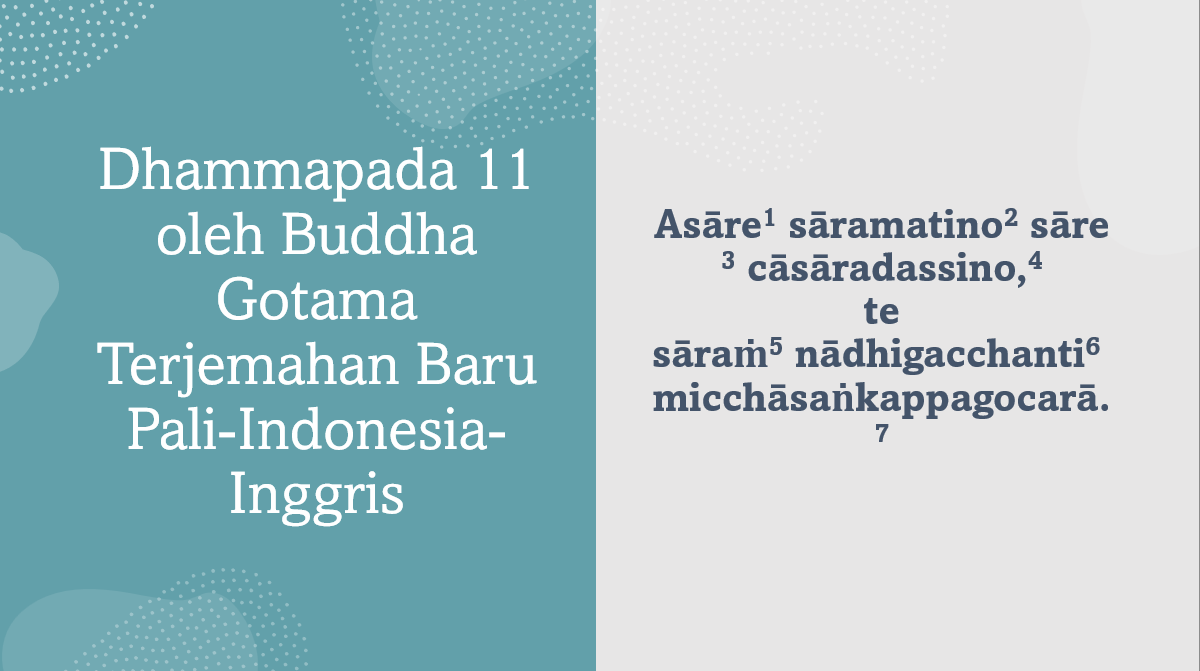
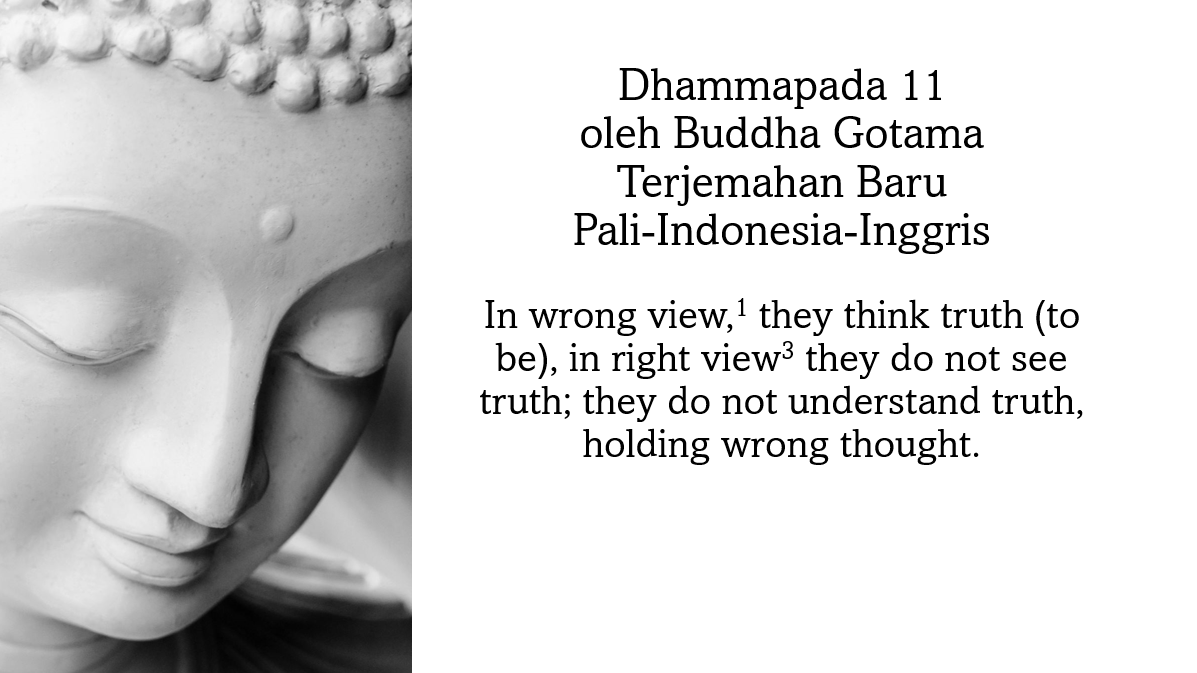
Dhammapada 11

Yamaka Vagga


Vocabulary 1
Vocabulary 2
asāre: in falsehood
sāramatino: (those who are) seeing truth or essence
sāre: in truth, in essence
cāsāradassino:  (a) and (those who are) not seeing truth or essence; (b) euphonic union, or sandhi of, ca ‘and’ + āsāradassino ‘(those who are) not seeing truth or essence’
te sāraṁ nādhigacchanti: they do not acquire, do not come into possession of, do not attain, (fig.) do not understand;
nādhigacchanti: (a) (3rd. pers. pl. act. pres. indic.) do not acquire, do not attain, do not come into possession of , do not acquire, (fig.) do not understand; (b)  euphonic union, or sandhi, of na ‘no, not;’ + adhigacchanti ‘to get to, to come into possession of, to acquire, (fig.) to understand;
micchāsakappagocarā: (pl. nom.) holding  wrong thought; fig. having wrong thought as a pasture

Grammar

1asāre: (a) lit., in  what is not an essence (asāra); (b) according to the Commentary, (in) wrong view (asāra), i.e., untruth (Tin, 1993:5).
2sāramatino: (a) the plural form of the masculine noun saramatī ‘one who imagines finding the essence, which is also an adjective which means  imagining finding the essence;’ (b) Geiger & Norman, 2005, § 83, p.76.5) write that sāramatino is  a result of the mixing-up of –in and –ī inflections  which has also led in the case of the –ī stems to the construction of forms according to the in declension.
Thus, aggino Saddh 585; dummatino Mhv 4.3 (with the analogous form mittadduno); sāramatino Dh.11; vajjamatino Dhp318 ….;
(c) Geiger & Norman (idem, § 95, pp. 87-88) further write:
The declension of substantives and adjectives ending in -in: Stem: hatthin ‘elephant’
(the sequence of cases has been reversed by the present author)

                                      Singular plural       

Singular                                                    Plural

Nom.   hatthī, hatthi                                  hatthī, hatthino

Gen.    hatthissa, hatthino                         hatthinaṁ

Dat.     hatthissa, hatthino                          hatthīnaṁ

Acc.     hatthiṁ, hatthinaṁ                         hatthī, hatthino

Ins.      hatthinā                                          hatthīhi

Abl.      hatthinā, hatthismā, hattimhā        hatthīhi

Loc.     hatthinī, hatthismiṁ, hatthimhi      hatthīsu

Voc.     hatthī                                            hatthī, hatthino 

(d)Duroiselle (1997:45, No.173) writes that there are some masculine nouns whose nominative singular ends in -ī. As a general rule, the masculine nouns of this class are adjectives used substantively; they properly belong to the consonantal declension, and their stems end in -in.

The plural nominative forms of these nouns take the suffix -no, as the those of dandī ‘merchant.’

singular                                                                       plural

sāramatī (stem in) ‘(one) imagining truth’             sāramatino ‘(those) imagining truth’ (11)

asāradassī or āsāradassin ‘(one) not seeing truth’  asāradassino ‘(those) not seeing truth’ (11; cāsāradassino = ca + asāradassino ‘and/but those not seeing truth)

Declension of sāramatī following Duroiselle (idem., p.33, No.136):

Singular                                                    Plural
Nom.   sāramatī                                        sāramatī, sāramatino
Gen.    sāramatissa, sāramatino               sāramatinaṁ
Dat.     sāramatissa, sāramatino               sāramatinaṁ
Acc.     sāramatiṁ, sāramatinaṁ               sāramatī, sāramatino
Ins.      sāramatinā                                     sāramatīhi, sāramatībhi
Abl.      sāramatinā, sāramatismā              sāramatīhi, sāramatībhi
Loc.     sāramatismiṁ, sāramatimhi           sāramatīsu
Voc.     sāramatī                                         sāramatī, sāramatino

3sāre: (a) lit., in the essence; according to the Commentary, (in the) right view, i.e.,(in) truth (Tin, idem.); (b) the locative case of sāra ‘essence, right view, truth.’ See the declension table below.
The declension of sāra, a neuter noun, following Duroiselle (1915/1997:28, No.124)

singular                                                    plural
Nom.  sāraṁ                                 sārāni,(a) & (b) sārā
Gen.   sārassa                              sārānaṁ
Dat.    sārassa, sārāya*                sārānaṁ
Acc.    sāraṁ                                 sārāni, sāre
Ins.     sārena**                             sārehi, sārebhi
Abl.    sārā                                    sārehi,  sārebhi
          sārasmā***
          sāramhā,*** sārato
Loc.     sāre, sārasmiṁ***            sāresu
           sāramhi***
Voc.     sāra(-aṁ***)                     sārāni, sārā

Remarks:
(a) ni is essentially the distinctive sign of neuter nouns in the nom. acc., and voc. plur. in all declensions.
(b) The final vowel of the stem is lengthened before ni.

*sārāya: (1) Perniola (1997:325, No. 259) writes that in Pali only the thematic stems have a true dative case in -āya…. For the rest, Pali uses the genitive and it is under the genitive that are classified the examples which in other languages are considered as datives; (2) Muller, Edward (1884:67) writes that the old dative in -āya is only used to denote the intention, and is almost synonimous with an infinitive; only few instances occur where the dative has a terminating meaning as Dhp. v. 174, saggāya gacchati ‘goes to heaven,” and Dhp. v.311, nirayāya upkaddhati ‘brings to hell’….
(3) Duroiselle (ibid, p.26, No.122) writes that:
(a) The true Dat. sing. in āya has now generally been displaced by the suffix of the gen. ssa; the Dat. āya is almost equal to an lnfinitive and mostly denotes intention.
(c) so is sometimes used also as an Abl. sing. suffix: vaggaso, by groups, bhāgaso, by share.
(d) sā is also found as an Ins. sing. suffix, as: balasā, by force, forcibly, talasā, with the sole of the foot.
(e)Before ehi, ebhi, Ins. and Abl. plur. and e, Acc. plur. , the final a of the stem is dropped: dukkha + ehi = dukkh + ehi = dukkehi
(f)Before su, the Loc. plur., the final a of the stem is changed to e: dukkhesu.

**sārena: (a) by, with, because of truth, essence;’ (b) formed from sāra + -nā, with the elision of the final in sāra and the change of -nā to e  (Kaccayana, idem, p. .., Thitzana trsl) ???

© Following Duroiselle (ibid, p. 8, No.21, & pp. 26-27, Nos. 120123), however, sārena would be derived from sāra + -ina in which the final a in sāra and the initial i in -ina combine to produce e.

Other examples of neuter nouns (Duroiselle, 1915/1997:28, No. 124):
citta, mind                                  sota, ear
mūla, root, price                  veḷuriya, coral
upaṭṭhāna, service                  ahata, cloth (new)
jala, water                              osāna, end
loṇa, salt                                  savana, hearing
vajira, diamond                     sāṭaka, garment
vāta, wind                                  pesana, despatch, sending
yotta, rope                               paṭṭana, a seaport
yuddha, fight                           paṇṇa, leaf

Remarks:
(vii) It will be noticed that neuter nouns in a differ from the masculine in a, in the nom. and in the nom., acc. and voc. plur.; all the other cases are identical.

(b) In the plur. the nom. acc. and voc. have the same form.

(viii) The form in āni, of the , acc. and voc. plur. is the most common.

***-smā and -mhā, and -smiṁ and -mhi:  (a) Mūller, Edward (1884:67-68) writes that in the ablative, the terminations -smā and -mhā, and in the locative, -smim and -mhi, are taken from the pronominal inflection. Besides, we have two other terminations for the ablative, to = skt. tas, and so = ças, which occur mostly in later texts, but also in a few instances in the Jataka and Dhp.v.320: cāpāto ‘from the bow’ ….; (b) Duroiselle (idem., pp. 26-27, No.122) writes that smā and mhā of the Abl. and smiṁ and mhi of the Loc. have been borrowed from the pronominal declension (see Declension of Pronouns); (c) The suffixes -asmā, -amhā, -ebhi, asmiṁ, and -amhi, and the singular vocative sāraṁ are alternate forms which are less common, or generally found in later or commentarial texts rather than in canonical texts (Gair & Karunatillake, 1998/2014:5).

4(i) This parses as ca + asāra + dassino; it is not clear to me why ca is found here, as it is not needed by the grammar, the meaning or the metre (Ānandajoti, www.ancient-buddhist-texts.net); (ii) cāsāradassino is ambiguous as it can be comprised of ca + either ᾱsara+dassino ‘seeing superficiality’ or a- + sradassino ‘not seeing substance’ (Tjan)

5sāram: (i) essence, as in Dhammasāra ‘essence of the Dhamma (Davids & Stede 1923:175); (ii)Truth- According to the Commentary, essence of the Dhamma. The essence of the Dhamma comprises sīla (moral precepts or morality), samādhi (concentation), pañña (knowledge), vimutti (liberation), vimutti-ñaṇadassana (Knowledge of Insight into liberation), paramattha (ultimate truth), and Nibbāna (Tin, 2003:5).

6nādhigacchanti: (a) (3rd. pers. pl. act. pres. indic.) do not acquire, do not attain, do not get to, do not come into possession of, (fig.) do not understand; (b) derived from na ‘no, not’ + adhigacchanti (3rd pl. act. pres. indic.) acquire, attain, get to, come into possession of, (fig.) understand; (c) adhigacchanti: derived from adhi-* (verbal pf.) ‘over, above, on, upon, at, to, in, superior to, great, towards’ + √gachha** ‘to go’ + -nti (a verbal suffix to indicate 3rd. pl. act. pres.indic.)

*(a) Other examples of the usage of the prefix adhi-: adhi- + √vas ‘to live = adhivas ‘to live in, to inhabit;’  adhi- + √bhās ‘to speak = ‘adhibhās’ to speak to, to address; (b) the prefix adhi becomes ajjh before a vowel (Duroiselle, 1915/1997:119, No. 516): adhi-+ agaṁ ‘to go’ = ajjhagaṁ ‘ (I) approach;’ © agaṁ is an example of the radical aorist.

Duroiselle (idem., p.94, Nos. 409-410) writes that this aorist is not very common. We will give a few examples. Let it be first remarked that the aorist may also take the augment a before it, as the does the imperfect.

4.10 from √gam, and √ga and √gu (subsidiary forms of √gam) ‘to go,’ we have:

(a)        Sing.                                      Plur.

  1. agaṁ, agamā, agamiṁ                  agumha
  2. agā, agamā                                 aguttha
  3. agā, agami                              aguṁ, agamixsu

(b) √as, to be (with augment a):

            Sing.       Plur.

  1.      āsiṁ          āsimha
  2.      āsi            āsittha
  3.      āsi           āsuṁ, āsiṁsu

4.11 √ṭhā

            Sing.       Plur.

  1.       aṭṭhaṁ   aṭṭhamha
  2.       aṭṭho    aṭṭhattha

3.       aṭṭha     aṭṭhaṁsu, aṭṭhuṁ

Remarks: For the doubling of initial ṭh, see 33.

4.12 From √kar we find: akaṁ (1st singular), no doubt formed on the analogy of: akā (1st, 2nd and 3rd singular); akā being itself from the Vedic form: akar, the loss of the r is compensated by the lengthening of the final a.

In the 1st singular, we also have: akaraṁ, akariṁ.
In the plural:    2. akattha;       3. akaruṁ, akarū, akariṁsu

4.13 √hū (a form of √bhū) to be.
3rd singular: ahū, ahu, and before a vowel, ahud. 1st plural: ahumhā; 3rd plural: ahuṁ.

4.14 √da

1st singular: adā, which is also 2nd and 3rd singular. In the plural we find: 3rd aduṁ, adaṁsu, adāsuṁ.

4.15 The augment a is not inseparable from the Aorist, so that we meet with such forms as: gā=agā, etc.

**gachha belongs to the irregular bases of the seventh conjugation, as written by Duroiselle (idem, p.93, No. 404):
404. The roots of the seventh conjugation, as has been remarked above (379), have two bases: one in e and one in aya, which are conjugated exactly like the roots of the third class of the first conjugation (see 393).

Irregular Bases

Some roots form their special bases according to none of the above given rules, and they are in consequence called Irregular.
The principal forms are here given:

Roots                                            Special bases

√gam, to go                           gaccha

√yam, to restrain                   yaccha

√guh, to hide                         gūhe

√dhā, to hold                         daha, dhe (391)

√dā, to give                           dajja

√jā, jan, to be born                 jāya

√pā, to drink                           piva

√ḍaṁs, to bite                        ḍasa

√dhmā, to blow                      dhama

√vyadh (=vadh)                      vadha

√sad, to sit                             sīda

√ṭhā, to stand                         tiṭṭhā

√is, to wish                             iccha

√vad, to speak, say                vajja, vajje, vada, vāde

√mar, to die                             miya, miyya, mara

√gah to take, seize                 gheppa*

√gam, to go                             ghamma, gaggha*

√jir, to grow old, decay            jiya, jiyya

√dis, das to see                       dakkha, daccha*

*These forms are given by the Saddanīti and the Akhyatapadamālā. They are regularly conjugated like gaccha: ghammāmi, ghammasi ghammati, etc.; ghagghami, ghagghasi ghagghati, etc.; ghammeyya, gagghe, gaggheyya, etc. The bases dakkha and daccha from √da, dis are formed on the false analogy of the future base, which we shall see when treating of the future. Most of the changes noticed above correspond to similar changes which occur in the 1st, 4th and 6th Conjugations of Sanskrit verbs.

7micchāsakappagocarā: (a)(1) (pl. 3rd. pers. nom.) holding wrong thoughts, fig. having wrong thought as a sphere or pasture; (2) the fig. meaning is derived from the analogy of the construction (i) X-pakata ‘done or made out of X, (ii) X-ja ‘be born of X, (iii) X-nidāna ‘having X as the source of origin,’ (iv) X-vipāka ‘having X as result or fruit,’ (v) X-samudaya ‘having X as the origin, or arising from X, or the origin of X’ (Gair & Karunatillake, 2014:28), but (vi) X-gamin (fem. gaminī) ‘leading to X, going to X,’ (vii) x-jāta ‘having become X’ (idem, p.160), (viii) X-deva ‘having X as god, highly respecting X’ (idem., p.161); (ix) (Davids & Stede (1924:32, Part III) kamāvacara ‘having its province in kāma’

(b) euphonic union, or sandhi, of micchā (3rd. pers. pl. adjective) ‘wrong, erroneous’ + sakappa (masc.) ‘thought’ + gocarā ‘(those who are) wandering, roaming, (those cows which are) grazing;’ © gocarā is derived from go (masc.) ‘cow” + carā (pl. adj. and agent noun or doer*) ‘(those who are) walking, wandering, roaming, (lit. those cows which are) grazing’ (action noun) ‘destination, or place, of wandering or roaming or walking, pasture, grazing field, a cow’s grazing,;’ (d) gocarā is 3rd. pl. nom. and adj. of gocara (3rd person. sg. nom. and adj.) ‘(one who is) walking, roaming, wandering, (lit. that cow which is) grazing, roaming.

*Duroiselle (1915/1997:141-142, Nos.576-578) writes:
(i)         Primary Derivatives (kita)

575. As has been said already Primary Derivatives are formed directly from the roots by means of certain suffixes; these suffixes are called kita suffixes.
576. The kita suffixes are given below in alphabetical order to facilitate reference.
a- (a) (ṇ) (a). By means of this suffix are formed an extremely large number of derivatives, some of which take guṇa and some of which do not. It forms nouns, (substantive and adjective) showing:
1st-action: √pac, to cook+a=pāka, the act of cooking; √caj, to forsake+a=cāga, forsaking, abandonment; √bhaj, to divide+a=bhāga, dividing; √kam, to love+a=kāma, love.
2nd- the doer or agent: √car, to roam+a=cāra and cara, a spy; √har, to take, captivate,+a=hara, the Captivator, a name of Shiva; √kar, to do, make+a=kara, that which does, the hand; also kāra, a doer, maker.
3rd- abstract nouns of action: √kar+a=kara, action, making; √kam to step, proceed+a=kama, step, succession, order; √kamp, to shake+a=kampa, shaking, trembling; √yuj, to join+a=yoga, joining.
4th- It forms adjectives: √kar+a=kāra, doing, making, also kara, causing, making; √car, to walk, roam, cāra, walking, roaming, and also cara, do; √plu, to swim, float+a=plava, swimming, floating.
The student will readily understand that the root may be preceded by any prefix: saṁ+√gam+a=saṅgāma, assembly; pa+√vis, to enter+a=pavesa, entrance; anu+√sar to go, move, walk+a=anusara, following. The same remark applies to all the other suffixes.
577. From the adjectives formed by this suffix (4th), are formed the upapada compounds (552): kammakāro=kammaṁ kāro (kammaṁ karotī’ ti), the doer of the act; kumbhakāro=khumbhaṁ kāro (kumbhaṁ karotī’ti), the maker of the pot, potter.
578. Very similar in nature with the upapada compounds are those compounds which are the names of persons. In our opinion they are purely and simply upapadas, but Kacchāyana has the following rule: “saññāyaṁ a nu” that is, to form a proper name, suffix nu (=ṁ=Accus. case) is added to the 1st member of the compound, which is the direct object of the root which forms the 2nd member and after which the suffix a is added to denote the agent: arindama, the subduer of his enemies=ari, enemy+ṁ (nu)+√dam, to subdue+a. So vessantara, who has crossed over to the merchants, (vessa+ṁ (nu)+√tar, to cross+a); taṇhaṅkara, creating desire=tanhā, desire+ṁ (nu)+kar+a. The name of a Buddha.
It will be seen from the above examples that the 1st member is in the Acc. case and is governed by the 2nd member which is an agent-noun formed by the suffix a.
Remarks: The nouns formed by a are masculine: they form the feminine according to rules (183), and the same applies to the adjectives (197).

English 1:
Carter & Paliwahandana

English 2:
Müller

Those who consider the non-essential as the essential,
And see the essential as the non-essential,
They do not attain the essential,
Being in the pastures of improper intentions.

They who imagine truth in untuth, and see untuth in truth, never arrive at truth, but follow vain desires.

Indonesia 1:
BDG

Indonesia 2:
CDD

Barangsiapa menganggap sesuatu yang tak hakiki sebagai hakiki, dan sebaliknya menganggap tak hakiki sesuatu yang hakiki, mereka yang terpacak pada pikiran keliru semacam ini tidak akan memperoleh apa yang hakiki.

Mereka yang menganggap (sebagai) hakiki pada sesuatu yang bukan hakiki, dan mereka yang melihat (sebagai) bukan hakiki pada sesuatu yang hakiki. Mereka yang bersekutu dengan pikiran keliru (seperti itu) tidak akan memahami sesuatu yang hakiki.

Dhammapada 10

Yamaka Vagga


Vocabulary 1
Vocabulary 2
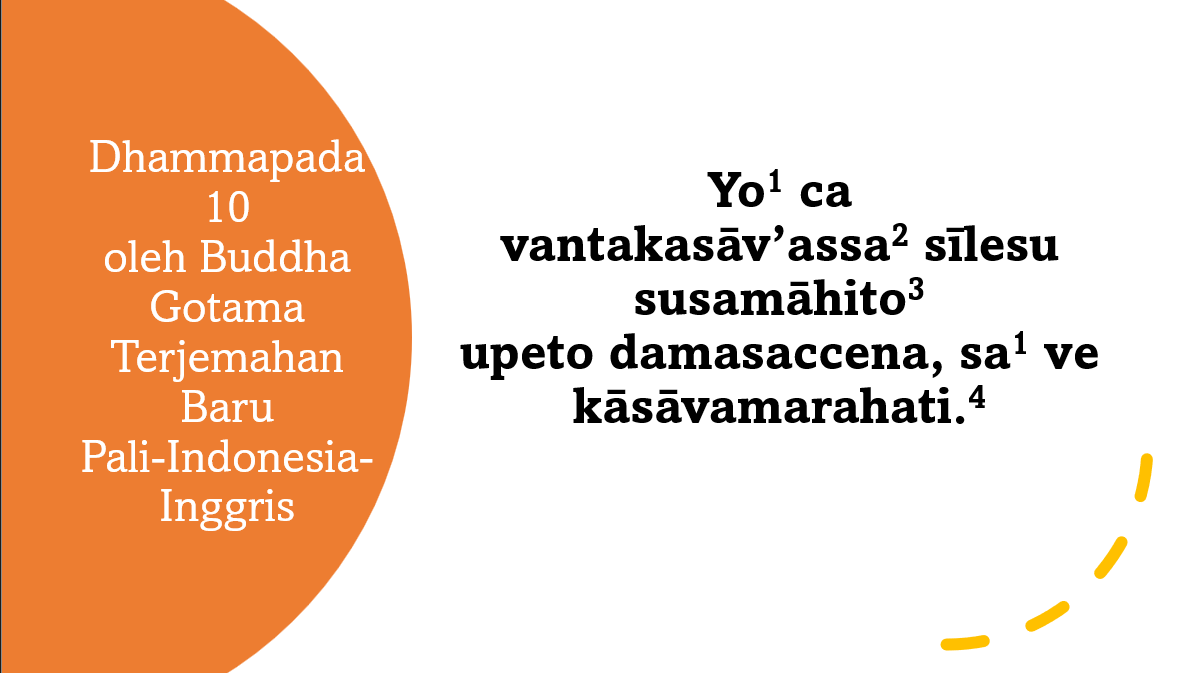
Yo: sg.masc.nom. of the rel. pron. ya ‘he who’ = he who
vantakasāv’assa: vantakasāvo+assa= vantakasāv’assa (euphonic sandhi) = (one who) would/could get rid of defilement;
sīlesu: sīla (nt.) = virtue, sīlesu (loc. pl.) = in virtues
upeto: upata (adj. made of upa (pf. meaning ‘close by, near’ + past part. of √i ‘ go’ = endowed. upeto (masc. nom. sg.) = endowed
damasaccena: dama (nt. derived from √dam ‘to domesticate, to tame’ = restraint; sacca (nt.) = truth; dama+sacca= damasacca (nt.) = restraint and truth; damasaccena (ins. sg.) by restraint and truth
na ( part.) = no, not
so (sg. masc. nom. of the personal pron so ‘he, this, that’ = he
kāsāvamarahati: kāsāva (adj.) = yellow; kāsāva (sg. acc. nt.) = yellow; arahati (3rd pers. sg. pres. act. indic.), derived from √arah ‘to deserve’ = deserves; kāsāva+ arahati = kāsāvamarahati = deserves the yellow (robe)

Grammar:

1(a)(i) the construction with a double pronoun, that is, a relative pronoun (e.g., yo) …, a demonstrative pronoun (e.g., so) …. is typical of a Pali sentence with a relative pronoun phrase acting as the subordinate clause and the main clause following it after a comma (also known as the ya + ta construction); in this construction, the demonstrative pronouns so, sā, and taare used as co-relative pronouns [Duroiselle, 1915/1997:153, No.592(1)]; (ii) The relative clause regularly precedes the main clause. The relative word introduces the clause, but may be preceded by indeclinables connecting the whole sentence to the narrative of which it forms a part (Warder, 1963/2001:71)

2vantakasāv’assa: (a) lit. has vomited all moral defilements; it means has discarded all moral defilements through the four-Path Knowledge (Magga ñāṇa) (Tin, 2003:5); (b) vantakasāv’assa: vantakasāvo+assa= vantakasāv’assa (euphonic sandhi)* = (one who) would get rid of defilement; vanta (adj. past part. of √vam ‘discard’) = vomitted, (fig.) discarded, got rid of, left behind; kasāva (masc.) defilement; vanta + kasāva = vantakasāva (adj.) = (one who has got oneself) rid of defilement; vantakasāvo (sg. masc. gen.) = of (one who has got oneself) rid of defilement; assa (3rd pers. sg. pot. act. of √as ‘ be’ = would be; (c)* vantakasāvo+assa= vantakasāv’assa (a euphonic sandhi):

3susamāhito: (a) susamāhita (adj. derived from su (pf. ‘well, thorough’ + sa* (pf. implying conjunction and completeness) +  ā (pf. denoting a close relationship to the object or the aim of action expressed in the verb) + past part. of √dha ‘ put’ = well-settled; susamāhito (sg. masc. nom.) = well-settled; (b) It is unexpected that the opposite form, sīlesu asamāhito, unsteady in virtue, is not found in the corresponding line in the previous verse (Ānandajoti, www.ancient-buddhist-texts.net).

*saṁ- or saṁ:
saṁ- or saṃ-, an indeclinable prefix to verbal roots:* (1) implying a conjunction, e.g., with, together;’ (2) denoting (i) ’completeness,’  (opposite vi-):
(a)Duroiselle (1915/1997:14, No. 38) writes that the niggahīta when followed by a consonant may remain unchanged.

Examples:

  • ta dhamma kata; (ii) ta khaa; (iii) ta patto

(b) Nasal-nasal: a nasal consonant (ń, ñ, ṇ, n, or m) followed by another nasal consonant, is assimilated to the latter: saṁ-nisīdati > sannisīdati ‘he sinks down’ (Perniola, 2001:23, No.15(a);

a.1sam-: (a) before a labial (b, bh, m, p, or ph) [(i) thus forming nasal-nasal (Perniola, idem.) (ii) niggahīta, followed by a consonant, may be transformed into the nasal of the class to which that consonant belongs (Duroiselle, idem., p. 14, No.39)]: Sambuddha* (saṁ- + buddha), sampajāna ‘attentive, thoughtful, mindful, deliberate’ (sa + pajāna ‘understanding, distinguishing’)

(b) before a vowel: samativijjhati, derived from saṁ– +ativijjhati ‘(it) penetrates,’ samacchati ‘(she, she, or it, or one) sits together,’ derived from saṁ- + acchati ‘(she, he, it or one) sits

*Sambuddha: (a) saṁ- + buddha, which is derived from budh ‘to enlighten’ + -ta (a past participle suffix; if formed from a transitive verb, it makes a passive meaning ; otherwise, it forms an active meaning) = budhta > buddha ‘enlightened.’ This is as written by Perniola [idem., p. 17, No.13(a)] that when  two mute consonants come together, the first is assimilated to the second since both are of the same strength:
yuj-ta > yutta ‘joined’
mad-ta > matta ‘intoxicated’
tadkāro > takkāro ‘he who does that’
sat-puriso > sappuriso ‘good man.’

The consonant t, however, preceded by one of the soft aspirate consonants gh, dh, or bh, is first shortened to d and then assimilation takes place:
labh-tum > labh-dum > laddhum ‘to bobtain’
lubh-ta > lubhda > luddha ‘greedy’
budh-ta > budh-da > buddha ‘enlightened ;’

(b) Duroiselle (ibid.,p 18, No.63) writes that   when initial t follows a sonant aspirate (gh, jh, ḍh, dh, or bh),  the assimilation is progressive: the final sonant aspirate loses its aspiration, the following t (surd) becomes sonant, viz. d, and, taking the aspiration which the final sonant has lost, becomes dh:

EXAMPLE:
√rudh+ta=rudh+da=rud+dha=ruddha

a.2saṁ– before (i) a surd (or sibilant)  (s), labial (b, bh, m, p, or ph), or glide (or semi-vowel) (y,* or v):, e.g., saṁsara, Saṁbuddha,* saṁyojana,b saṁyutta;b

Remark: In the case of final bh, initial t having become dh, regressive assimilation takes place: √labh + ta = labh + da = lab + dha = laddha ‘(having) taken, obtained, received;’ (labhati ‘obtains, takes, receives’)

a.2.1 by assimilation, also san– before a dental (d, dh, t, th, or n), e.g., santapeti, sandahati;

a.3saṅ– or saṇ: (a) before a guttural (or velar) (k, kh, g, gh, and ṅ) or aspirate (h), e.g.,  (i)saṅgha ‘assembly, community, brotherhood, sisterhood, order, or a chapter of a certain Buddhist order, or a certain number of monks;’  (ii) saṅkhāra, saṅkhata, asaṅkheyya; (iii) saha ‘smooth, gentle, mild,’ (Andersen, 1907/2020:253); saheti ‘to brush down’ (Davids & Stede 1921-1925/2005, Part VII, p.131);’ (b) before retroflex, or cerebral:,h, ṭ, ṭh, or : saṁ+hiṭṭhati > saṇṭhiṭṭhati ‘stands;’ saṁ+hānaṁ > saṇṭhānaṁ ‘position’ (called as assimilation or adaptation by Perniola, 1997:14, No. 11(b)]

a.4sañ- (i) before a palatal (c, ch, j, jh, or ñ), e.g., sañcarati [also found in Perniola, 1997:14, No.11(b)], sañchidati ‘to cut, ‘to destroy,’ sañjāti ‘birth, origin, outcome;’ sañjagghati ‘to joke,’ sañña ‘perception,’ viññū ‘intelligent, wise, learned, knowledgable;’ (ii) before a word beginning with e and the  ñ, the initial e changes into ññ: ta+eva= taññeva, paccantaraṁ+eva= paccantaraññeva; (iii) before a word beginning with h: eva hi kho= evañhi kho, ta+hitassa= tañhitassa (Duroiselle,1915/1997:14, No.40) [see also a.3(iii)];

a.5(i)sal- before the liquids l, ļ or ļh, e.g., sallakhetti ‘to observe,’ sallapati ‘to talk with;’ sa-before the liquid r, sometimes sā-, e.g., sāratta, sārambha (Davids & Stede 1921-1925/2005, Part IV:114,  Geiger & Norman, 2005, § 74.3, & the present author’s  own research);

(ii) Before initial l, the niggahīta of sa and pu is changed to l:

(i) saṁ+lakkhaṇā=sallakkhaṇā; (ii) paṭi saṁ līno=paṭisallīno; (iii) saṁ+lekko=sallekho (Duroiselle, 1915/1997:14, No.39); (iv)

puṁ+ligaṁ=pulligaṁ (idem., No.39);

a.6 Duroiselle( idem., No.39) writes that the niggahīta, when followed by a consonant, may be transformed into the nasal of the class to which that consonant belongs.

EXAMPLES with (the explanatory notes in the parentheses being added by the present author):
(xxv) raṇaṁ+jaho=ranañjaho (ñ belongs to the guttural (or velar) consonant class or group, consisting of g, gh, k, kh, and ń);
(xxvi) taṇhaṁ+karo=taṇhańkaro;
(xxvii) saṁ+ṭhito=saṇṭhito (ṇ belongs to the cerebral or retroflex) consonant class or group, consisting of ṭ, th, ḍ, ḍh, and ṇ);
(xxviii) jutiṁ+dharo=jutindharo (n belongs to the dental consonant class or group, consisting of d, dh, t, th, and n);
(xxix) saṁ+mato=sammato (m belongs to the (bi-)labial consonant class or group, consisting of b, bh, p, ph, and m);
(xxx) evaṁ+kho=evań kho [see (i)];
(xxxi) dhammaṁ+ca=dhammañca (ñ belongs to the palatal consonant class or group, consisting of c, ch, j, jh, and ñ);
(xxxii) taṁ+niccutaṁ=taññiccutaṁ;

bsaṁ- + yogo: the niggahīta following y is assimilated into the y, and both together may become ññ: saññogo
saṁ- + yutta: saññutta
Often, no coalescence takes place, and both letters remain unchanged:
saṁyuttaṁ, saṁyojanaṁ (Duroiselle, 1915/1997:14, No.41).

Examples taken by the present author from the other stanzas of the Dhammapada:
31: saṁyojanaṁ >saññojanaṁ
37: saṁyamessanti > saññamessanti

*(Davids & Stede 1921-1925/2005, Part IV:114,  Geiger & Norman, 2005, § 74.3, & Tjan’s own research)

Davids & Stede (ibid.) writes that saṁ- (or sa) is the second most frequently (16%) used prefix in Pali after vi- (19%).

4kasavamarahati: a euphonic combination of kāsāvaṁ+arahati with the niggahīta  in kāsāvabecoming m because it is followed by a vowel, namely, a in arahati (arahati= arhati (Geiger & Norman, 2005:22) (Duroiselle, 1915/1997:15, No.42): taṁ+ atthaṁ= tamatthaṁ; yaṁ+ahu= yamahu; kiṁ+etaṁ= kimetaṁ. Note: sometimes the niggahīta  transforms into d before a vowel, e.g., eta +attho= etadattho,  eta+eva= etadeva, eta +avoca= etadavoca, ya+idam= yadidam (Duroiselle, idem., No. 43).
Duroiselle (ibid.) remarks:
Rules 39 and 42 are not strictly adhered to in texts edited in Roman characters; in proses above all, niggahīta is allowed to remain unchanged before a vowel or consonant, even in the middle of a vowel sometimes; in poetry, the retention of niggahīta or its change to m before a vowel is regulated by the exigencies of the meteres.
Duroiselle (ibid., No. 43) also writes:” Sometimes niggahīta before a vowel may become d: (i) eta+attho= atadattho; (ii) eta+eva+ etadeva; (iii) eta+avoca= etadavoca; (iv) ya+anantara= yadannantaram; (v) ya+idam= yadidam
Duroiselle (ibid, Nos. 44-46) further writes:” Niggahīta  before a vowel or consonant may be elided; niggahīta  may sometimes be inserted before a vowel or consonant; a vowel may be elided after niggahīta.”
(b) Tilbe (1899:10-11) writes that when niggahīta () meets either a vowel or consonant, the group may remain intact; niggahīta may be elided; a vowel following niggahīta may be elided; or one of the following changes may occur (with the examples in the parentheses given by the present author):
(1) niggahīta preceding a vowel generally changes to m;.a.1 or if the vowel is e, the group changes to ññ;a4(ii)
(2) niggahīta followed by a mute [mute sonants: (i) gutturals: g, gh; (ii) palatals: j, jh; (iii) linguals (or retroflex): ḍ,h; (iv) dentals: d, dh, (v) labials: b, bh; (vi) liquids: y, r, ļ, v; (vii) aspirant: h)] is generally changed to the nasal (ń, ñ, ṇ, n, or m) of the class (guttural: ń, palatal: ñ, lingual (or retroflex):, dental: n; or labial: m) to which the mute belongs;a
(3) when niggahīta is followed by y, the group may become ññ;b or
(4) when niggahīta precedes h, it may change to ñ.a.3(iii)

English 1:
Sarada

English 2:
Carter & Paliwahadana

But one who is self-cleansed of stain, in moral conduct firmly set, having restraint and truthfulness is fit for the stainless robe.

But one who, well placed in virtues,
Would be with defilements ejected,
Endowed with control and truth,
That one is worthy of a yellow robe.

Indonesia 1:
CDD

Indonesia 2:
YDD

Namun seseorang yang mampu menyingkirkan semua noda batin, yang teguh dalam aturan moral, yang memiliki pengendalian diri dan kejujuran. Dia sesungguhnya patut menerima jubah kuning.

Tetapi seseorang yang telah terbebas dari kekotoran batin, selalu berbuat baik, penuh pengendalian diri dan memahami Kebenaran, maka ia layak megenakan jubah bhikkhu.

Dhammapada 9

Yamaka Vagga


Vocabulary 1
Vocabulary 2
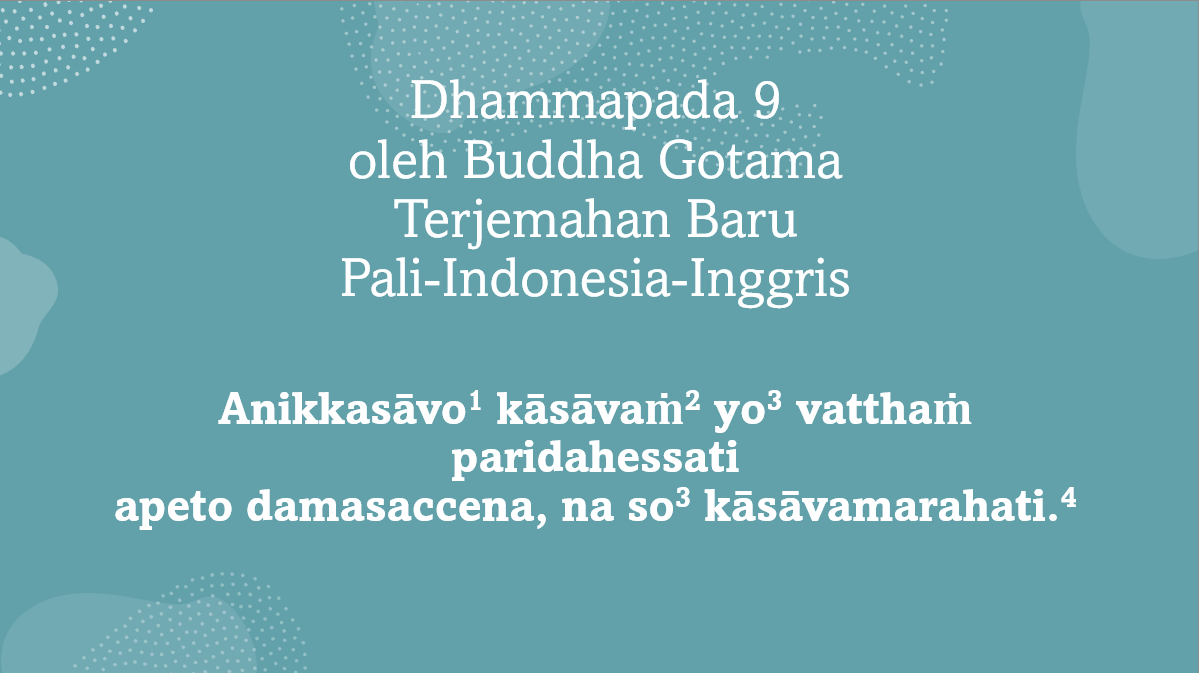
yo (sg.masc.nom. of the rel. pron. ya ‘he who’ = he who
vattha: vattha (nt.) = garment, robe; vattha (sg. acc.) = garment, robe
paridahessati (3rd pers. sg. fut. act. indic. derived from pari (pf. ‘around, complete’ +√dhā ‘put’ = will put on
apeto: apata (adj. & past part. of apeti), comprised of apa  (pf.) ‘away from’ +√i ‘to go’= devoid of, (med. deprived of); apeto (sg. masc. nom.) ‘devoid of’
damasaccena: (a) (inst. nt.) by, with, or of, restraint and truth; (b) euphonic union, or sandhi of damasacca + -nā ‘by, with;’ (c) damsacca: union of dama (nt.) ‘restraint’ + sacca (nt.) ‘truth;’(d) dama: derived from √dam ‘to domesticate, to tame’ + -a, a suffix used to form an action noun from a verb
na ( part.) = no, not
so (sg. masc. nom. of the demonstr. pron ta ‘it, that’ = he
kāsāvamarahati: kāsāva (adj.) = yellow; kāsāva (sg. acc. nt.) = yellow; arahati (3rd pers. sg. pres. act. indic.), derived from √arah ‘to deserve’ = deserves; kāsāva+ arahati = kāsāvamarahati = deserves the yellow (robe)

Pali Grammar

1The form is a double negative, a- ‘not, without, or devoid of’ + ni- ‘without, down’ + kasāva ‘mental defilement,’ not without mental defilement, impure’

2kāsāvaṁ, or kāsāvaṁ vatthaṁ: the yellow or reddish yellow robe donned by members of the Buddhist Religious Order. There is a play on words in the above stanzas; anikkasāvo’ meaning, not free from faults of moral defilements and therefore, stained; and kāsāvaṁ, the yellow robe, dyed somber in some astringent juice and is therefore stained (Tin, 2003:5)

3(a)(i) the construction with a double pronoun, that is, a relative pronoun (e.g., yo) …, a demonstrative pronoun (e.g., so) …. is typical of a Pali sentence with a relative pronoun phrase acting as the subordinate clause and the main clause following it after a comma (also known as the ya + ta construction); in this construction, the demonstrative pronouns so, sā, and taare used as co-relative pronouns [Duroiselle, 1915/1997:153, No.592(1)]; (ii) The relative clause regularly precedes the main clause. The relative word introduces the clause, but may be preceded by indeclinables connecting the whole sentence to the narrative of which it forms a part (Warder, 1963/2001:71)

(b)so: 3rd. pers. masc. sg. ‘he;’ the third person singular so refers to a remote person, and the third person singular ayaṁ refers to an adjacent one; so is also a demonstrative pronoun and used pleonastically; the demonstrative pronoun yo is less frequently used (Tilbe, 1899:102, Nos. 305 & 306)

4kāsāvamarahati: a euphonic combination of kāsāvaṁ+arahati with the niggahīta  in kāsāvaṁ becoming m because it is followed by a vowel, namely, a in arahati (arahati= arhati (Geiger & Norman, 2005:22) (Duroiselle, 1915/1997:15, No.42): taṁ+ atthaṁ= tamatthaṁ; yaṁ+ahu= yamahu; kiṁ+etaṁ= kimetaṁ. Note: sometimes the niggahīta  transforms into d before a vowel, e.g., eta +attho= etadattho,  eta+eva= etadeva, eta +avoca= etadavoca, ya+idam= yadidam (Duroiselle, idem., No. 43).

English 1:
Buddharakhita

English 2:
Tin

Whoever being depraved, devoid of self-control and truthfulness, should* don the monks’ yellow robe, he surely is not worthy the robe.

*In English and Indonesian, this auxiliary verb should not be used, as this stanza refers to what is an eternal, or general, or universal truth [Hands, 2011:208, No. 410; Thomson & martinet, 1986:159, No. 173(A); https://byjus.com/question-answer/give-some-examples-of-universal-truth/]

He who is not free from taints of moral defilements (kilesas) and yet dons the yellow robe, who lacks restraint in his senses and (speaks not the) truth is unworthy of the yellow robe.

Indonesia 1:
BDG

Indonesia 2:
CDD

Barangsiapa belum terbebas dari noda batin, tidak mempunyai pengendalian diri dan kejujuran; ia sesungguhnya taklayak mengenakan jubah kuning.

Seseorang yang belum terbebas dari noda batin yang ingin mengenakan jubah kuning, yang tanpa pengendalian diri dan tanpa kejujuran. Dia sesungguhnya tidak patut menerima jubah kuning.

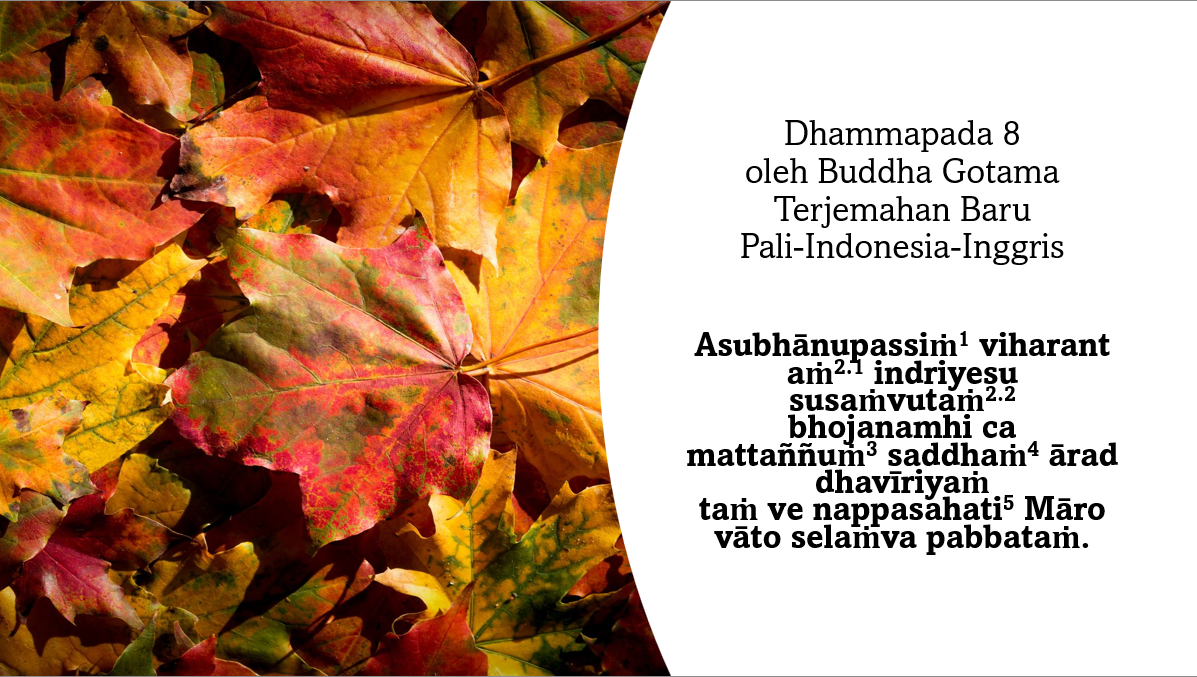
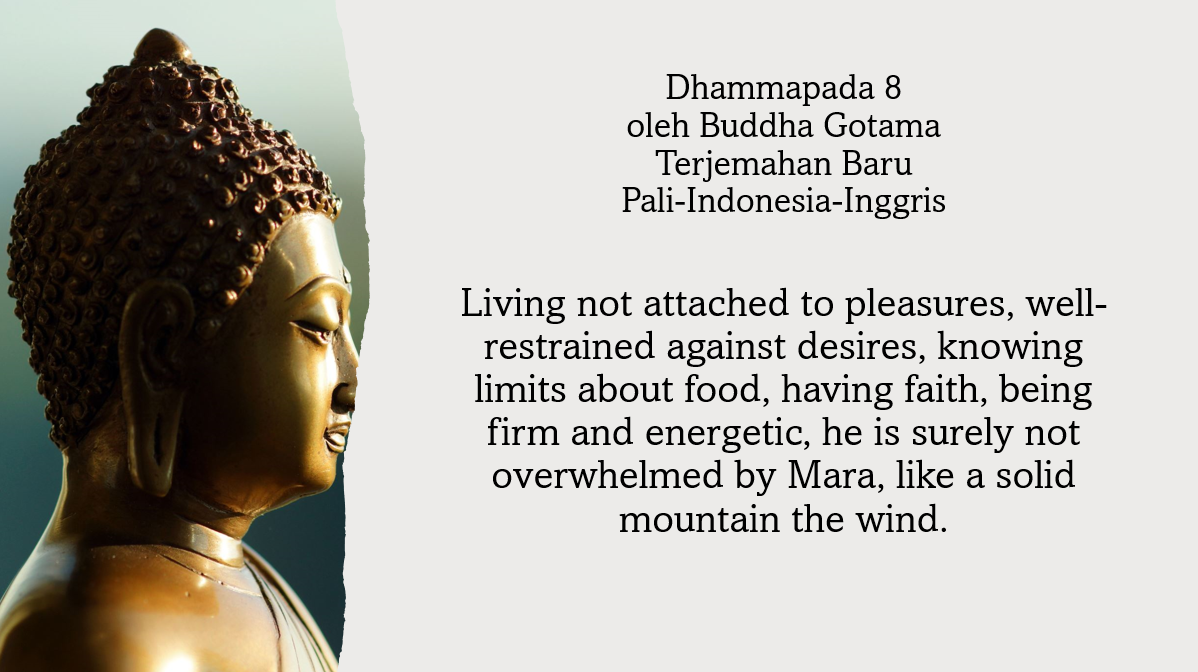
Dhammapada 8

Yamaka Vagga


Vocabulary 1

Vocabulary 2

viharanta: viharati (3rd pers.sg. pres. indic. act. of vi- (pf.  ‘away,’ opposite of the prefix sa) + √har ‘carry’ = lives; viharanta (pres.part. of viharati) = living; viharanta (sg. masc. acc.) = living

indriyesu: indriya (nt.) = sense organ; indriyesu (pl. loc.) = in senses

bhojanamhi: bhojana (nt.) = food; bhojanamhi (sg. loc.) = in food

saddhaṁ: saddha (adj.) = having confidence in, trusting; saddhaṁ (sg. masc. acc.) = having confidence in, trusting

āraddhavīriyaṁ: consisting of āraddha (adj. past part. of ā (pf. denoting a close relationship to the object or the aim of action expressed in the verb) ‘firm, resolved, or resolute+ √rabh ‘to grasp, to take hold of’; viriya (nt.) = energy; āraddhavīriya (adj. here vīriya is m.c. for viriya) energetic, with a firm effort; āraddhavīriyaṁ (sg. masc. acc.) = energetic

taṁ (sg. masc. acc. of the demonstr pron. ta ‘it, that’ = it, that, him

ve ( aff. part. emphasizing the preceding word) = truly, indeed

na-ppasahatī: na ( part.) = no, not. pasahati (3rd pers.sg. pres. indic. act. of pa- ( strengthening pf. often used to emphasize the intensity of an action) +√sah ‘overcome’ = overcomes. pasahatī is m.c. for pasahati; na +pasahatī = na-ppasahatī = cannot overcome

māro: māra (masc.) = Māra, the Evil One. māro (sg. nom.) = Māra

vāto: vāta (masc.) = wind. vāto (sg. nom.) = wind

selaṁ: sela (adj. masc.) = rocky. selaṁ (sg. acc.) = rocky

va (encl.) = like

pabbataṁ: pabbata (masc.) = mountain. pabbataṁ (sg. acc.) = mountain

Pali Grammar

  1. Inseparable Prefixes

1.1 Duroiselle (1915/1997:138) writes

(a) Like du- and su-, the prefix a- (or an before before a vowel) ‘not, without, free from, non,’, e.g., abhāya ‘, safe, free from fear or danger;’ abāla’ clever, not foolish;’ apassanto ‘not seeing;’ anāloketva ‘without looking,’ belongs to the class of inseparable prefixes:

du- and before a vowel dur-, ‘bad, ill, hard difficult,’ e.g. dubbaṇṇo, ugly, ill-favoured; dubbinīto ‘ill-conducted;’ duddamo ‘difficult to tame;’ duggo ‘difficult to pass;’ dujjano ‘a bad man;’ dukkaro ‘difficult to perform;’ dujjīvaṁ ‘a hard life.’

(b) su has the contrary meaning of du :good, well, easy. It implies excess, facility, excellence.

e.g. subhāsito, well-spoken; subahu, very much; sudanto, well-tamed; sukaro, easy to perform; sulabho, easy to be obtained.

Remarks: After du, the initial consonant is generally reduplicated; reduplication seldom takes place after su.

1.1.1 Warder (2014:236) also writes that a consonant is usually doubled after the prefixes u(d) and (dur); similarly the r of ni(r) is assimilated:

du(r) + caritaṁ > duccaritaṁ
u(d) + pajjati > uppajjati
ni(r) + pītika > nippītika
m(r) + yā > niyyā

1asubhānupassi:* (a) not contemplating pleasant things or pleasures, who is not contemplating pleasant things or pleasures; (b) formation: either from (1) the addition of the prefix a- ‘not, no’ to (sg. 3rd pers. masc. acc. adj. and substantive) subhānupassiṁ contemplating pleasant things or pleasures, who is contemplating pleasant things;’ (b) subhānupassiṁ; from subhānupassī ‘(one) contemplating pleasant things;’  + -ṁ, a masc. acc. suffix for a sg. 3rd. person or an adjective modifying a sg. 3rd pers.; (c) subhānupassī: from subhānupass ‘to contemplate pleasant things or pleasures’ + -ī** (producing a masc. noun); (d) subhānupass: from subha ‘pleasant’ + anupass ‘to contemplate,’ with the usual elision or suppression*** of the final a and the lengthening of the initial a (or subh + ānupass); (d) anupass: from anu- (pf.) ‘along, at, on, in, down, to, following, combined with’ +√pass ‘to see;’

*asubhānupassi: (i) ambiguous meanings: either (who is) not contemplating pleasant things or pleasures or (who is) contemplating unpleasant things, because asubha means ‘unpleasant, disgusting;’ (ii) the context decides;
**the new possessive suffix  –ī  or  the old -in  (Geiger & Norman, 2005: § 95, p.88; Duroiselle, 1915/1997:143), sometimes used substantively, as in the present stanza (Duroiselle, ibid.)
*** (i) Duroiselle (1915/1997:7, No. 17) calls it the elision of the final a in subha and the lengthening of the initial a in anupassī; (ii) Clough (1824:14) calls it the suppression of of the final a in subha and the lengthening of the initial a in anupassī; (iii) and (iii) Perniola (1915/1997:8, No.6(a)) calls is contraction. He also writes that when a vowel is in a closed syllable, it cannot be long: lāla+ antare > kālantare.
Sometimes, however, in the formation of compounds, there is a long vowel in a closed syllable: sa-+ attha > sāttha ‘with its meaning;’ sa-+ akhara > sākkhara ‘with its letters.’

–Iklan–


Untuk informasi lebih lanjut tentang manfaat dan pentingnya fang sheng, silahkan klik: https://www.buddha-gotama.com/2023/06/28/buah-lebat-fang-sheng-pengikisan-kilesa/

2.1viharantaṁ: (a) (sg. masc. acc.) living, one who, or what, lives; (b) formed from viharanta (adj. & present participle of the stem vihara ‘to live’ + -ntaṁ; (c) vihara is the stem of viharati ‘(she, he, it, or one) lives,’ which belongs to the verbs of the first class which form their stems by adding the suffix -a to the roots: vihar ‘to live’ + -a; (d) vihar is derived from vi- + ‘away, also denoting the reverse of the simple verb, or loss, difference, opposite, reverse, as expressed in English by un- or dis-,’ + √har ‘to carry.
(Perniola (2004:75, No.62) writes that in the formation of the present stem, the final vowel of the root or a medial short vowel takes the gua grade (strengthening or adapting):
ni-         ‘to lead’       ne-a-ti > nay-a-ti        > nayati
bhu-      ‘to be’         bho-a-ti  > bhav-a-ti   > bhavati
har-      ‘to carry’      har-a-ti                       > harati
mud-    ‘to delight’    mod-a-ti                     > modati

but the vowel -a and any medial vowel which is long either by nature or position remain unchanged:
vah-      ‘to carry’     vah-a-ti                   vahati
jīv-        ‘to live’        jīv-a-ti                      jīvati
hims-    ‘to hurt’       hims-a-ti                 himsati
nind-     ‘to blame’   nind-a-ti                  nindati

In verbs like nayati, bhavati, the groups aya/ava may be contracted to e/o, respectively: nayati > neti; bhavati > bhoti > hoti, with the loss of the consonantal sound ….;

(e) Duroiselle (idem., p.101, No. 446) These participles are conjugated like mahā (226) in the Masculine, Feminine and Neuter. The Present Participle may often be translated by “when …, while …”etc.; (f) Ānandajoti (2016:10) writes that the ending of the sg. masc. accusative case of the present participle parassapada of nt/nta forms is ntaṁ, as in gacchantaṁ, and the ending of the pl. masc. accusative case of the same parassapada is gacchante; hence, the parassapada above is conjugated like a noun ending in -a; (g)(i)Thitzana [in Kaccāyana Pali Grammar, No. 186.107, Volume 2 (2016), translated by Thitzana] writes that the affix -nta* of the word gacchanta etc. sometimes changes into “aṁ” when a si* vibhatti** is applied after them.

See each pairs of examples. Both “aṁ and anto” are shown in bold so that students can easily distinguish between the applied example and inapplicable examples. The second one *marked is inapplicable example:
gacchaṁ, * gacchanto (sg. masc. nom.) = the one who goes, while going
mahaṁ, * mahanto (sg. masc. nom.) = the one  who is great or honorable
caraṁ, * caranto (sg. masc. nom.) = the one who goes, while going
khādaṁ, * khādanto (sg. masc. nom.) = the one who munches, while munching.

Hence, viharantaṁ means (sg. masc. acc.) the one who lives.

*ntasaddo: refers to those nouns affixed with -nta affix. This nta is the last component part of -anta affix applied by Sutta No. 565 which is widely used as a present participle affix for many Kita nouns. Ntasaddo means any noun affixed with -anta but note that the letter “a” is left out in this expression and simply stated as “ntasaddo”. [nta=nta, saddo=word].
**si: a symbol for any inflection to be described as nominative singular; it is not itself one of these inflections (which are very varied, so that no common denomination is apparent). It is as if one were to call it “x, explaining: “where “x” = any inflection described as “nominative singular.” In the case of -ti, this is the actual inflection of the third person singular active indicative present tense  of all verbs. Thus in one sense there is only one “conjugation” of the active indicative present tense  of Pali verbs, since all take the same set of inflections; the seven or eight conjugations distinguished by the grammarians are based on the differences of present stem formation from the roots. On the other hand, there are several “declensions” of nouns, since their inflections vary considerably according to their stems (in -a, -an, -ant, -I, -ar, etc.).

(ii)Declension of vi- + √har- + -nta = viharanta (= the present participle of the stem vihara) for its nominative and accusative cases as an adjective and agent noun or doer:

Cases                  Singular                              plural
Nom.                   viharanto/viharantaṁ            harantā
Acc.                     viharanta                         harante

[formed following Gair & Karunatillake (1998/2014:36)]

(h)Gair & Karunatillake (1998/2014:37) write that one use of the present participle is as an actor verbal noun denoting the doer of the action (or agent noun). In this use, it takes the masculine endings given above, if the doer is masculine, or if gender is unspecified:

evaṁ desento (bhabbo)
‘One who thus preaches (is competent)’

*Gair & Karunatillake (1998/2014:71-72) write that the past participle (sometimes called the perfect or the passive participle) is most commonly formed with one of the two affixes -ta or-na. Of these two, -ta is the most common…. Past participles may also, like the present participle, take gender and number endings to form nouns; in the case of the past participle, the noun will generally refer to the performer of the action (i.e., the subject of the verb) if the verb from which it is formed is intransitive, or the one who has undergone the action, i.e., the object of the verb, if the verb is transitive.* The gender number endings, and their case forms, are those of -a stem masculine and neuter (I, 1.21-2) and -ā stem feminine (11, 1.1) nouns. The form Tathagato (nom.) ‘the thus-gone one,’ used for the Buddha, is an example, being formed from gata, the participle of gacchati.

*For example, √vu means to restrain, a transitive verb; saṁ- + -vu+ -ta = saṁvuta restrained, one who, or what, is or was restrained; the opposite is asaṁvuta ‘unrestrained, one who, or what, is or was unrestrained.’

(This part is also found in the discussion about asavuta below.)

(i)Perniola (1997:282, No.225) writes that in Pali, all the parassapada of the present participle have the suffix -ant, in which the final dental (or t) drops and the -n is changed to niggahīta. The suffix -ant has often been extended with the thematic vowel and thus a new suffix -anta is often used in the formation of the present participle. In fact this suffix is the only one used when the present participle is formed from the stem of the present ending in -e or -o: cintenta, karonta. Hence, vi- + √har + -anta > viharanta, the parassapada of the present participle;

 (j) About the present participle, Duroiselle (idem., p.100, Nos.439-440) writes that (i) all active participles are of the nature of verbal adjectives and must agree with their nouns, in number, gender and case; and (ii) The terminations of the present participle active are nta, a, or ṁ; -nta andare added to the base (or stem), and aṁ is added to the root.

Examples:

Root                     Base     Present. Part.                   Active Base

√pac, to cook,    paca      pacaṁ, pacanta               cooking

√kar, to do,        kara      karaṁ, karonta                doing

√chid, to cut,     chinda   chindaṁ, chindanta       cutting

√bhaṇ, to say,   bhaṇa    bhaṇaṁ, bhaṇanta         saying

√bhū, to be,      bhava    bhavaṁ, bhavanta         being

√pā, to drink,     piva       pivaṁ, pivanta                drinking

2.2indriyesu: (a) (pl. loc.) on, in, or among sense organs; (b) euphonic union, or sandhi of indriya + -su (a pl. loc. nt. suffix), with the final a changing to e, as written by [Duroiselle, idem., p. 27(h)]. Another example: butha ‘being’ + -su > buthesu (see stanza 59).

2.3susaṁvutaṁ: (sg. masc. adj. acc.) ‘well-restrained, one who, or what, is or was well-restrained; (b) union of su- (pf. ‘well, thorough’) + saṁ* (adj.  pf.) ‘denoting conjunction, completeness’ + vuta (past part. of √vu ‘to restrain’) ‘restrained;’

*saṁ- or saṃ-, an indeclinable prefix to verbal roots:* (1) implying a conjunction, e.g., with, together;’ (2) denoting (i) ’completeness,’  (opposite vi-):
(a)Duroiselle (1915/1997:14, No. 38) writes that the niggahīta when followed by a consonant may remain unchanged.

Examples:

(v)     ta dhamma kata; (ii) ta khaa; (iii) ta patto

(b) Nasal-nasal: a nasal consonant (ń, ñ, ṇ, n, or m) followed by another nasal consonant, is assimilated to the latter: saṁ-nisīdati > sannisīdati ‘he sinks down’ (Perniola, 2001:23, No.15(a);

a.1sam-: (a) before a labial (b, bh, m, p, or ph) [(i) thus forming nasal-nasal (Perniola, idem.) (ii) niggahīta, followed by a consonant, may be transformed into the nasal of the class to which that consonant belongs (Duroiselle, idem., p. 14, No.39)]: Sambuddha* (saṁ- + buddha), sampajāna ‘attentive, mindful, thoughtful, deliberate’ (sa + pajāna ‘understanding, distinguishing’)

(b) before a vowel: samativijjhati, derived from saṁ– +ativijjhati ‘(it) penetrates,’ samacchati ‘(she, she, or it, or one) sits together,’ derived from saṁ- + acchati ‘(she, he, it or one) sits

*Sambuddha: (a) saṁ- + buddha, which is derived from budh ‘to enlighten’ + -ta (a past participle suffix; if formed from a transitive verb, it makes a passive meaning ; otherwise, it forms an active meaning) = budhta > buddha ‘enlightened.’ This is as written by Perniola [idem., p. 17, No.13(a)] that when  two mute consonants come together, the first is assimilated to the second since both are of the same strength:
yuj-ta > yutta ‘joined’
mad-ta > matta ‘intoxicated’
tadkāro > takkāro ‘he who does that’
sat-puriso > sappuriso ‘good man.’

The consonant t, however, preceded by one of the soft aspirate consonants gh, dh, or bh, is first shortened to d and then assimilation takes place:
labh-tum > labh-dum > laddhum ‘to bobtain’
lubh-ta > lubhda > luddha ‘greedy’
budh-ta > budh-da > buddha ‘enlightened ;’

(b) Duroiselle (ibid.,p 18, No.63) writes that   when initial t follows a sonant aspirate (gh, jh, ḍh, dh, or bh),  the assimilation is progressive: the final sonant aspirate loses its aspiration, the following t (surd) becomes sonant, viz. d, and, taking the aspiration which the final sonant has lost, becomes dh:

EXAMPLE:
√rudh+ta=rudh+da=rud+dha=ruddha
a.2saṁ– before (i) a surd (or sibilant)  (s), labial (b, bh, m, p, or ph), or glide (or semi-vowel) (y,* or v):, e.g., saṁsara, Saṁbuddha,* saṁyojana,b saṁyutta;b

Remark: In the case of final bh, initial t having become dh, regressive assimilation takes place: √labh + ta = labh + da = lab + dha = laddha ‘(having) taken, obtained, received;’ (labhati ‘obtains, takes, receives’)
a.2.1 by assimilation, also san– before a dental (d, dh, t, th, or n), e.g., santapeti, sandahati;
a.3saṅ– or saṇ: (a) before a guttural (or velar) (k, kh, g, gh, and ṅ) or aspirate (h), e.g.,  (i)saṅgha ‘assembly, community, brotherhood, sisterhood, order, or a chapter of a certain Buddhist order, or a certain number of monks;’  (ii) saṅkhāra, saṅkhata, asaṅkheyya; (iii) saha ‘smooth, gentle, mild,’ (Andersen, 1907/2020:253); saheti ‘to brush down’ (Davids & Stede 1921-1925/2005, Part VII, p.131);’ (b) before retroflex, or cerebral:,h, ṭ, ṭh, or : saṁ+hiṭṭhati > saṇṭhiṭṭhati ‘stands;’ saṁ+hānaṁ > saṇṭhānaṁ ‘position’ (called as assimilation or adaptation by Perniola, 1997:14, No. 11(b)]
a.4sañ- (i) before a palatal (c, ch, j, jh, or ñ), e.g., sañcarati [also found in Perniola, 1997:14, No.11(b)], sañchidati ‘to cut, ‘to destroy,’ sañjāti ‘birth, origin, outcome;’ sañjagghati ‘to joke,’ sañña ‘perception,’ viññū ‘intelligent, wise, learned, knowledgable;’ (ii) before a word beginning with e and the  ñ, the initial e changes into ññ: ta+eva= taññeva, paccantaraṁ+eva= paccantaraññeva; (iii) before a word beginning with h: eva hi kho= evañhi kho, ta+hitassa= tañhitassa (Duroiselle,1915/1997:14, No.40) [see also a.3(iii)];
a.5(i)sal- before the liquids l, ļ or ļh, e.g., sallakhetti ‘to observe,’ sallapati ‘to talk with;’ sa-before the liquid r, sometimes sā-, e.g., sāratta, sārambha (Davids & Stede 1921-1925/2005, Part IV:114,  Geiger & Norman, 2005, § 74.3, & the present author’s  own research);
(ii) Before initial l, the niggahīta of sa and pu is changed to l:
(i) saṁ+lakkhaṇā=sallakkhaṇā; (ii) paṭi saṁ līno=paṭisallīno; (iii) saṁ+lekko=sallekho (Duroiselle, 1915/1997:14, No.39); (iv)
puṁ+ligaṁ=pulligaṁ (idem., No.39);

a.6 Duroiselle( idem., No.39) writes that the niggahīta, when followed by a consonant, may be transformed into the nasal of the class to which that consonant belongs.

EXAMPLES with (the explanatory notes in the parentheses being added by the present author):
(xvii) raṇaṁ+jaho=ranañjaho (ñ belongs to the guttural (or velar) consonant class or group, consisting of g, gh, k, kh, and ń);
(xviii) taṇhaṁ+karo=taṇhańkaro;
(xix) saṁ+ṭhito=saṇṭhito (ṇ belongs to the cerebral or retroflex) consonant class or group, consisting of ṭ, th, ḍ, ḍh, and ṇ);
(xx) jutiṁ+dharo=jutindharo (n belongs to the dental consonant class or group, consisting of d, dh, t, th, and n);
(xxi) saṁ+mato=sammato (m belongs to the (bi-)labial consonant class or group, consisting of b, bh, p, ph, and m);
(xxii) evaṁ+kho=evań kho [see (i)];
(xxiii) dhammaṁ+ca=dhammañca (ñ belongs to the palatal consonant class or group, consisting of c, ch, j, jh, and ñ);
(xxiv) taṁ+niccutaṁ=taññiccutaṁ;

bsaṁ- + yogo: the niggahīta following y is assimilated into the y, and both together may become ññ: saññogo
saṁ- + yutta: saññutta
Often, no coalescence takes place, and both letters remain unchanged:
saṁyuttaṁ, saṁyojanaṁ (Duroiselle, 1915/1997:14, No.41).

Examples taken by the present author from the other stanzas of the Dhammapada:
31: saṁyojanaṁ >saññojanaṁ
37: saṁyamessanti > saññamessanti

*(Davids & Stede 1921-1925/2005, Part IV:114,  Geiger & Norman, 2005, § 74.3, & Tjan’s own research)

Davids & Stede (ibid.) writes that saṁ- (or sa) is the second most frequently (16%) used prefix in Pali after vi- (19%).

3mattaññuṁ: (a) knowing the right measure, i.e., knowing moderation; (b) euphonic union, or sandhi, of mattā (fem.) ‘(right) measure’ [In compounds as in this case, mattā is shortened to matta (Davids & Stede 1921-1925/2005, Part VI, p.141)] 3.1+ ñu (adj.) ‘knowing,’ + -ṁ, a suffix indicating sg. masc. acc., with the doubling of ñ, as written by Duroiselle (idem., p.13, No. 33) that a consonant (in this matter ñ) following a word ening in a vowel (matta) is generally reduplicated, e.g., kata ‘done, what is done’ + ñu = kataññu ‘grateful;’ (c) ñu is the present participle ofña ‘to know;’

3.1 Duroiselle (idem, No.35) also writes that when, according to para (33), a consonant is reduplicated after a particle ending in a long vowel, this vowel is shortened:
ā+kamati=akkamati
parā+kamo=parakkamo

Exceptions: There are, however, a few exceptions to paras 34, 35. The following are the most common examples:
(i) na+añña=nāñña     (ii) na+assa=nāssa
na+assu=nāssu          (iv) kasmā+assa=kasmāssa,
(v) tatra+assa=tatrāssa           (vi) sa+antevāsiko=sāntevāsiko
(vii) sa+atthi=sātthi      (viii)vedanā+khandho=vedanākkhandho, etc.

4saddhaṁ/saddha: According to the Commentary:
unwavering (unshakable) faith in the Buddha, the Dhamma (the Doctrine) and the Saṁgha (the Buddhist Religious Order) and
faith or belief in kamma (action) and its results (Tin, 2003:4).

5The form here does not arise through sandhi; na is so closely associated with the verb it is modifying it becomes part of it, as we see frequently with the negative (Ānandajoti, www.ancient-buddhist-texts.net).

English 1:
Burlingame
English 2:
Buddharakhita
Whoever lives looking not for pleasure, exercising restraint over his senses.


Moderate in his enjoyments, endowed with faith, exerting the power of his will.

Him Māra does not overpower, even as the wind does not overpower a mountain of rock.

Just a strom cannot prevail against a rocky mountain, so Mara can* never overpower the man who lives meditating on the impurities, who is controlled in his senses, moderate in eating, and filled with faith and earnest effort.


*In English and Indonesian, this auxiliary verb should not be used, as this stanza refers to what is an eternal, or general, or universal truth [Hands, 2011:208, No. 410; Thomson & martinet, 1986:159, No. 173(A); https://byjus.com/question-answer/give-some-examples-of-universal-truth/]

Indonesia 1:
BDG
Indonesia 2:
CDD
Ibarat angin yang takmampu merobohkan bukit karang, demikian pula Mara tidak mampu menguasai orang yang tak menjadi budak keindahan, yang inderanya terkendali dengan baik, yang tahu batas dalam makanan, dan yang penuh keyakinan serta sangat bersemangat. Seseorang yang hidupnya tidak mencari kesenangan, yang inderanya terkendali, yang makan secukupnya, yang penuh keyakinan dan bersemangat. Sesungguhnya Māra tidak dapat menumbangkannya bagaikan angin tidak dapat menumbangkan sebuah gunung karang.

Dhammapada 5

Yamaka Vagga

Pali
Na hi verena1 verāni2 sammantīdha3 kudācanaṁ
averena4 ca sammanti
esa5 dhammo sanantano.6
Indonesian: Tjan Sie Tek
Sesungguhnya tidak pernah kebencian di dunia ini diredakan oleh permusuhan melainkan oleh avera.*
Itu** adalah kebenaran/hukum abadi.
*tiga arti sekaligus:  kesabaran, keramahan & tanpa permusuhan (Fronsdal, 2011:97)
**kata ganti anaforis (anaphoric pronoun): kata ganti yang menunjuk kepada seseorang atau ke sesuatu yang disebutkan sebelumnya di dalam sebuah tuturan.
Kata lawannya adalah kata ganti kataforis (cataphoric pronoun), yaitu kata ganti yang menunjuk kepada seseorang atau sesuatu yang (akan) disebutkan atau muncul kemudian. Contohnya adalah kata ia di kalimat yang berikut ini: karena ia rajin, Rudy berhasil dalam karirnya.
English: Tjan Sie Tek
Never is in the world enmity appeased by enmity, but (appeased) by avera.* This is an eternal** truth.
*patience, friendliness & absence of enmity
**This stanza and the one that follows do not form a pair, but seem to have been attracted into the collection at this point by word collocation on vera (Anandajoti www.ancient-buddhist-texts.net).
Vocabulary 1
Vocabulary 2
na: (indec. part.)= no, not.
hi: indeed, surely
verena: with, by, because of, or for, enmity, hostility, hatred;
verāni: (a) enmities, hostilities, hatreds; (b) pl. nt. nom of vera ‘enmity, hostility, hatred’
sammantīdha: (a) in this world calm down, become quiet or silent; (b) euphonic union, or sandhi, of sammanti ‘calm down, become quiet’ + idha (indec. adv.) ‘here, in this world,’ with the elision of the final letter i in sammanti and the lengthening of the initial letter i in idha
kudācanaṁ (indef. adv.) = at any time; na kudācanaṁ = not at any time, never
averena: (a) (sg. ins. nt.) with, by or because of (i) absence of enmity, hostility, or hatred; non-enmity, non-hostility, non-hatred; (ii) patience, friendliness, absence of enmity;
sammanti: (a) calm down, become quiet; (b) the act. indicative pres. tense for the pl. 3rd. pers. of sammati ‘calms down, becomes quiet;’ (c) sammati: is part of the verbs that seem to be passive but are actually transitive in meaning: anutappati ‘repents, miyyati ‘dies,’ paccati ‘ripens,’ dissati ‘appears’
ca: (indef. encl. part.) and, but
esa: (a) this, that; (b)(sg.masc.nom. of the demonstr. pron. eta ‘this, that’
dhammo: (a) truth, law;  (b) sg.  masc. nom. of dhamma ‘truth, law; mental phenomenon’
sanantano: (a) (sg. masc. nom.) eternal, primeval, ancient; (b) formed from the stem sanantana ‘eternal, primeval, ancient’

Pali Grammar

1verena: (a) derived from vera + -ina in which the final a in vera and the initial i in -ina combine to produce e [Duroiselle, 1915/1997:8, No.21, & p.27, No. 122(i) & Tilbe, 1899:10]; (b) euphonic combination or union, or sandhi, of vera ‘hatred, enmity’ and the 3rd. pers. sg. masc. or neuter instrumentative suffix -ena ‘with, by’ with the elision or suppression sometimes of the final vowel in the first word (Tilbe, 1899:7, No.67), in this case vera, or of either the final vowel in the first word or the initial vowel of the second word, e.g., pana ime ‘but these’ > either paname or panime (Clough, 1824:9, No.18),  or pana’me; tena+ime = tena’me (Duroiselle, 1915/1997:8, No. 21(b));  (b) when two different vowels come together, in this matter the final a in pasanna and the initial e in –ena, usually the first, i.e., the final a, is elided and the second vowel, i.e., the initial e is lengthened if it happens to be in an open syllable: purisa ‘man’ + -ena > purisena ‘with a man;’ buddha-uppādo > buddhuppādo ‘the arising of a buddha;’ mano-indriya > manoindriya ‘the faculty of the mind.’

*euphonic combination or union, or sandhi:: Perniola (1997:7) writes that in the formation of a word, when two vowels come together, they are generally not allowed to remain (unchanged), but: 1) they are contracted into one, or b) one of them is elided, or c) a sonant vowel (i, ī, u, ū) is changed into its corresponding semivowel (y or v, as the case may be), or d) a consonant is inserted between them.

2verāni: (a) pl. nt. nom. of vera + -ni ‘hatreds, enmities’ with the lengthening of the final a in vera. Duroiselle (1915/1997 :28, No. 124) writes that (a) -ni is essentially the distinctive sign of neuter nouns in the nom. acc., and voc. plur. in all declensions.
(b) The final vowel of the stem is lengthened before ni-; (b)(i) For the two forms of the pl. nom. cases of rupa and other neuters ending in a, see Duroiselle (1915/1997:27, No.123 & 124): rupa > rupā & rupāni, citta > cittā & cittāni, with the final a in the stems rupa and citta being lengthened to a before the suffix -ni; (ii) The suffix ni- is essentially the distinctive sign of neuter nouns in the pl. nom., acc., and voc. cases in all declinations [ibid., No.124(a) & (b)]; (c) the suffix ni-, when added to the root of a verb, forms a fem. noun, which is a few in number: √hā ‘to quit’, to forsake’ + -ni = hāni ‘abandonment, loss, decay; √yu ‘to fasten’, to unite’ + -ni = yoni ‘womb, origin, a form of existen’ (Duroiselle, 1915/199&;144).

–Iklan–


Untuk informasi lebih lanjut tentang manfaat dan pentingnya fang sheng, silakan klik: https://www.buddha-gotama.com/2023/06/28/buah-lebat-fang-sheng-pengikisan-kilesa/ 

3 sammantīdha: sammanti + idha,* with the suppression of the final i in sammanti and the lengthening of the initial i in idha: yāni idha > yānīdha ‘which is here;’ tatra aya > tatrāya (Clough, 1840 :9, No.19); sammanti is a passive voice or form

4averena: (a) the instrumentative case of the noun avera: absence of hate and the presence of patience and loving kindness (Fronsdal, 2011:97); (b) See also 1verena above about the euphonic union, or sandhi, of vera +-ena; averena is the opposite of verena. 

*Warder (2001:231, Lesson 24) writes that … idaṁ (a deictic marker) ‘this’ corresponds with idha ‘here, in this world’ and ettha ‘in this matter’ in that all refer to what is close to the speaker or writer concerned.

5esa: (a) Duroiselle (1915/1997: 13, No. 36) writes that (i) Before a consonant, the o in: so, eso, may be changed to a: eso dhammo or esa dhammo; so muni or sa muni; (i) Sometimes, this change occurs even before a vowel, thus creating a hiatus, which is allowed to remain: so attho or sa attho; and ©  The same change (of o to a), occurs also, but not so frequently, in: ayo (iron), mano (the mind), tamo (darkness), paro (other), tapo (penance, mortification).and a few others: ayopattaṁ or ayapattaṁ, etc.

(b)Duroiselle (ibid., No. 301) further writes that eso, esā, and etaṁ (deictic markers) may sometimes be translated into that.

(c) The deictic markers, i.e., eso ‘masculine this’, esā ‘feminine this,’ and etaṁ ‘neuter this,’ are also called as deictic pronouns by Warder (2001:29, Lesson 5, paraphrased), each of which points to someone or something present to the listeners in a direct speech, and each of which roughly corresponds to the English “this” when the object is pointed at, i.e., present. Hence, eso, esā,  and etaṁ are called as the “pronouns of presence,” as opposed to so, sā,  and taṁ ‘that,’ which are called as the “pronouns of absence,” as they are often used to speak of someone or something in a story and, therefore, absent from the listeners

6 (i)esa dhammo sanantano: This is the same as “poranako dhammo,” the doctrine followed by the Buddha and his disciple. The exhortation is not to return hatred for hatred but to conquer it by loving-kindness (absence of hatred) (Tin, 2003:3); (ii) Interestingly an alternative name for what is now known as Hinduism the sanātana (variant from of sanantana) Dharma ; this is the earliest use of the phrase I know of (Anandajoti, www.ancient-buddhist-texts.net);

English 1:
Tin

English 2:
Müller

Hatred is, indeed, never appeased by hatred in this world. It is appeased only by loving-kindness. This is an ancient law.

For hatred does not cease by hatred at any time; hatred ceases by love, this is an old rule.

Indonesia 1: CDD

Indonesia 2: YDD

Di sini (dalam dunia ini), segala kebencian tidak akan pernah menjadi reda oleh kebencian, namun mereka menjadi reda oleh keramahtamahan. Inilah hukum yang berlaku sejak dahulu kala.

Dalam dunia ini, kebencian tidak pernah dapat dilenyapkan dengan kebencian, kebencian hanya dapat* dilenyapkan dengan cinta kasih dan saling memaafkan. Ini adalah kebenaran abadi.

*In English and Indonesian, this auxiliary verb should not be used, as this stanza refers to what is an eternal, or general, or universal truth [Hands, 2011:208, No. 410; Thomson & martinet, 1986:159, No. 173(A); https://byjus.com/question-answer/give-some-examples-of-universal-truth/]

Dhammapada 3

Yamaka Vagga


Vocabulary 1

Vocabulary 2

akkocchi (3rd sg. pers. aor. of √kus ‘to abuse’ = abused.

avadhi (3rd sg. pers. aor. of √vadh ‘to strike’ = struck.

ajini (3rd sg. pers. aor. of √ji ‘to conquer’= (he) conquered.

ahasi: (3rd sg. pers. aor. of √har ‘to carry away, to rob’ = (he) took away, robbed; (ii) third person singular ahāsi (from the root har ‘to take away’ (Geiger, 2005:159)

ye (pl. masc. nom. of the demonstr. pron. ya (who, which’ = who, which

taṁ (sg. masc. acc. of the demonstr. pron. ta ‘it, that’ = it, that

veraṁ: vera (nt.) =hatred. veraṁ (nom. sg.) = hatred

tesaṁ (pl. masc. gen.. of the demonstr. pron. ta (it, that’ = their

na (indec. part.) = no, not

sammati (3rd sg. pers. pres.. indic. act. of √sam ‘to be appeased’= is appeased (Sarao, 2009:4-5)

Pali Grammar

1maṁ: me, accusative case

2 me: (i) Presumably me is ablative, he took from me, he robbed from me. (Anandajoti, www.ancient-buddhist-texts.net); (ii) genitive case, ‘my (belongings)’ (Sarada,1993:68 & Na, 2020:22); (iii) genitive case (Rozehnal,ibid., Stanza 3); (iv) the form me, of the genitive, dative, instrumentative, and ablative, singular cases, is enclitic; it is never used at the beginning of a sentence (Duroiselle, 1915/1997, No.289.b); (vi) not found as any case (Tilbe, 1899:59-60); (vii) me= mama, genitive case of the first person pronoun; variant aha; -‘me= ime (Andersen: 1907, 1996 :210); (viii) the enclitic forms me and te are the instrumentative, dative, and genitive cases of the first person singular (E.Muller, 1884:86-87); (ix) sg. gen. of 1st pron. ahaṁ ‘I’ = mine (Sarao, 2009:5)

3(a)We might have expected the genitive, not the nominative, form here, yesaṁ, for those…, the line could easily be rewritten to fit the metre: yesañ-ca upanayhanti, and in the next line: yesaṁ na upanayhanti (Anandajoti, www.ancient-buddhist-texts.net); (b)(1)  upanayhanti (3rd pl. pers.pres.. indic. act.; upanayhati,  3rd sg. pers. pres.. indic. act.), derived from upa (pf. meaning ‘close by, near’+√nah ‘to bind’= bind themselves to, to bear;’ (2) upa- + nah- +-ya + -nti = upanayhanti, as written by Duroiselle (1915/1997:20, No.78) that when y follows h, a metathesis, the transposition of letters, takes place:
(i) √sah+ya=sahya, and by metathesis = sayha ‘to be conquered, to be defeated, to be overcome;’ (sahati ‘to conquer, to defeat, to overcome)
(ii) √guh+ya=guhya=guyha ‘to be hidden;’ (guhati ‘to hide, to conceal’).

Note: Perniola (1997:142©) writes that the suffix -ya has been used to form the future participle passive. It is usally, though not always, added to the root in its guṇa (or strengthening) grade:

bhid-ya > bhed-ya > bhejja ‘to be broken;’ bhuj-ya > bhoj-ya > bhojja ‘to be eaten;’ bhu-ya > bhav-ya > bhabba ‘to be capable of;’

han-ya > hañña ‘to be killed;’

√guh+ya > guhya > guyha ‘to be hidden.’

(3) nayhati: to tie, to bind; Davids (1921-1925/2005: 183, Part IV) writes that nayhati is used only in compounds with the preposition upa- as upanayhati.

sammati: 3rd sg. pers. pres. act. indic. of √sam ‘to be appeased,’ a passive voice; sammanti 3rd pl. pers. pres. act. indic.; causative sameti ‘to cause to calm;’ past part. santa

Perbandingan 4 terjemahan

English 1:
Sarada
English 2:
Carter & Paliwahadana
Who bears within them enemity; “he has abused and beaten me, defeated me and plundered me”, hate is not allayed for them. ‘He reviled me! He struck me!
He defeated me! He robbed me!’
They who gird themselves up with this,
For them enmity is not quelled.
Indonesia 1:
BDG
Indonesia 2:
CDD
“Ia mencela saya, ia memukul saya, ia mengalahkan saya, ia merampok saya.” Barangsiapa menyimpan pikiran demikian, kebencian takmungkin reda. Dia mencelaku, dia memukulku, dia mengalahkanku, dia merampas milikku. Pada mereka yang menanggung rasa benci terhadap hal tersebut, kebenciannya tidak akan* menjadi reda.


*In English and Indonesian, this auxiliary verb should not be used, as this stanza refers to what is an eternal, or general, or universal, truth (https://byjus.com/question-answer/give-some-examples-of-universal-truth/)

Mari teman-teman pilih mana yang paling benar. Tulis komentar di bawah ini ya….

Dhammapada 2

Yamaka Vagga


Vocabulary 1

Vocabulary 2

manopubbaṅgamā: (pl. nt. nom.) directed, or controlled by mind; having mind as the director or controller

dhammā: (a) mental phenomena, the cetasikas; (b) masc. pl.nom. of dhamma, mental phenomenon

manoseṭṭhā: (a) (who, or what, are) led by mind, mind is their chief or best; (b) short form of manoseṭṭhā dhammā ‘mental phenomena (which) are led by mind, or mind is the chief of mental phenomena’

manomayā: produced or created by mind

manasā: (sg. nt. ins.) by or with mind

ce (encl.) = if

pasannena: (sg. inst.) clear with joy and faith; purified, pleased; believing, trusting, full of faith or devotion

manasā pasannena: (sg. masc. inst.) with the mind being clear with joy and faith; with a purified, believing, trusting, pious, or virtuous mind

 bhāsati: (a) (she, he, or one) speaks; (b) sg. 3rd pers. pres. act. indic. of √bhās ‘to speak’ + -a + -ti

(encl.) = or; when repeated: = either…or…

karoti: (a) (she, he, or one) acts, does, makes; (b) sg. 3rd pers. pres. act. indic. of √kar ‘to act, to do, to make’ + -o + -ti

bhāsati: (a) (she, he, or one) speaks; (b) sg. 3rd. pr. act. indic. of √bhās ‘to speak’ + -a + -ti

(encl.) = or; when repeated: = either…or…

tato: (a) hence, then, from this, from that, thereupon, thereafter; (b) sg. abl. of pron. base ta ‘it, this, that’ but used here as an adv.

naṁ: (a) him, that one; (b) sg. masc. acc. of the demonstr. pron. ta ‘he, this, that’

sukhamanveti:: (a) happiness follows; (b) a euphonic union, or sandhi, of (nt.) sukha ‘happiness’ + – (a suffix indicating a sg. nt. nom. & acc. and sg. masc. acc.) + anveti ‘follows’

chāyāva: (a) like a shadow, or shade; (b) chāyā ‘shadow, shade’ + va ‘like’

anapāyinī: faithful, never-departing

chāyāva anapāyinī: like a faithful shadow

Pali Grammar:

1.1manoseṭṭhā: mana(-s) (nt.) = mind; seṭṭha (adj.) excellent, best; manas + seṭṭha= manoseṭṭha* (adj.) (one who has) mind as the best, i.e., mind as a master or leader;
manoseṭṭhā (pl. masc. nom.) = (those who have) mind as a master or leader.

* manoseṭṭha: (a) a kammadhāraya samāsa [Perniola, 1915/1997:165(c)], contraction of manas+seṭṭha, with manas changing its final -as to -o; in many cases, however, the stem has passed to the thematic stem: āpas-maya > āpomaya ‘made of water’ [ibid., p. 159(i)]

1.2 manomayā: (i) the cetasikas, or mental concomitants (Narada & Pereira, 1940:1); (ii) manomaya* (adj.) = (which is) produced by mind;

manomayā
(pl. masc. nom.) = (which are) produced by mind; (iii) Contrast the cpd manomayā with cittakataṁ ‘decorated’ (in Stanza 147)

*manomaya: (i) a tappurisa samāsa [Perniola, 1915/1997:165(c)],  contraction of manas+maya, with manas changing its final -as to -o; in many cases, however, the stem has passed to the thematic stem: āpas-maya > āpomaya ‘made of water [ibid., p. 159(i)]

1.3the singular instrumental case of mano; Geiger  (2005, § 79, p.72.1) writes,”Not rare are the sg. instrumentals in –asā, formed on the analogy of as- stems on the basis of the equation mano:manasā = dhammo: x. Examples are found especially in the first two periods of the language, and again in the artificial poetry: they are rare in the post-canonical prose. Cf. balasā ‘with force’ instead of balena) Th 1141; damasā   beside damena Sn 655; padasā ‘on foot’ (instead of padena) Ja III 300.29 ….; manasā= manena, instrumentative case of mana ‘mind;’ manasā is canonical, and manena is post-canonical.

1.4 (i) pasannena: (a) pasanna (adj. derived from pa-, a pf. often used to emphasize the intensity of an action) + √sad ‘to sit’ = virtuous; manasā pasannena* (sg. masc. inst.= with a (totally) virtuous mind (Sarao, 2009:4);
(b) euphonic combination or union, or sandhi,* of pasanna and the 3rd. pers. sg. masc. or neuter instrumentative suffix -ena ‘with, by,’ with the elision or suppression sometimes of the final vowel in the first word (Tilbe, 1899:7, No.67), in this case pasanna, or of either the final vowel in the first word or the initial vowel of the second word, e.g., pana ime ‘but these’ > either paname or panime (Clough, 1824:9, No.18),  or pana’me; tena+ime = tena’me (Duroiselle, 1915/1997:8, No. 21(b));  (b) when two different vowels come together, in this matter the final a in pasanna and the initial e in –ena, usually the first, i.e., the final a, is elided and the second vowel, i.e., the initial e is lengthened if it happens to be in an open syllable: purisa ‘man’ + -ena > purisena ‘with a man;’ buddha-uppādo > buddhuppādo ‘the arising of a buddha;’ mano-indriya > manoindriya ‘the faculty of the mind.’

*euphonic combination or union, or sandhi:: Perniola (1997:7) writes that in the formation of a word, when two vowels come together, they are generally not allowed to remain (unchanged), but: 1) they are contracted into one, or b) one of them is elided, or c) a sonant vowel (i, ī, u, ū) is changed into its corresponding semivowel (y or v, as the case may be), or d) a consonant is inserted between them.

(ii) Manasā ce paduṭṭhena (Stanza 1) and manasā ce pasannena (Stanza 2): Manasā here means intention or volition (cetanā): volition leads one to the performance of volitional actions, both good and evil. This volition and the resultant actions constitute kamma; and kamma always follows one to produce result (Tin, 2003:1).

7naṁ: a common substitute of taṁ, a neuter personal pronoun and also a demonstrative personal pronoun [Duroiselle, 1915/1997:70, No.294 and (c)]; the letter n  generally substitutes for the initial t in any case of the three personal pronouns (or genders) so, sā, and taṁ where t occurs, and the middle t of any case of the three demonstrative pronouns eso, esā, and eta where t occurs, e.g., tassa, tassā, ta, etassa, etassā, etaṁ, (ibid., No. 295):

masculine feminine neuter
nassa = tassa nāya = tāya naṁ = taṁ
nena = tena nassā = tassā nena = tena
naṁ = taṁ nassāya = tassāya naṁ = taṁ
nasmā = tasmā nassaṁ = tassaṁ nasmā =


tasmā

nasmiṁ = tasmiṁ nāyaṁ = tāyaṁ nasmiṁ =


tasmiṁ

ne = te nā = tā, tāyo ne = te
nehi = tehi nāhi = tāhi nehi = tehi
nesaṁ = tesaṁ nāsaṁ = tāsaṁ nesaṁ =


tesaṁ

Duroiselle (ibid., No. 296) also writes that the forms with n above given are generally used when a noun has been already mentioned.
In the present stanza and Stanza 2, na refers to bhāsati ‘one who speaks’ or karoti ‘one who acts.’
Duroiselle (ibid., No. 301) further writes that eso, esā, and etaṁ (decitic markers) may sometimes be translated into that.

3 sukhamanveti: derived from the union of sukha, the sg. nom. case of sukha3.1 [in this context, meaning happiness, satisfactoriness, fortune, etc., and rebirth in the three upper planes of happy existence (Tin, 1956:1)] + anveti ‘to follow’ [with the niggahīta  (ṁ) changing to m when it precedes a word beginning with a vowel (Duroiselle, 1915/1997:15, No.42): taṁ+ atthaṁ= tamatthaṁ; yaṁ+ahu= yamahu; kiṁ+etaṁ= kimetaṁ.

3.1 Declension of sukha, a neuter noun

cases Singular Plural
nominative sukhaṁ sukkhāni,


sukhā

genitive sukhassa sukhānaṁ
dative sukhassa


sukhāya

sukhānaṁ
accusative sukhaṁ sukhāni,


sukhe

instrumentative sukhena sukhehi, sukhebhi*
ablative sukhā


sukhamā

sukehi, sukhebhi,* sukhamhā
locative sukhe


sukhasmiṁ

sukhamhi

sukhesu
vocative sukha sukhāni, sukhā

Remarks:

  • Ni is essentially the distinctive sign of neuter nouns in the nom., acc., and voc. Plur. In all declensions.
  • (b) the final vowel of the stem is lengthened before ni.
  • * The suffix ebhi is poetic (ibid., p. 27(f), No. 122, or archaic (Geiger, 1916/2005:73)

More about niggahīta and its changes

Dueroiselle (ibid.) remarks:   Rules 39 and 42 are not strictly adhered to in texts edited in Roman characters; in prose above all, niggahīta  is allowed to remain unchanged before a vowel or consonant, even in the middle of a vowel sometimes; in poetry, the retention of niggahīta  or its change to m before a vowel is regulated by the exigencies of the metres.

Duroiselle (ibid., No. 43) also writes:” Sometimes niggahīta  before a vowel may become d: (i) eta+attho= atadattho; (ii) eta+eva+ etadeva; (iii) eta+avoca= etadavoca; (iv) ya+anantara= yadannantaram; (v) ya+idam= yadidam

Duroiselle (ibid, Nos. 44-46) further writes:” Niggahīta  before a vowel or consonant may be elided; niggahīta  may sometimes be inserted before a vowel or consonant; a vowel may be elided after niggahīta .”

**Duroiselle (ibid., No. 27.a.) also writes:” When u is followed by a dissimilar vowel, it is changed to v: (a) anu+eti*= anveti; (b) dhātu+anta= dhātvanta; (c) dhātu+attha= dhātvattha; (d) bahu+ābādho= bahvābādho; (e) su+ agata= svagata; (f) anu+aḍḍhamasa= anvaḍḍhamasaṁ.”

Another example (by the present author): su+akkhāta= svākkkhāta, with the lengthening of the initial a in akkhāta
*eti: formed from √i ‘go’ + -ti (a personal suffix indicating the 3rd pers. sg. act. indic. case), so that eti means goes (Davids, Part I, p.61), with the the strengthening (or guṇa) of the root √i to e (Duroiselle, ibid., pp. 22-23, Nos. 101, 105-110).

5anapāyinī: an adjective, meaning not departing, never departing, derived from:

  • an (neg. part.) = no, not + apa (pf.) = away from > apāya (masc. derived from apa (pf.) meaning ‘away from,’‘off’ + √i ‘to go’ = ‘going away’ i.e., a state of woe after death, hell. an+apāya+inī (poss. sf.) = anāpayinī (fem.) = never departing, constantly following. anāpayinī (nom.sg.) = (i) never departing, constantly following (Sarao, 2009:3-4); (ii) faithful (Wagiswara & Saunders, 1912:22);
  • anapāyinīanapāyin-, Adj.: non-departing. Possessive form of the word apāya(separation, loss) preceded by negative particle an- (not). The word apāya is derived from the verb i-, to go, preceded by the prefix apa- (away from). Nom.Sg.f. = anapāyinī (Rozehnal, ibid. Stanza 2); or
  • na* ‘no, not’ + apayin [derived from apa ‘away from, off’ +√ī ‘to go’ + -in** + -ī*** where na* changes into an- and √ī first strengthened into e and, then, into ay (Duroiselle, 1915/1997:23, Nos. 109-110) ‘going away, departing,’ an adjective].

* In an ubhe-tappurisa compound, the prefix na- changes into an- if the component word begins with a vowel (Kaccāyana, § 333-334).

** the suffix –ī (or –in or – i) forms a very great number of derivatives whose stem end in in and the sg. nom. in ī (see 137,173); they are properly possessive adjectives, sometimes used substantively. Guna, as a rule, takes place: √gah ‘to take”, to receive’ + -in= gāhin ‘taking, catching;’ √kra+-in= kārin (or karĪ) ‘doing; pāpakārī ‘sinner; √yā ‘to go’ > yāyin ‘going; nagarayāyī ‘going to the town; √dā ‘to give’ > dāyin (or dayi) ‘giving, giver. Note that y is inserted between the suffix and the roots ending in a long a (ā). The feminine is formed according to Rule No. 189 (Duroiselle, 1915/1997:143).

*** the suffix -ī (ibid.), making anapāyinī an uṇadi.

English 1:
Buddharakhita
English 2:
Tin
Mind precedes all mental states; mind is their chief. They are all mind-wrought.


If with a pure mind a person speaks or acts, happiness follows him like his never-departing shadow.

All mental phenomena have mind as their forerunner; they have mind as their chief; they are mind-made. If one speaks or acts with a pure mind, happiness (sukha) follows him like a shadow that never leaves him.
Indonesia 1: Bdg Indonesia 2:CDD
Segala keadaan pikiran dipimpin oleh batin. Batin adalah pemuka dan pembentuknya.


Jika seseorang berucap atau bertindak dengan pikiran murni, kebahagiaan niscaya akan menyertainya ibarat bayang-bayang yang selalu mengikuti dirinya.

Segala keadaan batin didahului oleh pikiran, dan dibentuk oleh pikiran. Apabila seseorang berkata


atau berbuat dengan pikiran bajik, oleh karena itu kebahagiaan akan mengikutinya seperti bayang-bayang yang tidak pernah meninggalkannya.

Mari teman-teman pilih mana yang paling benar. Tulis komentar dibawah ini ya…